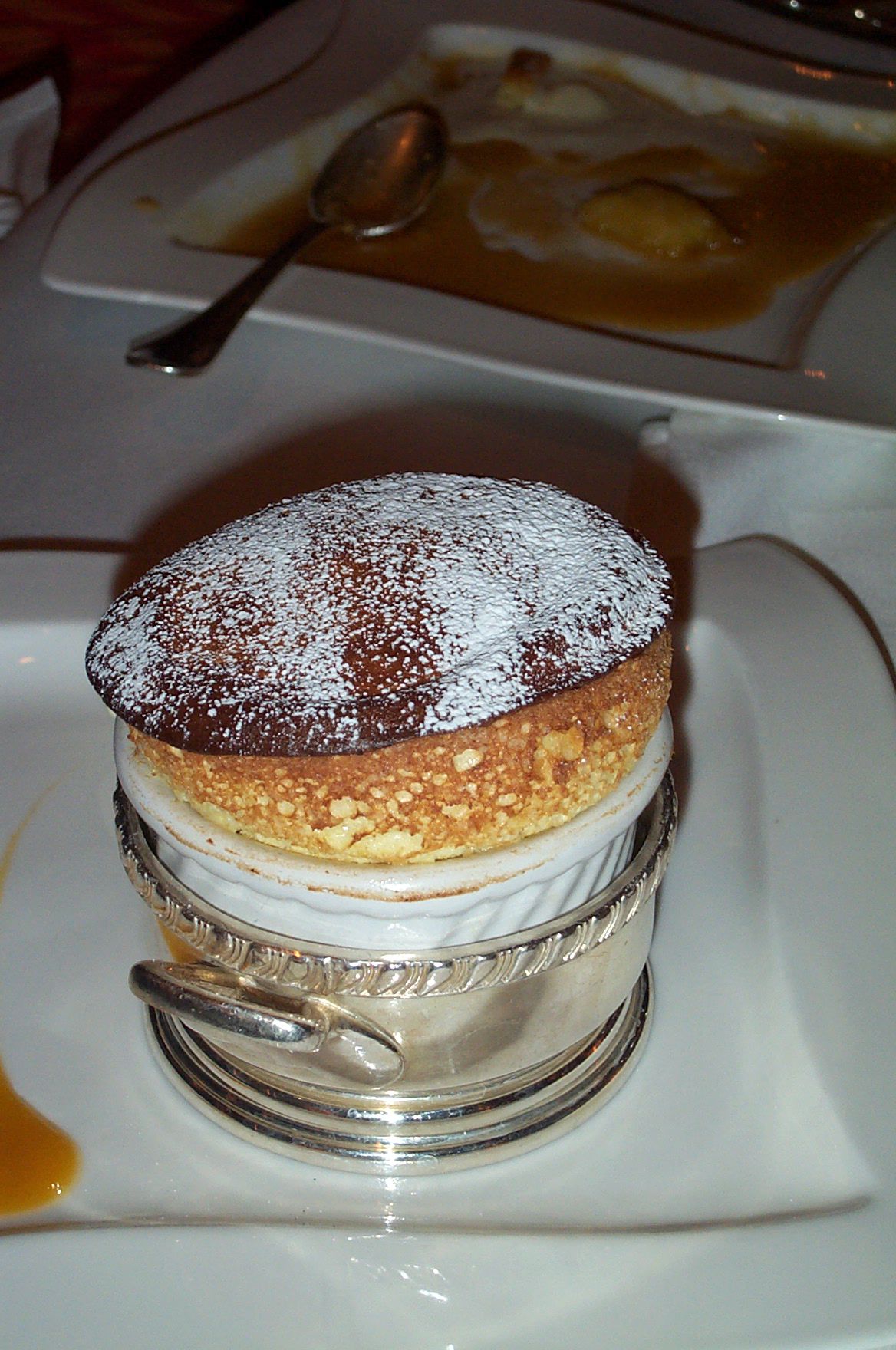
The soufflé is not difficult because it is mysterious. It is difficult because it refuses to hide the handoffs. A sauce can be corrected. A tart can wait. A plated dessert can be rebuilt behind the pass if one component slides. A soufflé arrives as a live deadline: the kitchen has made a foam, the oven has inflated it, the ramekin has guided it, and the server has only a narrow window to place it before the guest sees time working against the dish.
That is why the soufflé still belongs in a fine-dining conversation even when it looks old-fashioned. Its drama is not garnish. It is evidence. The dish tells you whether pastry, hot line, front of house, and table rhythm can behave as one system. When it rises, the room looks effortless. When it sinks, everyone understands instantly that effort arrived too late.
The lead photograph is useful for exactly that reason. Nothing about it is diagrammatic or explanatory in the abstract: just a browned crown above a white ramekin, close enough for the surface to feel warm and unstable.[5] A good soufflé is fine dining's most honest visual. It shows the guest the success condition before a server says a word.
Lift is made before the oven
The basic mechanism is simple enough to state and hard enough to execute. A soufflé joins a flavored base to whipped egg whites, then uses heat to expand trapped air and steam while egg proteins set enough structure to hold the rise for a brief moment.[2][3][6] That means the dish is not a magic oven trick. The oven only reveals the choices already made: how heavy the base is, how clean the whites are, how far the foam was whipped, how violently it was folded, how the ramekin was coated, and how quickly the mixture reached heat.
Food science helps strip away the romance without killing the pleasure. The Institute of Food Science & Technology explains egg-white foam as tiny gas bubbles held in liquid by protein films; heating then coagulates the protein and evaporates water, converting a fragile liquid foam toward a more solid structure.[6] The Exploratorium makes the same point from another angle: beaten egg whites can expand dramatically because proteins stretch into films around air bubbles, and egg moisture becomes steam that helps baked mixtures rise.[2]
That is the whole service problem in miniature. A soufflé asks a kitchen to preserve a temporary architecture. Too much fat from a yolk, a greasy bowl, or a heavy base interferes with foam formation.[3][6] Too little folding leaves streaks and weak distribution; too much folding knocks out air. Overwhipping turns glossy elasticity into grainy brittleness. Underwhipping gives the base nothing to hold. The dish is therefore a craft test before it is a recipe.
Modern foam research gives that old kitchen language a stricter frame. A 2022 open-access study in Food Hydrocolloids analyzed egg-white foam microstructure and found that sugar and acidity change bubble size, shape, and viscoelastic behavior.[1] The point for a pastry chef is not to turn dessert into a lab report. It is to recognize that "a good foam" is not one thing. It is a chosen structure. The soufflé's rise depends on whether that structure can survive mixing, heat, and service long enough to become pleasure.
The base has to be louder than it tastes
The base is the soufflé's memory. It carries chocolate, cheese, fruit, fish, herbs, liqueur, or vegetable flavor, but it also adds weight and moisture. That tradeoff is why many bad soufflés are polite in the wrong way. They rise, perhaps, but taste like warm air with a hint of whatever the menu promised. Others taste strong in the bowl and collapse in the oven because the base overwhelms the foam.
This is where the dish becomes more interesting than its reputation. The base must be intense enough to survive dilution by egg white and air, but light enough to let lift remain the main event. A chocolate soufflé is not a chocolate cake with a nervous posture. A cheese soufflé is not a gratin with altitude. The best versions make flavor feel suspended. You taste the base as something held aloft, not as something buried under pastry technique.
The Escoffier School's practical recipe guidance is blunt about the mechanics: prepare the base before whipping the whites, keep yolk and fat out of the whites, beat to glossy peaks, fold quickly, avoid overmixing, prepare the dish so the mixture can climb, and serve immediately after baking.[3] Those steps sound domestic until a dining room tries to run them at scale. Then each one becomes an operating constraint.
That is why the soufflé disappeared from many contemporary menus. Eater's history notes that the dish grew with fine dining from the early twentieth century through the mid-century, then became rarer as French restaurant formality receded, pastry staffing tightened, and restaurants became less willing to carry a dessert that needs oven space, a la minute timing, and graceful delivery.[4] In other words, the soufflé did not fade because chefs forgot how to make it. It faded because the operating model changed.
Service is part of the recipe
Fine dining often hides labor inside calm. The soufflé reverses that habit. It makes service visible as recipe logic.
The server cannot treat the dish like an ordinary dessert pickup. They need the table ready before the ramekin leaves the kitchen. They need the sauce or crème anglaise ready if the room finishes it tableside. They need a route clear enough that the crown does not take a long, cooling tour through the dining room. They need to understand whether the guest should see it whole before it is pierced, and whether the finishing pour is meant to add moisture, aroma, theater, or all three.
That service layer has deep historical roots. Britannica's account of French gastronomy describes the shift toward Russian-style service, in which guests receive courses individually while food is at its best, and links Escoffier's reforms to shorter menus, faster service, and organized kitchen teams.[7] The soufflé thrives in exactly that world: individual timing, disciplined brigade work, and the idea that hot food should arrive while heat still matters.
It also exposes the limits of nostalgia. A soufflé served because it seems "classic" is not automatically good. If the kitchen has no pastry capacity, if the room cannot coordinate tableside finishing, or if the menu pace makes guests wait twenty minutes after they are already done, the dish becomes a museum piece with a deadline. The better reason to serve it is because the restaurant wants the deadline. It wants to show that it can make fragility feel hospitable.
Why it still feels luxurious
The soufflé's luxury is not ingredient cost. Eggs, sugar, butter, cheese, chocolate, and fruit can all be ordinary. The luxury is alignment.
Every part of the dish has to be slightly better than casual. The ramekin is buttered and dusted not for ceremony but to give the mixture a clean climb.[3] The whites are glossy, not dry. The base is seasoned past comfort because air will soften it. The oven is ready rather than requested. The server is waiting rather than surprised. The table receives the dish while rise is still a present-tense fact.
That is why a simple soufflé can feel more exacting than a dessert built from many components. A composed plate can create complexity by addition: crumble, tuile, gel, quenelle, sauce, frozen element, herb. A soufflé creates complexity by agreement. If one part is late, dirty, heavy, cold, rough, or inattentive, the result announces it.
There is also a sensory reason it keeps working. The outside browns and dries just enough to give the spoon resistance. Inside, the foam stays moist, hot, fragrant, and unstable. Sauce poured into the center turns collapse into service rather than failure. The guest does not merely eat a structure. They participate in its ending.
That ending is the whole point. Fine dining spends a lot of money trying to make dishes feel permanent: signature plates, protected recipes, branded gestures, photographs that circulate long after the meal. A soufflé refuses permanence. Its best moment is short, and everyone at the table knows it. That makes it unusually honest. The restaurant is not promising a timeless object. It is promising competence at exactly this minute.
When the soufflé works, the room gets quiet in a specific way. The server arrives. The crown is still high. The spoon breaks the surface. The sauce disappears into heat. The dish settles, but not before it has shown what craft is supposed to do: turn timing, air, protein, flavor, and service into one breath.
Sources
- Jose C. Bonilla, Jesper L. Sorensen, Amalie S. Warming, and Mathias P. Clausen, "Quantitative image analysis of protein foam microstructure and its correlation with rheological properties: Egg white foam," Food Hydrocolloids 133, 2022 - open-access study of egg-white foam microstructure, sugar, acidity, and viscoelastic behavior.
- Exploratorium, "Science of Cooking: The Amazing Multi-Tasking Egg" - explanation of egg proteins, egg-white foams, steam lift, and coagulation in baked foods including souffles.
- Auguste Escoffier School of Culinary Arts, "How to Make a Soufflé" - practical overview of soufflé base, egg-white handling, folding, ramekin preparation, oven timing, and immediate service.
- Daniel Maurer, "The Rise and Fall of the Soufflé in Modern Cuisine," Eater, June 2, 2016 - history of soufflés in fine dining, staffing and service risks, and modern menu decline.
- Wikimedia Commons, "File:Souffle.jpg" - real 2000 photograph by stu_spivack of a baked soufflé used as this article's image.
- Institute of Food Science & Technology, "Protein: foam formation" - explanation of how egg-white proteins trap air bubbles, link into foams, and set when heated.
- Encyclopaedia Britannica, "Gastronomy" - context on Carême, Escoffier, organized kitchen teams, shorter menus, and Russian-style course service.