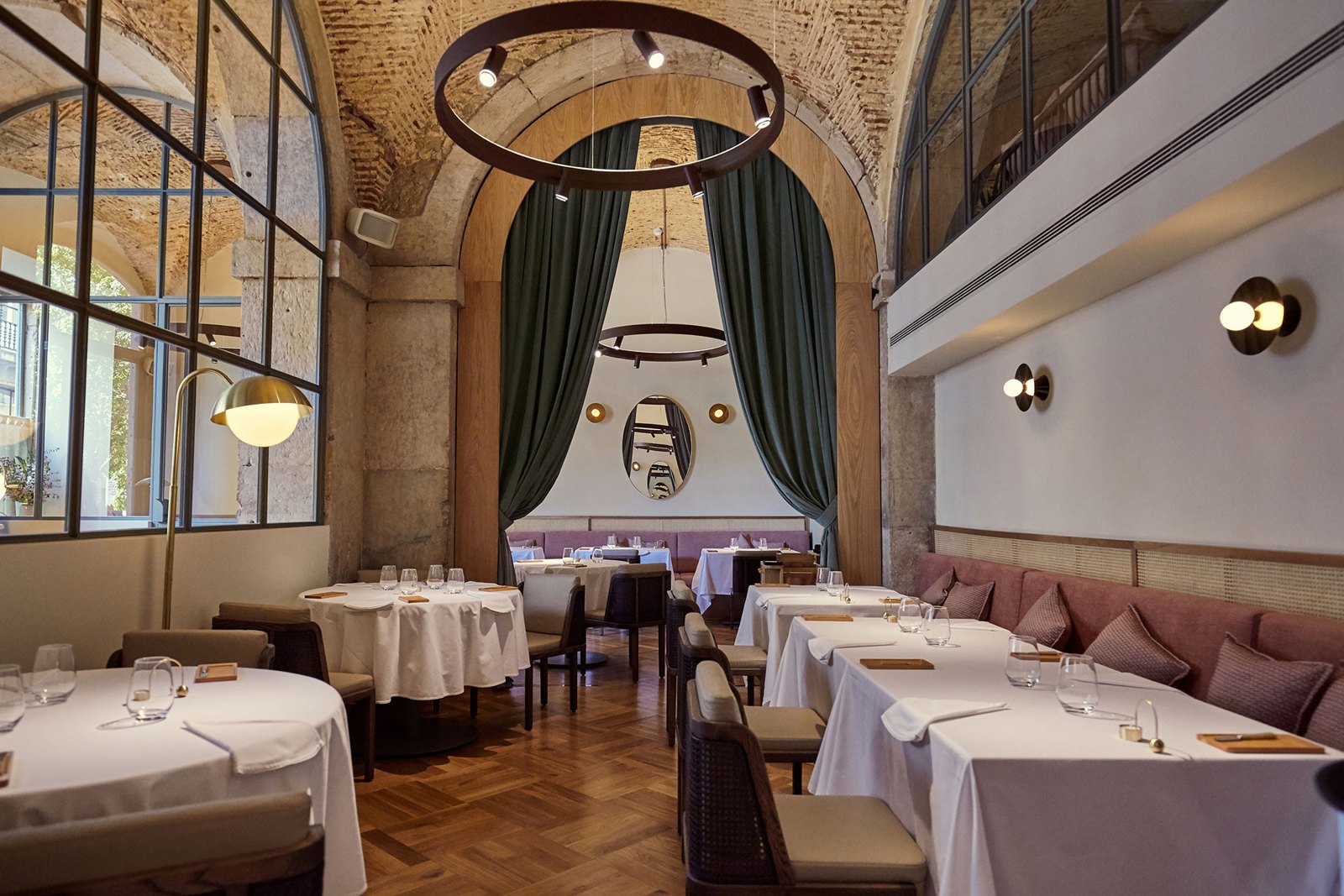
Belcanto is easy to summarize too quickly. Two Michelin stars, Jose Avillez, Chiado, one of Lisbon's flagship tables.[1][3][4] All of that is true, and all of it is incomplete. What makes Belcanto feel durable in 2026 is not only prestige. It is compression. The restaurant takes a city full of historical memory, filters it through a room with just ten tables, and serves contemporary Portuguese cooking in a format that feels formal without becoming museum-like.[1][2][4]
That is why the profile still matters now. Michelin continues to list Belcanto as a Two Star restaurant in the 2026 Portugal guide, while 50 Best Discovery places it at No. 42 in The World's 50 Best Restaurants 2025 after No. 31 in 2024.[3][4] Those signals confirm status. The more interesting question is what kind of flagship Belcanto has chosen to be. The answer is a relatively rare one: a high-end house that keeps narrowing the frame until Portuguese memory, not luxury excess, becomes the central subject.[1][2][4]
Chiado works as a filter, not just an address
50 Best Discovery's profile is useful because it describes the room in plain physical terms: Belcanto sits in Lisbon's historic centre, and the wood-panelled dining room holds just ten tables.[4] That scale matters. Many fine-dining flagships try to read as large even when they are small. Belcanto does the opposite. It uses smallness as a discipline.
The effect is architectural as much as culinary. A ten-table room cannot hide behind buzz, crowd energy, or endless turnover. It has to make every seat feel intentional. That helps explain why Belcanto reads less like a prestige machine and more like a carefully edited flagship. Chiado supplies the old-city texture, but the restaurant does not ask the neighborhood to do all the work. The room itself has to carry formality, pace, and attention.[1][4]
That physical compression is also why Belcanto keeps its identity clearer than some larger luxury projects. The meal begins in an old quarter of Lisbon, yet the restaurant does not freeze itself into nostalgia. The official site calls the cuisine "contemporary Portuguese," which is a precise description because the house is not trying to reconstruct the past course by course.[1] It is trying to make Portuguese references legible inside a modern flagship grammar.
The food is built on memory, but memory is kept in motion
Belcanto's FAQ states the core choice very directly: guests can order a la carte or choose the Belcanto Tasting Menu, and that tasting menu is framed as a voyage through the restaurant's work "from the beginning to the present day."[2] That line explains a lot. Belcanto is not presenting itself as a laboratory that happens to be in Portugal. It is presenting itself as a continuing argument about Portuguese cuisine, one that keeps early signatures, later refinements, and current technique in the same sentence.[1][2]
50 Best Discovery gives the clearest shorthand for how that argument lands on the plate. The profile points to classics such as suckling pig and Portuguese pot-au-feu, then places them beside more overtly imaginative dishes such as "The garden of the goose that laid the golden eggs."[4] That combination is the point. Belcanto wants historical and fairy-tale registers to coexist.
The restaurant therefore feels strongest when you read it as an editor of memory rather than a collector of references. A less controlled flagship would let the old dishes carry all the emotional weight and the newer dishes carry all the surprise. Belcanto appears to be aiming for something tighter: recognizable Portuguese anchors, formal service, and enough invention to stop the room from turning commemorative.[1][2][4]
Belcanto is unusually clear about the service contract
Another reason the restaurant profile feels strong in 2026 is that Belcanto's public-facing rules are much less vague than many comparable rooms. The FAQ says a meal can easily last two to three hours, lunch tasting menus are served until 1:30 p.m., dinner tasting menus until 9 p.m., and only a la carte options are available after those cutoffs.[2] The same document notes that the tasting menu is served only to full tables.[2]
Those details are not administrative clutter. They reveal the operating logic. Belcanto is not structured as one mandatory marathon. It preserves two lanes: a la carte for diners who want precision without the full arc, and the tasting format for guests who want the restaurant's self-authored narrative from start to finish.[2] That makes the flagship more flexible without making it loose.
The rest of the service contract follows the same pattern. Smart casual is acceptable, children under twelve are not recommended, the table is held for twenty minutes, and cancellations inside forty-eight hours trigger a charge of 200 euros per person.[2] None of this reads especially severe by current luxury standards. What it does read as is deliberate. Belcanto wants the room polished, but it does not want stiffness to become the product.
The wine list keeps the room Portuguese even when the format turns international
The strongest single operational detail in the FAQ may be the wine section. Belcanto says the list includes more than 350 choices and that about 80 percent of them are Portuguese, while still keeping international range across Champagne, whites, reds, Port, Madeira, older bottles, and rarer vintages.[2] That is more than a cellar brag.
For a restaurant built on "contemporary Portuguese cuisine," this matters because the beverage program can either stabilize or blur the house identity. A globally fluent tasting room can easily start talking in a generic luxury accent once the wine pairings become detached from place. Belcanto seems to avoid that trap by keeping Portugal as the majority language of the cellar even while allowing cosmopolitan breadth.[2]
That decision fits the room's broader personality. Belcanto does not read like a restaurant trying to prove that Lisbon can imitate Paris, Copenhagen, or New York. It reads like a restaurant confident enough to keep Portuguese memory in the foreground while borrowing whatever technical or theatrical tools it needs around the edges.[1][2][4]
Why Belcanto remains a high-value Lisbon flagship
Belcanto's main advantage is therefore not novelty by itself. Plenty of ambitious restaurants can build surprising plates. Plenty can install luxury lighting and polished service. Belcanto's harder achievement is proportion. The room is small, the references are old, the cooking is contemporary, the service rules are clear, and the cellar stays rooted in Portuguese wine even while the format remains fully international.[1][2][4]
That combination makes the restaurant a strong fit for diners who want Lisbon itself to stay visible inside the luxury frame. Book it if you want a flagship that treats Portuguese cuisine as living material rather than heritage theater. Think twice if your ideal high-end meal depends on maximal spectacle or radical experimentation for its own sake. Belcanto appears stronger when it is read as a formal memory machine: compact, polished, and still moving.[2][3][4]
Sources
- Belcanto official website - restaurant positioning and "contemporary Portuguese cuisine" description.
- Belcanto FAQ (English PDF, April 2025) - service structure, tasting-menu rules, meal duration, wine list details, dress code, cancellation policy, and opening hours.
- MICHELIN Guide, "Belcanto - Lisbon - a MICHELIN Guide Restaurant" - current 2026 Portugal guide listing and Two Star status.
- 50 Best Discovery, "Belcanto" - current profile covering Chiado location, 10-table room, ranking history, and representative dishes.