Most chef interviews become vague the moment charisma enters the room.
Wing gets more interesting when you ask a harder question: what exactly is Vicky Cheng operationalizing when he says he wants guests to leave feeling like they have had a Chinese meal? At this address in Central, the answer is unusually clear. The cooking, the room, and the service are all trying to translate banquet memory into a format that can live inside contemporary fine dining without becoming stiff, nostalgic, or faux-European. [1][3]
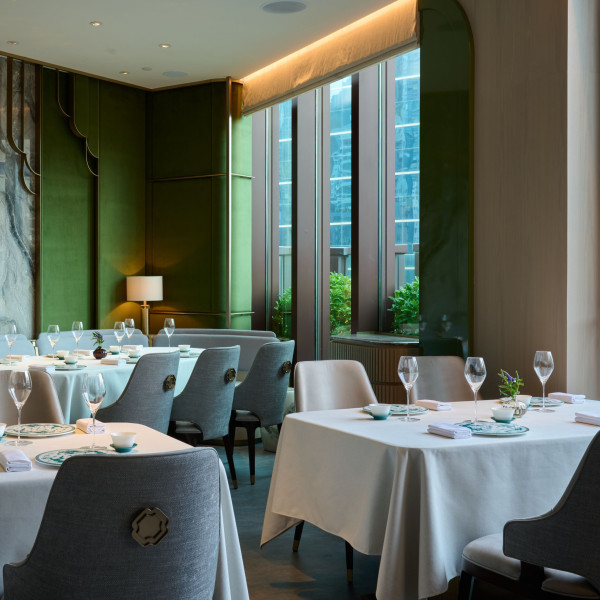
Image context: the cover image shows Wing's main dining room on the 29th floor of The Wellington. It is the right visual anchor for this article because Wing's argument is as much about how a Chinese meal is received as about what lands on the plate.
Q1) What does "boundaryless Chinese" actually mean at Wing?
Cheng's own official positioning is careful. Wing describes itself as "a refined Chinese cuisine" experience shaped by quality ingredients, finesse, invention, and roots in tradition. [1] The phrasing matters because it avoids two dead ends that weaken a lot of high-end Chinese restaurants in international hotel zones: empty heritage theater on one side and novelty-first fusion on the other.
The clearest public explanation comes from The World's 50 Best Restaurants' hospitality feature. There, Cheng says he labels the cuisine at Wing "boundaryless Chinese" and insists that guests should leave feeling they have had a Chinese meal, while also receiving a level of service more commonly associated with European fine-dining restaurants. [3] That is the useful definition. The project is not about dissolving Chinese identity. It is about releasing Chinese cuisine from one fixed formal script.
This is why Wing feels more consequential than a generic "modern Chinese" label suggests. The room is not trying to reenact a loud banquet hall, but it is also not treating Chinese food as raw material for French-format abstraction. The ambition is narrower and harder: preserve the emotional grammar of a Chinese meal while improving precision, pacing, and hospitality legibility for a tasting-menu setting. [1][3]
Q2) Why does banquet memory matter more than branding language?
Because Cheng's public hospitality story starts at the family table, not in a strategy deck.
In the same 50 Best feature, he recalls fighting with his siblings for the teapot because pouring tea was a sign of respect, and also trying to secure the best morsels from shared dishes for his grandmother's bowl. [3] Those details are small, but they explain more about Wing than any trend label could. They tell you the restaurant is not merely borrowing Chinese aesthetics. It is trying to elevate the social codes of care that sit inside Chinese dining culture.
That memory structure helps explain why Wing has connected so strongly in Hong Kong. Dining Media Asia describes the restaurant as Cheng's love letter to Chinese heritage and emphasizes that the room feels intimate and elegant rather than coldly monumental. [5] Read next to Cheng's own banquet memories, the effect becomes easier to name. Wing is using fine-dining tools to intensify generosity, not to flatten it into polish.
This matters because modern Chinese luxury dining often gets trapped between two awkward poles. One pole is maximalist splendor without intimacy. The other is technical minimalism that scrubs away the shared-table warmth many diners actually associate with Chinese food. Wing's emotional advantage is that it seems to know exactly what it wants to keep from older meal formats: respect, selection, sequencing, and care made visible. [3][5]
Q3) Why is dried seafood the real engine of Cheng's cooking?
If banquet memory explains the service, dried seafood explains the flavor argument.
In his June 12, 2025 interview with 50 Best, Cheng calls dried seafood the unsung hero of Chinese cuisine and frames his work as an effort to tell that story more forcefully. [4] That is a revealing priority. Many fine-dining rooms reach for premium ingredients as a prestige shorthand. Cheng is pointing somewhere else: toward an older pantry logic where time, preservation, concentration, and marine savor are already part of the cuisine's deepest language.
The 50 Best Discovery profile strengthens that point by describing Wing as a more formal expression of Cheng's vision of traditional Chinese fare, noting his dexterity with seafood and his interpretation of the eight great Chinese cuisines. [2] Together, these sources show why Wing does not read like a luxury ingredient showroom. Its center of gravity is pantry intelligence.
Dried seafood is crucial in that system because it carries duration. It brings storage, labor, memory, and a very specific Chinese sense of richness that is different from simply adding truffle, caviar, or wagyu to everything. At Wing, that ingredient logic gives Cheng a way to modernize without cutting the line to older Chinese culinary seriousness. [2][4]
Q4) How does Wing keep hospitality from feeling imported?
The strongest clue is that the service script is built around attention rather than display.
The hospitality-award profile says Wing's team anticipates a diner's wishes and tailors the experience from subtle cues. Cheng also talks there about personalization, storytelling, and recruitment. [3] This is a different ambition from the old model in which Chinese restaurant service was measured mostly by speed, abundance, or visible deference. Wing is chasing softness, anticipation, and emotional calibration.
At the same time, the dining room is not pretending tea and wine live in separate civilizations. The 50 Best Discovery page notes that Wing offers both a serious French-heavy wine program and a Chinese tea selection. [2] That pairing matters because it shows the restaurant refusing a false choice between Chinese identity and global fine-dining literacy. The room can speak both fluently.
Even the physical setting supports the argument. The official site places Wing on the 29th floor of The Wellington, directly beneath sister restaurant VEA, with a clearly defined main dining room and private-room reservation structure. [1] In practical terms, this is a highly controlled urban flagship. In atmospheric terms, it lets Cheng stage a Chinese meal in a vertical, polished Central address without draining it of warmth.
Q5) What should a serious diner verify before booking?
Start with fit, not hype.
Wing's official reservation page says online bookings for the main dining area are released only for the following 28 days at midnight Hong Kong time, while private-room inquiries run through email, WhatsApp, or phone. [1] The Discovery profile describes dinner service from Monday through Saturday and frames the experience around tasting menus rather than casual drop-in dining. [2] Put those together and the operating model becomes clear: Wing wants committed diners, not opportunistic traffic.
That should change how you judge the restaurant. If your ideal Chinese meal is a sprawling, spontaneous table where the order evolves midstream, Wing is not designed for that mood. If you want to see what happens when banquet memory, Chinese pantry depth, and elite hospitality are compressed into a disciplined Hong Kong tasting-room format, this is exactly the point of the booking. [1][2][3]
The useful pre-booking question, then, is not whether Wing is famous enough. It is whether you want a Chinese meal translated into a more focused, high-attention register. Cheng's public record suggests that is the promise he is trying hardest to keep. [3][4][5]
Bottom line
The best way to understand Wing in 2026 is to stop calling it simply modern Chinese and start reading it as a hospitality system.
Its core moves are all connected: a Chinese meal should still feel Chinese; banquet memory should survive refinement; dried seafood should carry flavor authority; and service should feel observant rather than rigid. That is why Wing matters beyond rankings. It offers a persuasive answer to a harder question facing high-end Chinese dining right now: how do you make the meal more precise without thinning out its cultural warmth? [1][2][3][4]
Sources
- Wing official website - philosophy, reservations, address, and dining-room structure.
- 50 Best Discovery, "Wing" - rankings snapshot, seafood focus, eight-great-cuisines framing, and service overview.
- The World's 50 Best Restaurants, "Wing in Hong Kong is at the forefront of a new trend in Chinese dining" (April 23, 2025) - boundaryless Chinese, banquet memory, and hospitality philosophy.
- The World's 50 Best Restaurants, "Vicky Cheng: 'I'm free to break the rules without offending anyone'" (June 12, 2025) - dried seafood, training background, and ingredient logic.
- Dining Media Asia, "Wing: Chef Vicky Cheng's Love Letter to Chinese Heritage in Hong Kong" (October 30, 2024) - heritage framing, room mood, and Hong Kong context.