The easy way to tell the Atelier Crenn story is to stop at poetry. Dominique Crenn's restaurant has long invited that reading: the phrase "Poetic Culinaria," the intimate room, the sea-leaning menu, the sense that every course wants to stir memory as much as appetite.[1][3] That description catches the atmosphere. It misses the deeper line.
What matters in 2026 is that Atelier Crenn no longer reads like French luxury transplanted into California and lightly perfumed with local produce. The official menu page says Crenn was born and raised in France, spent summers in Brittany, and built a menu around the bounty of the sea, local farmers, expert fishermen, and small purveyors.[1] The farm page then makes the second half of the story explicit: Bleu Belle Farm in Sonoma supplies fruit, vegetables, herbs, and flowers, while regenerative agriculture and a restaurant-to-farm compost program help shape the menu's material logic.[2] Michelin's current listing and 50 Best Discovery reinforce the same line from the outside, describing a house where Brittany upbringing, California evolution, seafood, plants, and a wave-like dining room all belong to one coherent identity.[3][4]
That is why the restaurant still feels unusually complete. Atelier Crenn did not abandon French luxury. It rerouted it through the ocean, the farm, and a tighter moral and operational infrastructure.
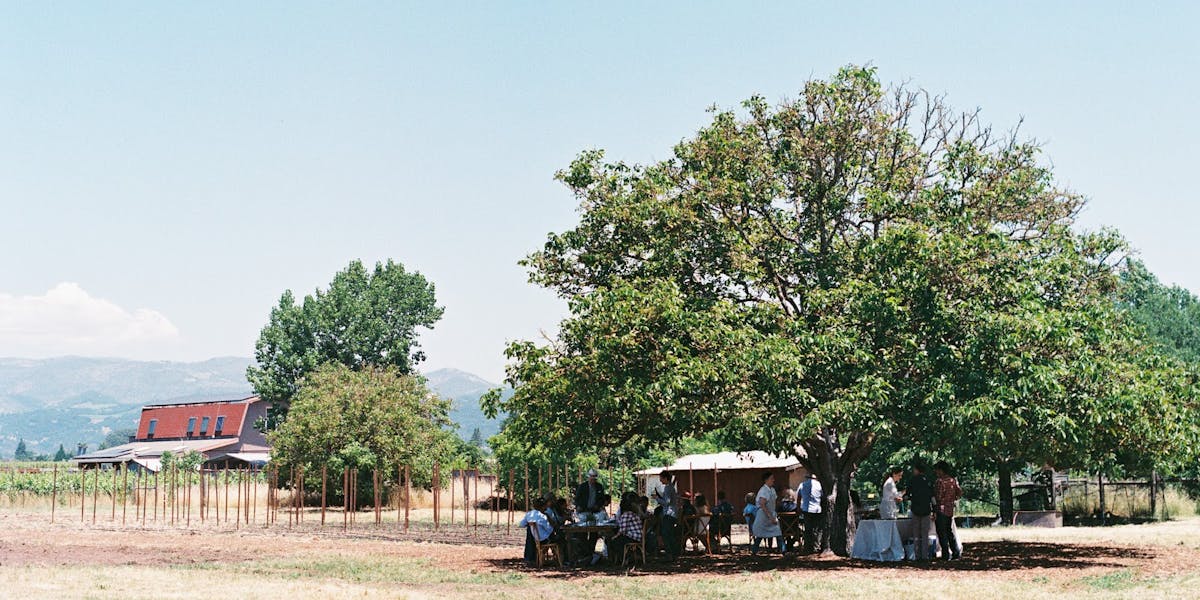
Image context: the lead image uses Atelier Crenn's official Bleu Belle Farm photograph rather than a plated course or dining-room glamour shot. That choice fits because the article is about the restaurant's lineage widening outward: the farm is no longer backstage support, but one of the places where the house now explains itself.[2]
1. Brittany never disappeared; it changed coasts
The official menu page gives the origin story in one clean line: Crenn's childhood summers in Brittany gave her a deep love and respect for the sea.[1] Michelin's current listing turns that biographical note into culinary form, describing Atelier Crenn as a singular atelier where Brittany upbringing meets present-day California, with a pescatarian menu, French sauces, and a brioche recipe traced back to Crenn's grandmother.[4] Those details matter because they keep the restaurant from being misread as a generic California tasting room with French polish on top.
The sea remains the house grammar. Seafood dominates the meal, a vegetable-forward option exists alongside the main pescatarian format, and the language of the official site keeps returning to memory, inspiration, and resonance rather than to static signature dishes alone.[1] Even the 2023 renovation, as described by 50 Best Discovery, follows that same line: a 25-foot paper chandelier was installed to evoke the movement of waves and draw on Crenn's French childhood.[3] In other words, the restaurant's autobiography is still active. It has simply been translated into a new coastline.
This is the first important shift in the lineage. Atelier Crenn once could be read primarily as a French chef's personal lyricism expressed in San Francisco. Today it reads more like a transoceanic line: Brittany gives the emotional weather, while Northern California supplies the working conditions under which that weather can still feel alive.[1][3][4]
2. The farm changed what luxury has to answer to
Bleu Belle Farm is where that translation becomes concrete. The official farm page says the menus of Atelier Crenn and Bar Crenn are inspired by what grows there, and that the farm team uses regenerative agriculture practices to rebuild organic matter and restore biodiversity.[2] The same page names participation in California's native plant program and a detailed compost program that begins in the restaurants themselves.[2] This is no longer the old luxury pattern in which produce simply arrives looking beautiful and local.
The menu page sharpens that point by naming the producers more intimately. Atelier Crenn now highlights two small dairies for butter and cream, including Animal Farm Creamery, whose weekly table butter comes from a single cow named Timothy, and San Martin Milk Company, which supplies butter for the house brioche.[1] Read together, the farm page and menu page suggest a narrower, more exacting definition of abundance. Luxury here has less to do with distance traveled or rarity for its own sake. It has more to do with how tightly the restaurant can connect memory, ethics, and ingredient quality without letting the result feel didactic.[1][2]
This is also why the California element matters more than scenery. Sonoma is not presented as pastoral branding. It is an editing tool. The farm lets the restaurant decide what freshness, seasonality, and biodiversity should mean before the plate is designed, not after.[2] That is a deeper transformation than merely sourcing beautiful vegetables.
3. The dining room protects the line from turning diffuse
Atelier Crenn would be less persuasive if all of this agricultural and autobiographical thinking spilled into a room that felt sprawling or over-explained. Instead, 50 Best Discovery emphasizes that there are just eight tables in the dining room, and that the 2023 redesign made the room more visibly oceanic without enlarging its scale.[3] The result is important. The house remains intimate enough for poetry to feel concentrated rather than ornamental.
The official FAQ fills in the operating discipline behind that intimacy. Dinner is estimated to last two to three hours; reservations are final though transferable; the dress code is casual-elegant; and a 20% service charge is directed toward equitable wages and benefits across the staff, alongside a 3% San Francisco health-care surcharge.[5] Those details are easy to dismiss as logistics. They are part of the restaurant's lineage too. They show a house trying to align the tone of refinement with a more explicit social and labor structure than old-school French luxury usually made visible.[5]
That is the second important shift. Atelier Crenn's elegance no longer lives only in plating, sauce work, or atmosphere. It also lives in duration, staffing, and the refusal to let the room behave like a throughput machine.[3][5]
4. Modernity here is infrastructural, not cosmetic
The strongest proof appears in the restaurant's environmental commitments. On the official menu page, Atelier Crenn says it is a Certified Plastic Free establishment and the first restaurant in the United States to remove single-use plastics, while also describing vendor education and staff training around that standard.[1] Michelin's Green Star coverage places Crenn among the first American chefs publicly recognized for commitment to sustainable gastronomy.[6] The farm page then closes the loop by treating compost, biodiversity, and regenerative practice as ordinary kitchen realities rather than as public-relations garnish.[2]
This is what makes Atelier Crenn's current identity more durable than the old stereotype of "poetic fine dining." Poetry alone can become fragile. Infrastructure is harder to fake. When the sea-led menu, the farm, the supplier relationships, the plastic-free policy, and the service structure all point in the same direction, the restaurant starts to feel less like a performance of conscience and more like a fully revised luxury model.[1][2][5][6]
That does not mean Atelier Crenn has become rustic or anti-ceremonial. Michelin is clear that the restaurant still offers French mastery, rich sauces, refined seafood work, and the sort of polish expected of a three-star room.[4] The deeper story is that those old signals of excellence have been made to answer to a different set of obligations.
Atelier Crenn therefore matters in 2026 for a reason more specific than prestige. The restaurant shows what happens when French luxury keeps its appetite for craft and beauty, then submits that appetite to the sea, the farm, and a tighter ecological conscience. Brittany is still present. California is still present. The achievement lies in making them operate as one line rather than two competing identities.[1][2][3][4]
Sources
- Atelier Crenn, "Our Menu" - official page covering Crenn's Brittany background, the sea-focused pescatarian menu, local fishermen and farmers, dedicated dairy producers, wine-pairing posture, and the restaurant's certified plastic-free commitment.
- Atelier Crenn, "Bleu Belle Farm" - official page covering the Sonoma farm, regenerative agriculture, biodiversity work, California native plant participation, and the compost loop that begins at the restaurants.
- 50 Best Discovery, "Atelier Crenn - San Francisco" - current profile covering Poetic Culinaria, the eight-table dining room, the 2023 redesign with a 25-foot paper chandelier evoking waves, and the restaurant's 2025 North America's 50 Best placement.
- MICHELIN Guide, "Atelier Crenn - San Francisco" - current Michelin listing describing the restaurant as a meeting of Brittany upbringing and California evolution, with a pescatarian menu, French sauces, Bleu Belle Farm produce, and grandmother's brioche.
- Atelier Crenn, "Frequently Asked Questions" - official policy page covering the two-to-three-hour experience, final-but-transferable reservations, casual-elegant dress code, equitable-wage service charge, and San Francisco health-care surcharge.
- MICHELIN Guide, "Going Green at Atelier Crenn" - Michelin's Green Star feature on Dominique Crenn's sustainability commitments and recognition within the first American class of Green Star honorees.