The lazy Alinea story has always been plate-level magic: the balloon, the splatter dessert, the vapor, the surprise. Those things are real. They are also only half the mechanism. Read Alinea's own public materials on April 30, 2026, and a different structure comes into focus. The official site does not present one dining room with one tasting menu and a few upgrade flourishes. It says plainly that Grant Achatz and his team offer three distinct experiences every night: the Kitchen Table, the Gallery, and the Salon.[1] Tock, where the restaurant is currently selling those reservations, turns that claim into a working operating map. The Kitchen Table is described as the most intimate and immersive format; the Gallery as a multi-sensory journey; the Salon as a more classic table arrangement, with different party sizes and different price bands attached to each lane.[2]
That matters because it changes the unit of analysis. Alinea is not simply a famous modernist kitchen that happens to have multiple room types. It is a house built to distribute one cuisine across different social contracts.
The 50 Best Discovery profile helps explain where that structure came from. Its current write-up says Alinea reopened in 2017, after a full rethink for the restaurant's tenth birthday, with a new look and those same three distinct tasting experiences.[4] The profile also calls dining at Alinea avant-garde performance art and stresses that the guest is part of the show, not merely a spectator.[4] Once you set that beside the official site and the live booking page, the logic becomes clearer. Alinea's signature move is not only surprise. It is control over the distance between the guest and the surprise.
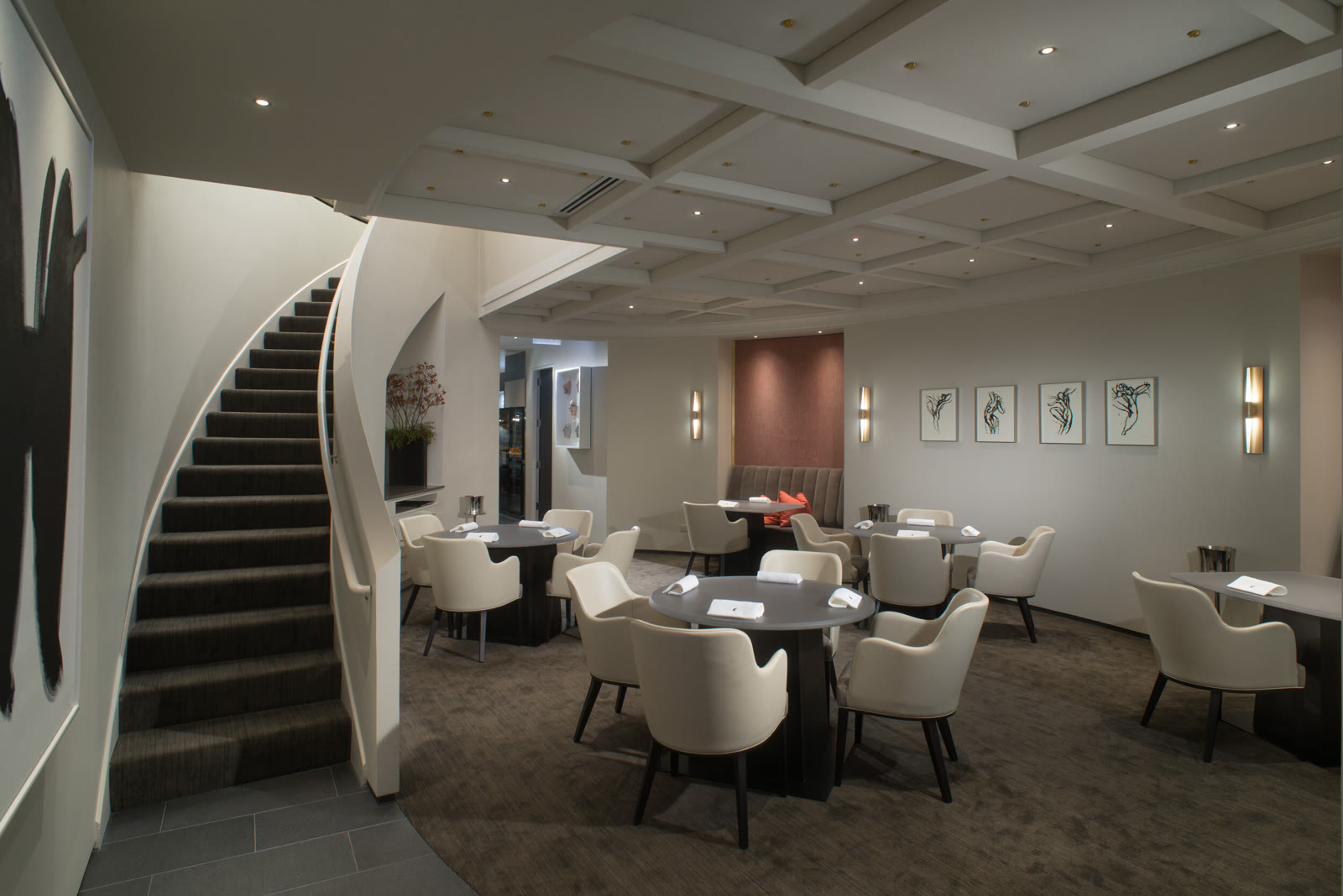
Image context: the cover uses the official Gallery room photograph rather than one of Alinea's famous plated moments. That choice fits the argument because the restaurant's strongest design decision is spatial. The room tells the guest what kind of night this will be before the first composed bite arrives.[1][2]
1. Three experiences means three different thresholds of commitment
Many restaurants use room labels as a pricing ladder. Alinea's public copy suggests something more deliberate. The homepage lists the Kitchen Table, the Gallery, and the Salon as separate nightly experiences, not as minor seating variations.[1] Tock then gives each one a distinct promise. The Kitchen Table is sold as the house's most intimate, immersive, and cutting-edge format, booked for small prepaid parties at $495 per person. The Gallery is framed as an intimate, multi-sensory journey and is also currently priced at $495 per person. The Salon shifts the tone: individual tables, a more classic dining format, and a lower current band of $375 to $395 per person.[2]
That pricing architecture is revealing. The house is not saying that one room gets the good food and another gets the reduced version. It is saying that the same restaurant can be entered through different levels of closeness and theatrical pressure. The highest price is attached to formats where immersion is tightest. The lower Salon price is not a bargain-basement afterthought; it is the lane for diners who want the cuisine without the maximum degree of choreographed intensity.[2]
This is a serious operations decision. Modernist dining can overwhelm guests when every table is forced into the same register of explanation, surprise, and interaction. Alinea's three-lane system lets the restaurant sort people by appetite for ritual as much as by budget.
2. The Kitchen Table turns immersion into a small-party instrument
The Kitchen Table is the clearest example. Tock describes it as completely private and positions it as Alinea's most intimate and cutting-edge offering for small parties.[2] That wording matters because the restaurant is not using the kitchen-adjacent experience as mass-market spectacle. It is using it as a concentrated instrument for guests who want the house at full resolution.
In practical terms, this solves a recurring problem in high-end theatrical dining. Surprise loses force when it scales too broadly, but it also becomes hollow if the guest feels managed from too far away. A private, small-party Kitchen Table gives Alinea a way to keep its most ambitious service beats under tight control. Proximity sharpens accountability. If the house wants to turn dinner into a sequence of reveals, the room can support that ambition without asking dozens of strangers to surrender in exactly the same way at exactly the same pace.[2]
The important point is not only exclusivity. It is editability. The Kitchen Table lets Alinea tune the dinner like chamber music instead of arena production.
3. The Gallery is where Alinea's public thesis becomes legible
If the Kitchen Table is the most compressed version of the house, the Gallery looks like the clearest statement of Alinea's main idea. The official site places it alongside the other two core experiences, and Tock currently sells it as an intimate, multi-sensory journey rather than a neutral dining room.[1][2] The private-events page adds another crucial layer: in event mode, the Gallery is described as semi-private and able to hold up to 16 people, seated.[3]
That scale helps explain why the 50 Best description lands so well. Discovery says Alinea is built around performance art, that diners play a role in the experience, and that Achatz's restaurant remains a benchmark for interactive modernist dining.[4] The Gallery seems to be the room where that argument can be made most cleanly. It is large enough to create collective energy and shared astonishment, but still small enough to keep gesture, pacing, and reveal from dissolving into banquet noise.
This is the operational genius of the Gallery. It gives Alinea a room that can feel public without becoming anonymous. In a restaurant whose reputation depends on theatrical timing, that middle size is not incidental. It is one of the house's core tools.
4. The Salon keeps the restaurant from hardening into one ritual only
The Salon may be the least flashy lane and the most strategically important one. Tock describes it in notably calmer language: individual tables for guests who prefer a more classic dining format, with party sizes up to six and a lower current price than the Kitchen Table or Gallery.[2] The private-events page expands the spatial logic behind that calmer contract. One Single Salon can take up to 24 people, all three salons together can take up to 50, and a full venue buyout reaches 66 guests while still including an interactive course in the kitchen.[3]
Those numbers reveal the underlying house model. Alinea is not a single sacred room that occasionally tolerates larger groups. It is a building that can widen and narrow its theatrical field while preserving authorship. The Salon tier matters because it prevents the restaurant from becoming a cult object that only works at one intensity. Guests who want a more traditional table relationship can still enter the same culinary universe. Groups can scale upward for private use. Yet even at full buyout size, the kitchen remains part of the event script.[2][3]
That is a subtler achievement than the famous dishes, but it may be the more durable one. Restaurants built entirely around one kind of spectacle eventually become self-imitation. Alinea's room system gives it more than one speed.
Why the building matters as much as the plates
The best way to understand Alinea in 2026 is to stop treating the rooms as packaging around a famous tasting menu. The public documents point to a more serious interpretation. The official site defines the restaurant through three distinct nightly experiences.[1] Tock assigns each one a separate intimacy level, party-size logic, and price band.[2] The private-events page exposes the deeper load-bearing structure: a Gallery that can hold a small semi-private crowd, salons that can expand for larger groups, and a full-house format that still routes guests through the kitchen's theater.[3] The 50 Best Discovery profile then supplies the cultural reading. Alinea remains important because it turned avant-garde performance into a durable dining format, then rebuilt the house in 2017 so that format could be entered through more than one door.[4]
That is why the restaurant still reads as unusually complete. Plenty of famous tasting-menu rooms know how to surprise. Fewer know how to let different kinds of guests buy into different amounts of surprise without weakening the identity of the meal. At Alinea, the room still decides the script.
Sources
- Alinea official homepage - current dining-room framing and the statement that the restaurant offers three distinct experiences every night: the Kitchen Table, the Gallery, and the Salon.
- Alinea on Tock - current descriptions of the Kitchen Table, Gallery, and Salon, plus the live party-size and pricing ranges visible on April 30, 2026.
- Alinea private events page - current Gallery and Salon capacity details, full-buyout size, and the note that full-venue events include an interactive course in the kitchen.
- 50 Best Discovery, "Alinea - Chicago - Restaurant" - current profile covering the 2017 revamp, the three-experience structure, and Alinea's performance-art framing.