A cassava flatbread makes an appealing introduction to Ajualä. In Ingrid Paredes's 2024 account for 50 Best, the Santo Domingo restaurant cooks its casabe on a burén, a clay cooking surface heated from below, then dresses it with a hot, herb-filled sauce.[1] The description offers something immediate to imagine: a thin bread, the heat beneath it, a sauce that wakes it up. An ingredient with deep local familiarity gets the opening line.
Chef Saverio Stassi's restaurant in Piantini develops that invitation across both food and architecture. Dominican materials become things to eat, touch and look at; the chef's accumulated techniques give them different forms. Ajualä's addition to 50 Best Discovery in February 2025 brought this project into a wider restaurant guide.[2] Looking beyond that recognition reveals the more interesting story: how a restaurant makes its attachment to a place tangible.
This profile draws on published reporting, the chef's interviews and the architects' account. The dishes below are documented examples of its repertoire, with their dates retained where relevant.
A chef brings his history to the island
Stassi was born in Venezuela. In a 2024 interview with Santo Domingo Times, he described learning through restaurant work, later specialist courses and placements in other kitchens. He characterized his foundations as French through training and Italian through inheritance. Ajualä, he explained, gave him a setting in which to bring his experience together around Dominican produce.[3]
That biography helps explain the menu's ease with borrowed forms. A familiar preparation can give diners a way into an ingredient; the ingredient can, in turn, change what they expect from the preparation. The interesting work happens where the two meet.
Consider the cassava gnocchi and cativía described in Diario Libre's February 2025 report. The latter is a fried cassava empanada filled with stewed salt cod; the gnocchi come with djon-djon mushrooms.[2] One root supplies both a casing and a dumpling. Read alongside the casabe, these dishes suggest an enjoyable way to follow the restaurant's thinking: notice how much range it finds within a familiar staple. Cassava keeps returning, but the task assigned to it changes.
This also makes the ingredient more than a place-name on a menu. The diner encounters it through the shape and structure of a mouthful. There is pleasure in recognizing a food again after the kitchen has given it another job.
Family memory, and a dish that did not sell
The local emphasis leaves room for the chef's own memories. In Giuliana Chiappe's 2023 Bienmesabe profile, Stassi's Venezuelan tequeños appear under a name recalling his home country. The same report describes his mother, Diana, making the restaurant's fresh pasta and his wife overseeing its ice-cream laboratory.[4] The kitchen's identity includes the people doing the work, as well as the origin of the produce.
Chiappe also records a revealing disappointment. Stassi said that a beef-tongue preparation required 32 trials, pleased him greatly, and was nevertheless removed because customers did not order it.[4] It is a small puncture in the usual restaurant success story, and a useful one. A dish can satisfy its maker while failing to find a place in dinner.
The episode gives the profile a human scale. Stassi is making food for a roomful of other people, whose curiosity, appetites and hesitations help shape the surviving menu. Creative freedom includes the uncomfortable work of listening.
The house becomes part of the meal
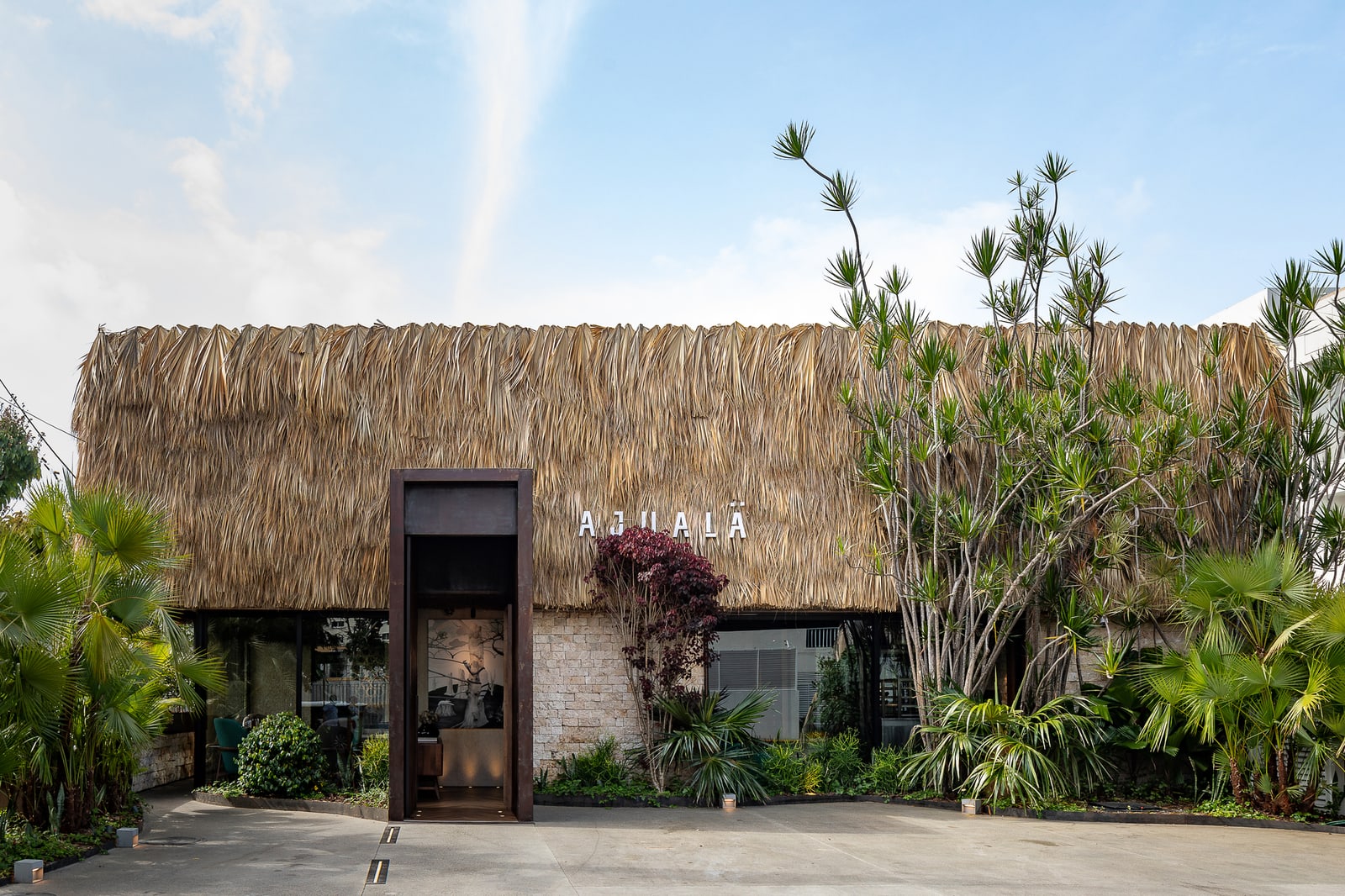
Ajualä's building underwent its own translation. In their account published by ArchDaily in 2021, Portafoglio Grupo Arquitectónico and Grupo HCR describe adapting an existing house. They wanted local materials and local labor to carry the same ambition as the cooking: familiar resources used inventively.[5]
Their sequence begins with a tall entrance faced in weathered steel. Inside, a charcoal cooking area forms a backdrop to reception; the bar and dining spaces follow. Wine storage draws inspiration from building blocks used in the Dominican Republic.[5] These choices give a guest several ways to register workmanship before considering the menu.
The connection is clearest at the level of handling. A cook changes a root's role through preparation; a designer changes a material's role through placement and construction. That is a reading of the documented project, rather than a claim that every chair or bottle has a local origin. Its appeal lies in making the room participate in the restaurant's idea.
Familiarity still has discoveries inside it
Stassi's enthusiasm also extends to ingredients he thinks diners overlook. In the 2024 interview, he singled out black sapote, contrasting its relative neglect with the familiarity of mamey sapote. Mango, avocado and cassava remained among his favorites.[3] The curiosity runs in both directions: toward an underused fruit and back toward foods people already know.
Ajualä's own link page, checked on October 9, 2026, continues to present local produce and creative cooking as its premise. It supplies menu and reservation links and gives the address as Calle Andrés Julio Aybar 13.[6] Those current links are the place to establish what the kitchen is serving when booking.
The enduring attraction in this record of Ajualä is the attention paid to what is close at hand. A root can sustain several dishes. A house can acquire another purpose. A chef's memories can make room for the ingredients of an adopted home. Dinner gives those ideas their most convincing form when they become something a guest wants another bite of.
Sources
- Ingrid Paredes, “Where to eat in Santo Domingo,” 50 Best, September 13, 2024 — Ajualä's casabe, burén preparation and Piantini setting.
- Diario Libre, “Restaurante Ajualä hace su debut en la lista ‘50 Best Discovery’,” February 26, 2025 — Discovery inclusion, chef background, cassava cativía and gnocchi with djon-djon mushrooms.
- Evelyn Betancourt Holt-Seeland, “Saverio Stassi,” Santo Domingo Times, May 21, 2024 — interview on training, culinary influences, Ajualä's purpose and favorite Dominican ingredients.
- Giuliana Chiappe, “Saverio Stassi, el chef venezolano que eleva la comida en República Dominicana,” Bienmesabe / El Estímulo, September 27, 2023 — family work, Venezuelan memories and the withdrawn beef-tongue dish.
- Portafoglio Grupo Arquitectónico and Grupo HCR, “Ajuala Restaurant,” ArchDaily, May 7, 2021 — architects' account of the house conversion, materials and spatial sequence; architectural photography.
- Ajualä, restaurant link page — stated concept, address, menu and booking links; checked October 9, 2026.