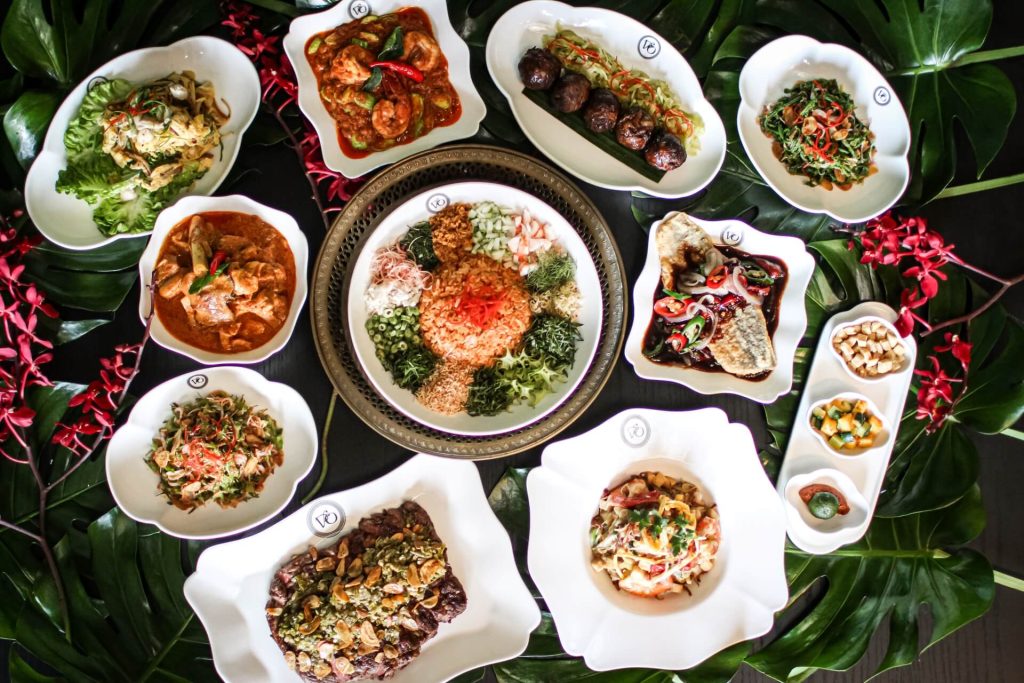
At a tok panjang, the table could grow with the guest list. Dawn Marie Lee's account in PASSAGE describes tables joined end to end, with room to add another. Large celebrations could spill into a neighbour's home.[1] It is hospitality expressed through furniture: a feast able to make room.
It is a lovely starting point for a feast now encountered as a restaurant experience. A long surface crowded with dishes promises abundance. Its history also asks more particular questions: who has gathered, what occasion brings them together, and which foods belong at that gathering? Following those questions reveals how tok panjang moved between households, caterers and dining rooms.
A table with more than one inheritance
The name itself joins languages: tok is Hokkien for table, panjang Malay for long. Singapore Chinese Cultural Centre's Culturepaedia links the formal long dining table to British influence in affluent Peranakan households. Its account places the furniture within a cuisine already bringing Malay and Chinese ingredients and techniques together.[2] The setting and the cooking both carried the marks of exchange.
Lee describes groups of communal dishes repeated along the table, each typically shared by six to eight people. Food was replenished; desserts followed the savouries.[1] A bowl close enough to reach invites another spoonful. Repeating dishes gives guests access to the same feast without sending everything along the entire table.
Arthur S K Lim's Tok Panjang: The Evolution of a Peranakan Heritage Feast offers a useful way to approach that abundance. The publisher describes a book tracing the practice through Lim's family traditions, explaining which menus, occasions and pieces of crockery went together, and including his mother's recipes.[3] That family basis matters. An inherited feast comes with particular people and memories; the phrase “traditional menu” needs a household behind it.
Who carried the cooking into public
The restaurant lineage complicates any neat division between family food and professional food. In a 2024 CNA report, Jenny Yap recalled that her grandfather, Yap Chee Quee, came from Hainan and worked in a Peranakan household before opening a coffeeshop. He founded Guan Hoe Soon in 1953; its name combines the names of his three sons.[4] Skills acquired through domestic employment became the basis of a public business.
The same report shows how closely that inheritance still depended on hands. At Guan Hoe Soon, keluak flesh was mixed with minced fish and pork, then pressed back into the shells for ayam buah keluak. Denise Tan described the chicken gravy as earthy and bittersweet, with tamarind and lemongrass adding brightness.[4] This is reported tasting, but it gives the restaurant history a useful texture: a family name can travel above the door while a particular balance of flavours travels through repeated kitchen work.
A restaurant advertisement makes the next change unusually visible. In the Peranakan Association's magazine, issue 4 of 2004, Guan Hoe Soon described its earlier tok panjang catering as seated service with continual replenishment on Nonya tableware. It then promoted buffet catering made possible by warmers and portable heating equipment, available for homes and other venues.[5]
An advertisement cannot tell us how every guest experienced the transition. It can tell us how one business presented it. The selling point was the ability to carry familiar cooking into more settings. Moving from a replenished seated feast to a buffet changes who fetches the next helping and where people gather. The continuity sits partly in the food; the social choreography has been revised.
A famous dish does not settle an old menu
The menu history contains a revealing tension. Lee's 2023 account says that dark dishes such as ayam buah keluak were formerly avoided at joyous occasions and entered tok panjang menus over time. Culturepaedia, drawing on interviews with practitioners, describes ayam buah keluak among wedding dishes.[1][2] These accounts should not be flattened into a single rule covering every family and period. Their different emphases make a universal, timeless wedding menu difficult to defend.
A documented revival shows the choices more clearly. In September 2018, Malay Mail previewed Debbie Teoh's Melaka Tok Panjang dinner at Bobo KL. The menu included ayam buah keluak, pineapple, banana-flower sambal and individual bowls of chicken broth containing fish-paste omelette rolls. Teoh also adapted the braise sey bak, usually made with pork offal, by using beef.[6]
Dessert carried its own investment of time: pulut tekan came with duck-egg seri kaya that the report said took up to seven hours to cook. Guests would sit at long tables.[6] The revival joined a recognisable setting to laborious dishes while openly allowing a substitution. It is a more interesting historical object for admitting that choice. We can see what the cook wanted to carry forward and where she changed the meal.
For a dining room presenting tok panjang, that specificity is part of the pleasure. Naming a family's version or a particular celebration gives the succession of dishes meaning. Explaining an adaptation lets a guest appreciate the cook's judgment. A beautiful spread can invite the first spoonful; the story of why these bowls belong together can sustain the conversation well into dessert.
Sources
- Dawn Marie Lee, “Tok Panjang,” PASSAGE, 2023 issue IV, pp. 7–10 — table arrangements, communal service and changing festive menus.
- The Nutgraf, “Peranakan Chinese food in Singapore,” Culturepaedia, Singapore Chinese Cultural Centre, updated July 30, 2026 — cultural influences, celebration foods and the photograph courtesy of Violet Oon Singapore.
- Landmark Books, publisher's description of Arthur S K Lim's Tok Panjang: The Evolution of a Peranakan Heritage Feast — the book's family-based scope, menus and tableware.
- Denise Tan, “What do Singapore's oldest Peranakan restaurant and an Amoy Street kopi stall have in common?”, CNA Lifestyle, April 18, 2024 — Guan Hoe Soon's Hainanese roots and reported kitchen and tasting observations.
- Guan Hoe Soon Restaurant advertisement, The Peranakan, 2004 issue 4, PDF p. 14 — a primary commercial account of seated tok panjang service and the adoption of buffet equipment.
- Lee Khang Yi, “Chance of a lifetime: Dine on Peranakan 'Tok Panjang' wedding dishes,” Malay Mail, September 5, 2018 — the announced menu and adaptations for Debbie Teoh's Bobo KL dinner.