The lazy way to describe Addison is to call it San Diego's big special-occasion room and stop there. The better reading is narrower and more interesting. Addison matters because William Bradley stopped using luxury dining as a language imported whole from somewhere else and instead built a house style he and the restaurant now call California gastronomy.[1][2][5] That phrase could have become empty branding. At Addison, it has hardened into something more disciplined: a ten-course menu, a bluff-top room that feels composed rather than showy, and dishes that keep letting California brightness meet French technique, Asian inflection, and a kind of expensive playfulness without turning diffuse.[1][2][4][5][6]
The current public record is unusually coherent on that point. Addison's own experience page says the restaurant celebrates regional ingredients and Southern California influences through Bradley's distinct perspective, while the Fairmont page adds the physical frame: arched windows, hillside views, and a wine cellar placed at the center of the restaurant rather than hidden as a silent support system.[1][2] Michelin then gives the food argument its sharpest form. The guide says Bradley has been at the stoves since 2006, and that global inspiration plus Californian sentimentality are now the core of the cooking, from Regiis Ova reserve caviar with koshihikari rice and applewood-smoked sabayon to shellfish chawanmushi and playful opening bites.[4] Forbes' 2025 feature pushes the same idea from the chef's side: Bradley now wants diners to recognize something emotionally familiar in the food even when the form is newly edited.[6]
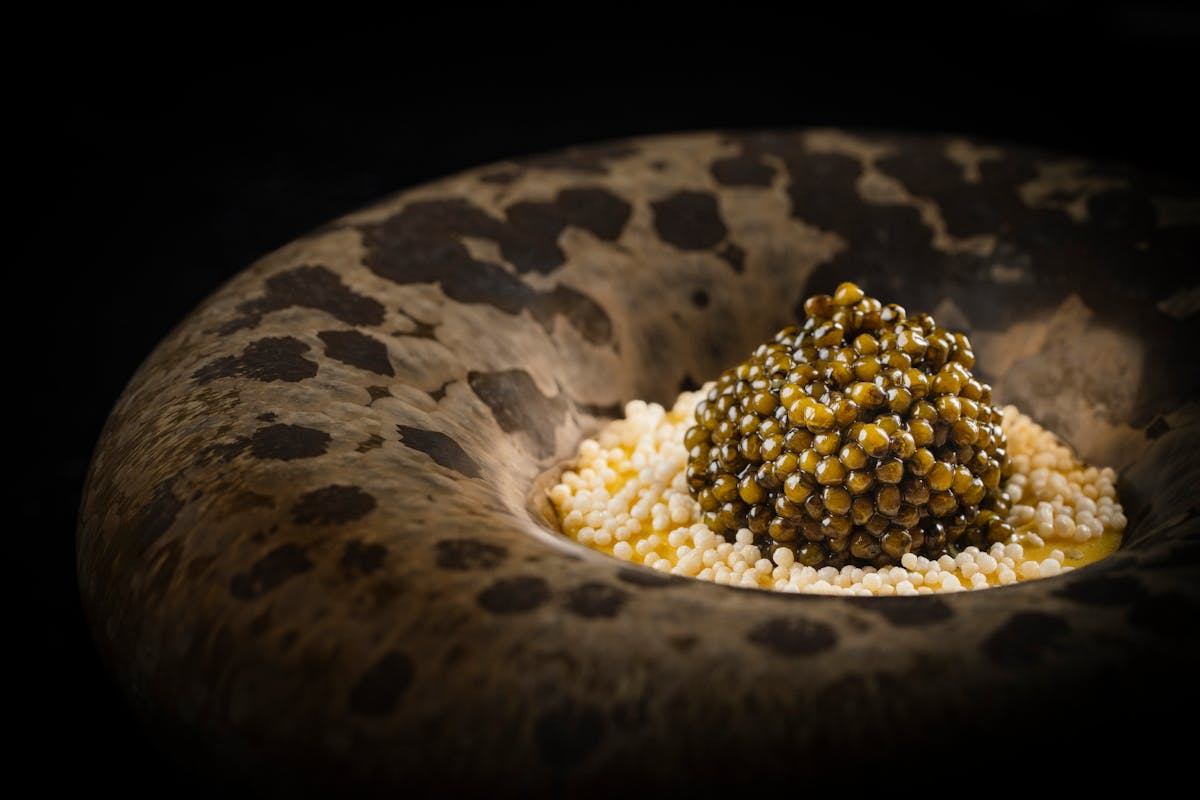
Image context: I used Addison's official caviar-rice photograph rather than a room shot because this plate is the cleanest shortcut into the restaurant's current thinking. The ingredients read as luxurious immediately, but the gesture is more specific than luxury-signaling. Rice, sesame, smoke, and caviar are being made to speak one calm California sentence together.[1][4][6]
1. The room is expensive, but the point is control
Addison sits inside a resort landscape that could easily tempt a restaurant into laziness. The Fairmont page leans into the transportive setting: the restaurant sits high on a bluff, arched windows frame twilight views, and the ten-course menu arrives inside a room built for occasion.[2] The 50 Best Discovery profile paints a similar picture, describing high ceilings and windows looking over the Carmel Valley hillside.[5] Those details matter, but mainly because Bradley does not let them do all the narrative work.
That is the first reason Addison feels authored rather than generic. A weaker room in this position would sell scenery first and let the food function as confirmation that the booking was prestigious. Addison uses the scenery as containment. The dining room widens the meal's atmosphere, but the meal itself stays tightly written.[1][2][5] Even the official language around pairings helps here. Addison and Fairmont both talk about top California vintages, newly discovered bottles, and rare Champagnes, which suggests a program built to sharpen the menu's tone rather than drown it in cellar theatre.[1][2]
2. Bradley's real move was to stop imitating the old center
The most important fact about Addison is not merely that it has three Michelin stars. It is that Bradley gave himself permission to stop chasing a generic modern-French ideal and start using Southern California as the menu's emotional and technical field. Addison's own public framing now treats this turn as central rather than incidental.[1][7] Michelin's interview with Bradley makes the motive clearer: he says he looks around the state and takes inspiration from the cuisines that are strongly present there, then tries to turn those flavor profiles into something that still belongs inside a three-star format.[5]
That shift explains why Addison now reads as more than a polished luxury room with local produce. Forbes' feature is especially useful because it shows the kitchen leaning into dishes that carry memory without becoming kitsch: versions of tepache, lengua, tempura, and Cantonese quail have all passed through the menu, while the caviar-over-koshihikari and shellfish chawanmushi keep returning as stable signatures.[6] This is not random eclecticism. Bradley's stated goal is familiarity under transformation, food that reminds diners of something without collapsing into straight reproduction.[5][6]
The distinction matters. Plenty of restaurants borrow freely from California's Mexican, Asian, and coastal food worlds, but many of them end up sounding like mood boards. Addison sounds more like a grammar. French technique still gives the food structural pressure, yet the references now travel toward what Southern Californians actually eat, smell, and remember.[4][5][6]
3. The caviar rice tells you how the whole menu works
If one dish has become Addison's thesis statement, it is the caviar course.[1][4][5][6] Michelin treats it as the clearest expression of the restaurant's current identity, and 50 Best Discovery highlights it as Bradley's showstopper.[4][5] That makes sense because the dish performs several jobs at once. It offers luxury in the oldest possible way through caviar, but the base is koshihikari rice, the sabayon is smoked with applewood, and the whole composition is seasoned with sesame.[4] The ingredients do not line up under one national tradition. They line up under one house sensibility.
This is also why Michelin's additional examples are revealing. Chicken liver churros, Kumamoto oysters with pickled green strawberry, Iberian ham folded over potato, and shellfish-studded chawanmushi all suggest a kitchen more interested in tuned contrasts than in purity for its own sake.[4] Forbes deepens that reading by reporting how Bradley thinks about recognition, texture, and the pleasure of a dish that feels connected to childhood or everyday food memory even when it arrives in a highly edited form.[6] Addison's luxury is therefore not only ingredient cost. It is editorial confidence.
That confidence is harder to achieve than it looks. Once a restaurant starts speaking in multiple food memories, it risks losing shape. Addison avoids that by keeping the courses tight, the references legible, and the textures highly controlled. The point is never to make diners admire the sheer number of influences in the room. The point is to make them feel that the influences have already been disciplined into one voice.[1][4][6]
4. The wine program matters because it keeps California from sounding provincial
There is a second problem Bradley has to solve. If you build a serious fine-dining identity around California, the room can begin to sound local in a narrow way rather than local in an expansive way. Addison answers that through wine and service. The experience page describes an extensive list with top California vintages and discoveries from around the globe; Fairmont adds rare Champagne; the contributors page shows a dedicated leadership role for wine and service under Sean McGinness.[1][2][3]
This is more than hospitality polish. It is how the restaurant keeps California gastronomy from becoming a closed circuit. California remains the anchor, but the cellar makes clear that the restaurant still understands itself as a global fine-dining address, not a regional manifesto with luxury plating. The balance is crucial. Addison does not renounce worldliness. It filters worldliness through San Diego rather than the other way around.[1][2][3][5]
5. Why Addison still feels worth reading in 2026
Three-star restaurants often grow less legible after they reach the summit. They add prestige faster than they add new meaning. Addison currently looks like it is doing the opposite. Michelin's interview with Bradley suggests the team now feels confident enough to evolve subtly rather than change for the sake of novelty.[5] Forbes describes a kitchen that is cooking with more certainty, more humor, and more trust in its own Southern California roots.[6] The public-facing material from Addison and Fairmont then confirms that the restaurant has not retreated into vagueness: the format is still ten courses, the setting is still calm and architectural, and the menu still announces regional ingredients without apology.[1][2]
That is why Addison matters beyond San Diego boosterism. The restaurant has found a way to make California luxury feel authored. Not merely local. Not merely opulent. Authored. The caviar rice, the chawanmushi, the hilltop room, the centrally visible cellar, the mix of California vintages and rare Champagne, and Bradley's insistence on familiarity transformed through technique all point in one direction.[1][2][4][5][6] Addison no longer reads like a Southern California outpost trying to prove that it belongs in a global conversation. It reads like a room that has finally decided what its own language is, and now trusts it enough to keep writing in it.
Sources
- Addison, "The Experience" - official page covering the restaurant's California Gastronomy framing, ten-course tasting menu, $395 price, regional ingredients, Southern California influences, wine pairings, and the caviar-rice photograph used here.
- Fairmont Grand Del Mar, "Addison by William Bradley" - official hotel page covering the bluff-top setting, arched windows, central wine cellar, ten-course format, California vintages, rare Champagne, and private-dining framing.
- Addison, "Contributors" - official page covering the current leadership team behind the dining room, including Sean McGinness as director of wine and service.
- MICHELIN Guide, "Addison - San Diego - a MICHELIN Guide Restaurant" - current listing covering William Bradley's tenure since 2006, the three-star status, Californian sentiment filtered through global inspiration, and signature dishes including the caviar rice and shellfish chawanmushi.
- MICHELIN Guide, "William Bradley on California Gastronomy and San Diego Culture" - interview covering Bradley's account of California gastronomy, his attention to the state's predominant cuisines, and the team's confidence after reaching three stars.
- Forbes, "Three-Michelin-Star Addison Dives Deeper Into California Gastronomy" - feature covering Bradley's familiarity-through-transformation approach, menu examples such as tepache, lengua, Cantonese quail, the returning caviar-rice and chawanmushi signatures, and the kitchen's Southern California confidence.
- Addison, "Recognition" - official page covering the restaurant's award framing and the way Addison publicly points readers toward coverage of its move from French-classic positioning to California gastronomy.