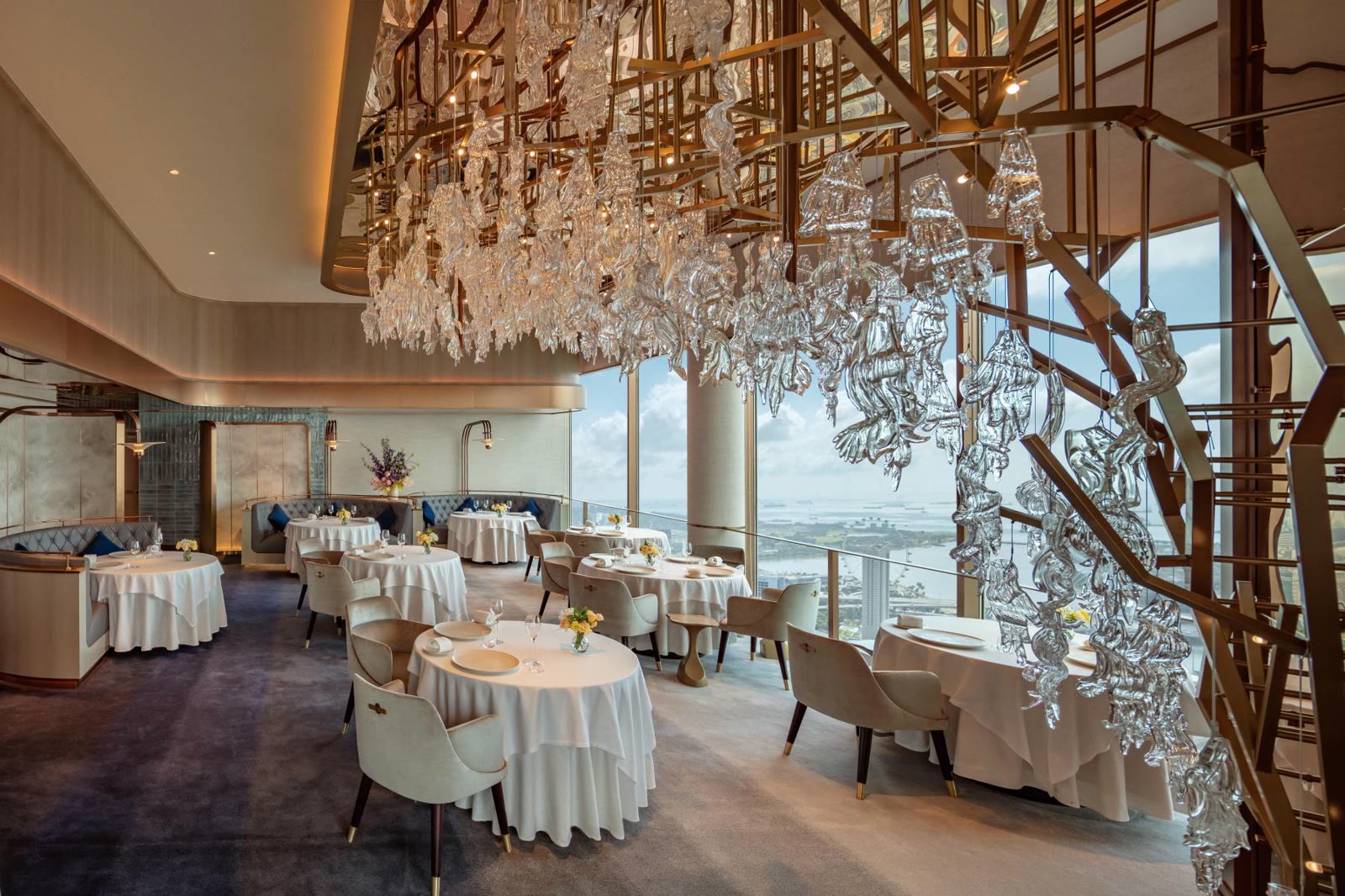
Many high-floor tasting rooms ask the view to do too much of the work. The elevator opens, the city flares out below the glass, and the meal spends the rest of the night living off borrowed drama. JAAN by Kirk Westaway works because the skyline is only the frame. The stronger attraction sits inside the frame: a 35-seat room, a deliberately narrow British vocabulary, and a menu that tries to keep Devon memory intact even after carrying it up to the 70th floor of a Singapore hotel.[1][2][3]
The current public record is unusually consistent on that point. Swissôtel's official page describes JAAN as a multi-sensorial journey through Devon, unfolding through the halls before the guest reaches the main dining room, with Kirk Westaway involved in everything from supplier selection to bespoke tableware and custom furniture.[1] 50 Best Discovery then fills in the guest-facing shape: a former French restaurant redirected into "reinvented British cuisine," an intimate 35-seat room, and a tasting format that still treats classics such as leek and potato soup, venison, and wild seabass as live material rather than museum pieces.[2] Michelin's listing brings the outside verdict: Two Stars, strong views, polished service, top British produce, a dressed-up fish-and-chips course, and even an alcohol-free gin-and-tonic palate cleanser that reads as part of the composition rather than as a health-side add-on.[3]
Image context: the lead image uses JAAN's official interior photograph because this walkthrough is about room control before it is about any single plate. The windows matter, but the tighter fact is the scale of the room itself: thirty-five seats, soft colors, and enough restraint to keep the cooking from turning into skyline background.[1]
1. The approach already tells you how the menu wants to be read
JAAN's official page does not simply say that Devon inspires the cooking. It says guests move through a multi-sensorial journey through Devon before they reach the main dining area.[1] That wording matters. It suggests the restaurant wants the meal to begin before the first bite, with the approach itself acting as a quiet sorting mechanism. You leave the lobby machinery of a large hotel, rise above the city, pass through the halls, and then enter a room small enough to make the rest of the evening feel authored rather than diffuse.[1]
That is a strong structural choice for Singapore. Many destination dining rooms in the city compete by widening the sense of occasion: bigger hotel glamour, louder luxury, more obvious spectacle. JAAN tightens instead. 50 Best Discovery describes one of Singapore's most spectacular views, but it pairs that claim with the counterweight that really matters: an intimate room, not a grand hall.[2] Michelin reinforces the same balance when it praises the ambiance and panorama while still centering the food and service.[3] The city remains visible the whole time, yet the restaurant is clearly trying to stop the view from becoming the only story.
2. The small room keeps British memory from turning into costume
Westaway's public story is useful because it explains why JAAN's Britishness does not read like export nostalgia. In the 2019 50 Best interview marking the rename from JAAN to JAAN by Kirk Westaway, he explained that he wanted to cook the food he grew up eating and had been gradually introducing more British elements before making that philosophy the full concept in July 2018.[4] Michelin's feature after the second star adds the deeper emotional layer: a childhood in Devon, close to the sea, family-grown vegetables, and early familiarity with strong dairy and produce.[5]
Once those details are in view, the room starts to make more sense. Swissôtel's page stresses that Westaway has shaped the experience beyond the plates alone, including the suppliers, the tableware, and the furniture.[1] That level of control matters because British food, when exported lazily, can collapse into iconography: a tart, a roast, a fish course, a cream element, a sentimental backstory. JAAN avoids that problem by staging the meal in a room small enough for tone to stay coherent. The British references arrive polished, edited, and carefully proportioned. They do not have to shout to remain legible.[1][4][5]
This is also why the formal dress code and tightly defined service window feel appropriate rather than stiff. On the official page, lunch and dinner are both bounded experiences with vegetarian alternatives available alongside the main menus.[1] The dining room is not meant to feel like a pub above the clouds. It is meant to feel like a very controlled reading of British culinary memory inside a global fine-dining setting.
3. The classics are rewritten in fine-dining grammar, not simply elevated
The most useful clue in the Michelin listing is the description of fish & chips.[3] Michelin does not praise the dish because it is comforting in a familiar way. It praises the way the classic gets remade, with sour cream, lemon zest, and caviar turning a pub association into something more exacting.[3] That single example helps explain how to read the whole tasting-menu walkthrough. JAAN is not interested in reproducing British classics faithfully at luxury scale. It is interested in extracting what is memorable about them, then rewriting them in a finer syntax.
50 Best Discovery points toward the same method with different examples: leek and potato soup, roasted venison, wild seabass, and thoughtful vegetarian menus.[2] None of those signals are random. They describe a house style built from recognisable anchors, each one cleaned up until it can carry a more elegant rhythm. The soup is not there to perform rusticity. The venison is not there to imitate country-house heaviness. The seabass is not there as a generic premium fish. Each course seems to be asked to preserve a trace of familiarity while shedding excess weight.[2][3][4]
That is why the walkthrough feels steadier than the average special-occasion hotel meal. The courses appear designed to accumulate one kind of argument: British cuisine can travel, refine itself, and still keep the emotional outline of where it came from.[2][4][5] JAAN does not need to prove that Britain possesses a haute-cuisine canon equal to France's in every historical sense. It needs to show that memory, produce, and precision can make a convincing modern menu in the present tense. The plates do that work one by one.
4. Produce keeps the menu from slipping into soft-focus nostalgia
The official Swissôtel page says Westaway's passion reaches into the selection of the world's best gourmet suppliers.[1] Michelin sharpens that into a more precise claim about top British produce and inspirations.[3] The feature on the second star makes the logic clearer still by tying the restaurant's development to produce and provenance rather than to flag-waving nationalism.[5] That chain matters because it protects JAAN from becoming a sentimental brand exercise.
If the food were only about childhood recollection, the meal would risk turning soft around the edges. Instead, the public material keeps returning to discipline. Westaway's Devon background is treated less as folklore than as a sourcing compass.[4][5] Britishness at JAAN is not a costume rack of obvious dishes. It is a stricter filter for ingredients, structure, and flavor memory. Even the vegetarian alternatives advertised on the official page fit that logic. They suggest the restaurant's confidence lies in how it thinks, not only in how it handles meat or fish.[1]
This is where the fish-and-chips reference becomes more instructive than cute. A weaker restaurant would use it as a wink. JAAN seems to use it as proof of method. If a classic as overexposed as fish and chips can survive reinterpretation, then the rest of the menu can move freely between recollection and precision without losing its spine.[3][4]
5. What the walkthrough is really selling in 2026
The easiest way to book JAAN badly is to book it for the panorama and hope the cooking rises to meet the room. The better reading runs the other way. The view is there to widen the space around a very narrow culinary thesis. Devon is the anchor.[1][4][5] British classics are the usable vocabulary.[2][3] The 35-seat room is the discipline that keeps the vocabulary from spreading too thin.[1][2] Once those pieces lock together, the tasting menu stops looking like a hotel luxury add-on and starts reading like a coherent authored dinner.
That is why JAAN still feels worth serious attention. Plenty of restaurants can put diners high above a city. Fewer can keep a small regional memory intact once they get there. JAAN's achievement is that the elevator ride never erases Devon. It simply reframes it through polished service, careful produce, and a room small enough to make every classic carry its weight.[1][2][3][4][5]
Sources
- Swissôtel The Stamford, "JAAN by Kirk Westaway" - official page covering the Level 70 location, the multi-sensorial Devon journey, the 35-seat room, supplier and design control, lunch and dinner menus with vegetarian alternatives, dress code, hours, and the official interior image used here.
- 50 Best Discovery, "Jaan by Kirk Westaway" - current profile covering the 70th-floor dining room, the shift from French roots to reinvented British cuisine, example dishes, the tasting-menu entry point, and lunch/dinner service days.
- MICHELIN Guide, "Jaan by Kirk Westaway - Singapore - a MICHELIN Guide Restaurant" - current listing covering the two-star status, British produce focus, the fish-and-chips reinterpretation, the alcohol-free gin-and-tonic palate cleanser, and current opening hours.
- The World's 50 Best Restaurants, "Why chef Kirk Westaway flipped Jaan's menu to embrace British cuisine" (June 3, 2019) - interview covering the July 2018 concept turn, Westaway's wish to cook the food he grew up eating, and the restaurant's rename to JAAN by Kirk Westaway.
- MICHELIN Guide, "Kirk Westaway on JAAN's second MICHELIN Star: 'It's Just the Beginning'" - feature covering Westaway's Devon childhood, family-garden produce memories, and the restaurant's produce-and-provenance logic.