WM still screens like a premium scarcity asset. As of 2026-04-10 close, the stock finished at $229.45, equal to roughly $92.45 billion of market value and about 34.79x trailing earnings.[4] That is not a market asking whether the business is good. It is a market already paying for the answer.
The narrower question is what that premium now has to prove. Priced is the old WM case: scarce landfills, dense collection routes, steady municipal and commercial pricing, and a legacy business that still produced a 31.5% adjusted operating EBITDA margin in 2025.[1] New is whether the Stericycle-heavy healthcare layer can keep converting into cleaner group margins and free cash flow fast enough to justify management's 2026 "harvest" story. WM is guiding to $3.75 billion to $3.85 billion of free cash flow in 2026 and says it plans to return about $3.5 billion to shareholders while bringing leverage back into a 2.5x to 3.0x target range.[1] At this multiple, the market is no longer paying up for landfill moat alone. It is paying for integration plus cash conversion.
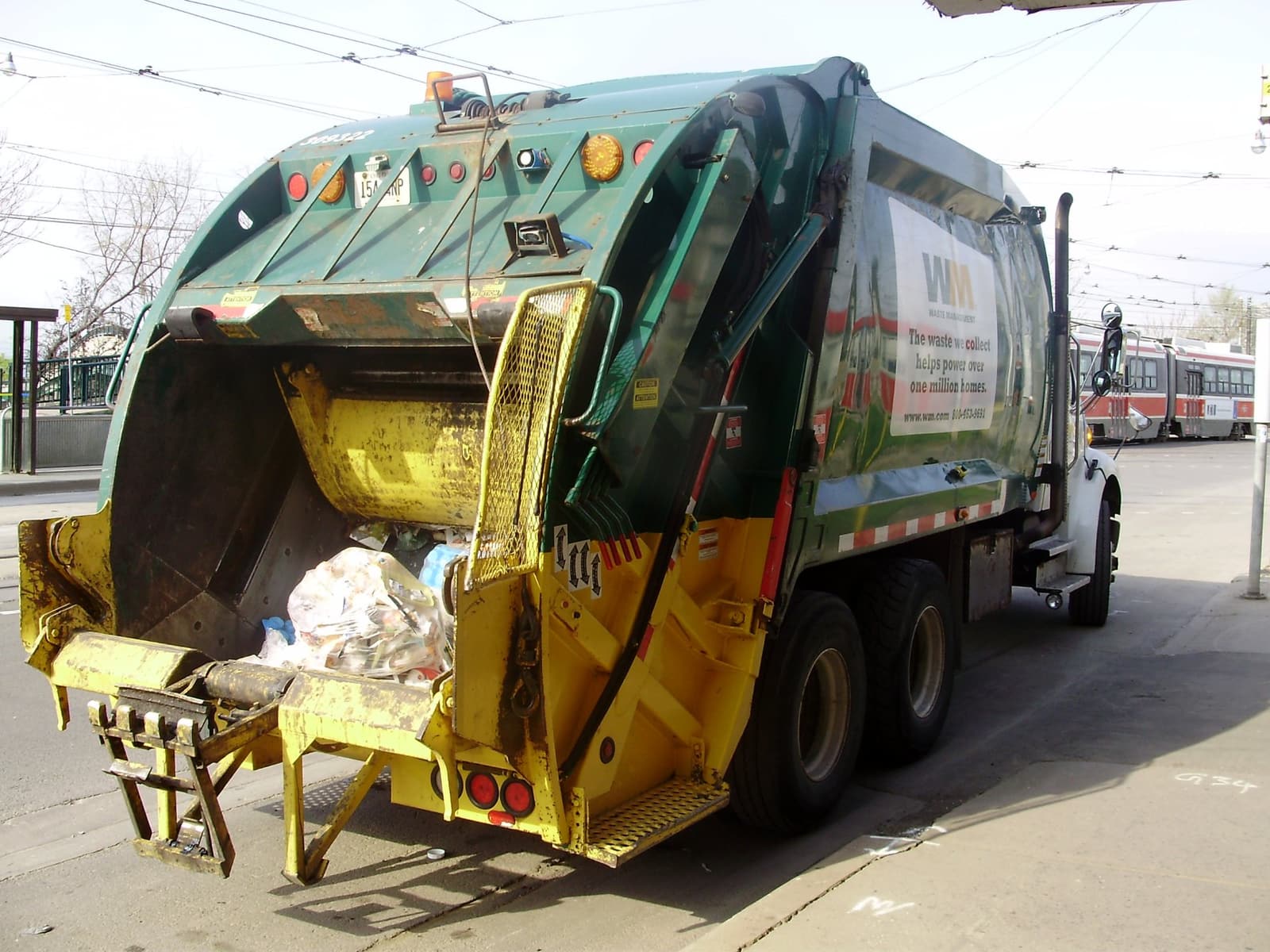
Image context: the cover uses a documentary street photograph of a WM truck rather than a generic recycling icon or green-energy montage. That fits the article because the business is still physical first: routes, trucks, workers, transfer stations, and disposal assets have to convert pricing power into cash.[6]
Priced vs new
The easy reason the stock keeps a premium is that the old machine is still unusually strong. In 2025, WM's revenue rose to $25.204 billion; operating EBITDA grew 13.5%; cash flow from operations grew 12.4%; and management said the company delivered its best-ever operating expenses as a percentage of revenue for the fourth quarter and full year.[1] Inside the legacy solid-waste business, core price rose 5.4%, collection-and-disposal volume grew 1.1%, and adjusted operating EBITDA margin reached 31.5%.[1] Those are numbers that reinforce the long-standing moat story rather than weaken it.
That is why the valuation argument has moved. When a company with real asset scarcity, regulated route density, and a long pricing history is already trading at almost 35x trailing earnings, the next rerating rarely comes from investors suddenly discovering the moat.[4] It comes from a second layer of proof. In WM's case that second layer is the healthcare platform brought in through Stericycle and the broader claim that 2026 should become a cash-harvest year rather than another year of acquisition digestion and heavy investment.[1][5]
Why the premium still makes sense
1. The legacy collection-and-disposal engine still deserves respect
There is no serious argument that WM's core business has rolled over. The 2025 numbers still show disciplined pricing, positive volume, and expense control working together.[1] That matters because the landfill moat is not just a slogan about scarce permits. It is an operating system built from route density, disposal ownership, contract discipline, and the ability to hold price without losing the network.
In other words, the old business still earns its right to a premium multiple. A company that can push core price above 5%, keep volume positive, and still post a 31.5% adjusted operating EBITDA margin in the legacy business is not easily replicated.[1] Investors are rational to pay more for that than they would for a lower-quality industrial with similar top-line growth.
2. The new proof sits inside healthcare-margin conversion
The harder part of the story is also the more important one. WM's Stericycle rationale deck framed the transaction as one that would be accretive to operating EBITDA and cash flows within one year of close, even though it would initially push leverage up to around 3.6x.[5] That was the bargain management offered investors: tolerate the temporary leverage and integration noise, then collect better margins and cash generation once the platform is absorbed.
The 2025 results show progress, but not a finished job. WM said Healthcare Solutions grew adjusted operating EBITDA by almost 60% in 2025 and delivered a 16.9% adjusted operating EBITDA margin.[1] That is a real improvement. It is also still far below the 31.5% margin profile of the legacy business.[1] This spread is the key valuation issue now. If Healthcare Solutions keeps climbing, the acquisition becomes a margin-expansion and cash-conversion story. If it stalls in the high teens while the legacy business does most of the work, the premium multiple starts to look as though it already pulled forward too much of the synergy case.
That is why the healthcare segment matters more than it did six months ago. The moat is already understood. Margin convergence is the marginal variable.
3. 2026 is supposed to be the harvest year
Management has made the standard explicit. WM's 2026 plan calls for free cash flow between $3.75 billion and $3.85 billion, about $3.5 billion of shareholder returns through dividends and buybacks, and leverage back inside a 2.5x to 3.0x long-term range.[1] Once a company spells out a cash-and-capital-allocation bridge that clearly, investors stop grading it on narrative and start grading it on actual conversion.
This is the piece that makes the current valuation stricter than the old "quality compounder" case. A premium business can justify a premium multiple. A premium business that has just finished a large acquisition and promises a cash harvest must justify something more precise: that the acquisition did not simply raise the story's ambition, but actually raised the amount of distributable cash that reaches shareholders.
The stock does not need another quarter proving that garbage collection is resilient. It needs quarters proving that the post-Stericycle organization can turn that resilience into a better consolidated cash machine.
Six numeric anchors
- Market premium: WM closed at $229.45 on April 10, 2026, equal to roughly $92.45 billion of market cap and a 34.79 trailing P/E.[4]
- 2025 scale: revenue reached $25.204 billion in 2025, up from $22.063 billion in 2024.[1]
- Cash and earnings quality: operating EBITDA grew 13.5% and cash flow from operations grew 12.4% in 2025.[1]
- Legacy moat output: core price rose 5.4%, collection-and-disposal volume grew 1.1%, and the legacy WM business posted a 31.5% adjusted operating EBITDA margin.[1]
- Healthcare conversion: WM Healthcare Solutions grew adjusted operating EBITDA by almost 60% in 2025, but margin still sat at 16.9%.[1]
- 2026 cash test: management guided to $3.75 billion to $3.85 billion of free cash flow, about $3.5 billion of shareholder returns, and leverage back to 2.5x to 3.0x.[1]
Those anchors are enough to frame the valuation. The stock already reflects trust in the core franchise. The debate now lives in whether the healthcare and capital-allocation bridge is strong enough to keep the premium from looking fully priced.
Strongest counterweight
The strongest pushback is that the market may simply be right to pay up. WM's legacy business is still throwing off unusually clean margins, Healthcare Solutions is already improving, and management is no longer promising an abstract synergy someday. It is guiding a specific 2026 free-cash-flow range and an explicit shareholder-return number.[1] If the company can post one or two more quarters of healthcare-margin improvement while repurchases resume on schedule, then the current multiple may look less demanding than this article suggests.
That counterweight is real. This is not a short thesis against a low-quality roll-up. It is a narrower claim that a premium multiple now depends on the second engine proving it can approach the quality of the first.
Falsifier
This walkthrough is leaning too hard on the remaining integration gap if the next reporting cycle shows Healthcare Solutions continuing to close the margin spread, the 2026 free-cash-flow path remaining intact, and shareholder returns restarting without leverage drifting back outside the target band.[1][2] If those things happen, the market will be justified in treating the acquisition as a completed quality upgrade rather than as a still-open proof point.
Watchlist
- April 28, 2026: WM is scheduled to release first-quarter 2026 financial results after the market close.[2]
- April 29, 2026, 10 a.m. ET: management hosts the first-quarter 2026 investor conference call; the key question is whether Healthcare Solutions margin and free-cash-flow cadence still support the full-year bridge.[2]
- May 12, 2026, 10:00 a.m. Central Time: WM's annual meeting is the next formal stockholder checkpoint on capital allocation, board oversight, and post-acquisition execution.[3]
Takeaway
WM still deserves a premium for the business it already owns. The legacy collection-and-disposal machine remains scarce, disciplined, and structurally profitable.[1] The narrower issue is what part of that quality is still incremental for shareholders at nearly 35x trailing earnings.[4] In April 2026, the answer runs through Stericycle margin conversion and the credibility of the free-cash-flow harvest. The moat is priced. The new proof is whether the second engine can start looking more like the first.
Sources
- WM, "WM Announces Fourth Quarter and Full-Year 2025 Earnings" (January 28, 2026).
- WM, "WM Sets Date for First Quarter 2026 Earnings Conference Call" (March 26, 2026).
- Waste Management, Inc., Definitive Proxy Statement for the 2026 Annual Meeting of Stockholders (SEC DEF 14A; annual meeting scheduled for May 12, 2026).
- Stock Analysis, "Waste Management, Inc. (WM) Stock Price & Overview," accessed April 11, 2026.
- WM, "WM's Acquisition of Stericycle - Framing the Strategic Rationale" investor presentation (July 23, 2024).
- Wikimedia Commons, "File:Waste Management Truck Toronto.jpg."