Constellation Brands did not report a magical reopening of demand. It reported something narrower and more useful. Priced is the part investors already know: imported beer still pays for the company, Modelo remains the biggest brand in the portfolio, and wine and spirits no longer drive the valuation story. New is that the fourth quarter finally showed a broader beer bench helping carry the load, while management also reset the next year's cash-flow expectations lower enough to remind investors that brand strength alone is not the whole thesis.[1][2][3]
That is why the quarter matters even though the headline beat was real. Adjusted fourth-quarter EPS came in at $1.90 versus a $1.74 Wall Street consensus, and adjusted revenue of $1.92 billion also came in slightly above estimates.[1][5] The more important question is not whether Constellation cleared one quarter's bar. It is whether the company has moved from a one-franchise story to a wider portfolio-and-cash story that can hold together in a softer consumer environment.[1][2][4][5]
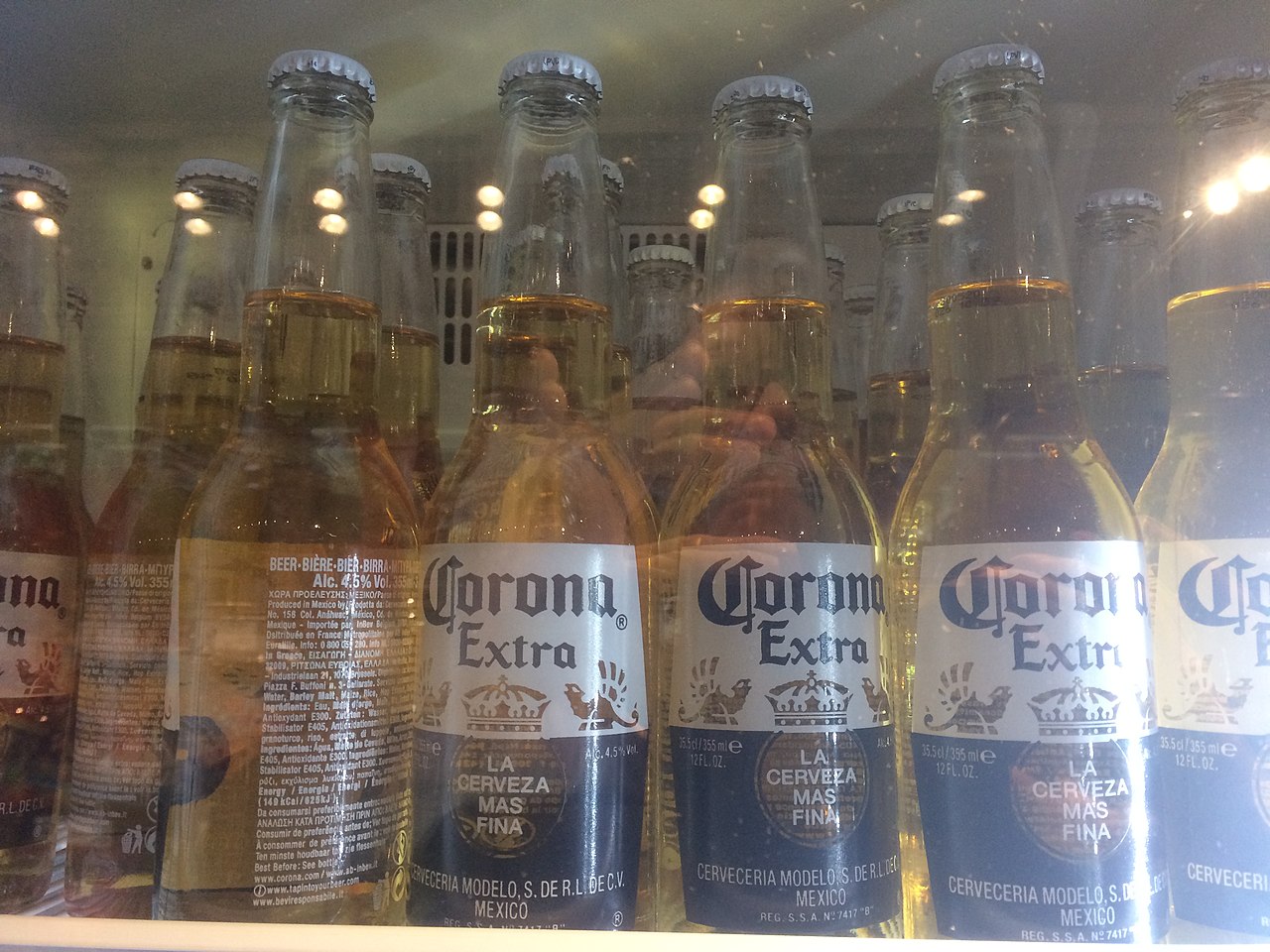
Image context: the cover uses a real Wikimedia Commons retail photograph of Corona bottles rather than a stock market visual. That is the right entry point because the operating debate still starts in the aisle: brand visibility, price realization, package mix, and whether the imported-beer shelf can keep producing cash even when consumers become more selective.[6]
Beer still pays for almost everything
Start with the basic shape of the company. For fiscal 2026, Constellation reported $9.139 billion in net sales, $2.721 billion in reported operating income, $2.943 billion in comparable operating income, $9.61 of reported EPS, and $11.82 of comparable EPS.[1][3] Inside that total, the Beer business generated $8.315 billion of net sales and $3.161 billion of operating income. Wine and spirits, by contrast, produced only $823.8 million of net sales and $10.5 million of operating income.[1]
That split is the real framing device for the stock. Investors can talk about premiumization, portfolio curation, or long-term brand architecture, but the economic center is still brutally clear: the imported-beer machine funds the model. If that engine slows, everything else becomes an argument about damage control. If it stabilizes, the rest of the company gets time to improve.[1][3]
Fiscal 2026 did show real pressure. Beer shipments fell 3.8%, depletions fell 2.1%, net sales fell 3%, and operating income fell 7%. Operating margin also slipped 170 basis points to 38.0%, hurt by lower shipment volume, unfavorable fixed-cost absorption, and aluminum tariffs.[1] This is why the stock could not live on old Modelo mythology alone. The company needed evidence that the portfolio had not narrowed into one overworked hero brand.
Why the fourth quarter matters more than the annual total
The quarter supplied that evidence, though not in a perfectly clean way. Beer shipments rose 1.1%, depletions rose 0.6%, and net sales increased by a little over 1%.[1][2][3] More important than the aggregate number was the composition. Modelo Especial depletions were down just under 1% and Corona Extra was down about 6%, but Pacifico rose about 21%, Victoria about 17%, and Modelo Cheladas about 5%.[1][2][3]
That mix matters because it changes the risk profile of the beer business. A narrower story in which Modelo has to do all the work leaves the company exposed to one consumer lane, one set of retail trends, and one set of demographic pressures. Management was explicit that retailers in ZIP codes with larger Hispanic populations continued to weigh on portfolio performance, even if the rate of decline improved during the quarter.[2][3][4] The encouraging signal is not that those pressures vanished. It is that Pacifico, Victoria, and several Corona and Chelada extensions were strong enough to keep the broader franchise moving while the pressure eased.[1][2][3]
The problem is that growth did not arrive with cleaner margins. Fourth-quarter beer operating income fell a little more than 8%, and operating margin dropped 340 basis points to 33.2%, as higher depreciation, unfavorable fixed-cost absorption, and aluminum tariffs offset the small volume and pricing recovery.[1][2][3] In other words, Constellation proved it still has retail traction. It did not yet prove that renewed traction immediately converts into the old margin shape.
Wine and spirits is smaller, but it still affects the read-through
The wine-and-spirits business no longer drives the equity story, yet it still matters because it influences how much of the beer cash machine reaches shareholders unblurred. The remaining portfolio delivered approximately 3% depletion growth in fiscal 2026 and more than 8% depletion growth in the fourth quarter, helped by brands such as Kim Crawford and Mi CAMPO tequila.[2][3] That is the encouraging part.
The less encouraging part is the earnings translation. Fourth-quarter wine-and-spirits net sales fell 58% to $194.2 million, and operating income was only $2.6 million. For the full fiscal year, net sales were $823.8 million and operating income just $10.5 million.[1] Some of that distortion reflects the 2025 wine divestitures and the deliberate shrinking of lower-value volume, which is why the year-over-year comparisons look so violent.[1][3] But the conclusion for investors is still simple: the cleanup has made the portfolio easier to understand, not yet meaningful enough to change the beer-dominant economics of the group.
The next proof is cash, not just a beat
This is where the comparison with last fall becomes useful. In September 2025, management cut fiscal 2026 comparable EPS guidance to $11.30 to $11.60, cut beer net-sales guidance to down 4% to down 2%, and reduced expected free cash flow to $1.3 billion to $1.4 billion as high-end beer buy rates decelerated and softness among Hispanic consumers hit the portfolio harder than the broader category.[4] Fiscal 2026 ultimately finished better than that reduced frame: comparable EPS landed at $11.82, operating cash flow reached $2.7 billion, and free cash flow reached $1.8 billion.[1][3]
That sounds like a clean all-clear until you look at the next guide. For fiscal 2027, management now expects enterprise organic net sales between down 1% and up 1%, beer net sales in the same down 1% to up 1% range, beer operating margin of 37% to 38%, operating cash flow of $2.4 billion to $2.5 billion, capital expenditures of about $800 million, and free cash flow of $1.6 billion to $1.7 billion.[1] They also withdrew the previously issued fiscal 2028 outlook.[1][3]
That is the real reason this quarter should be read carefully. The company has shown enough breadth to keep the beer thesis alive. It has not given investors permission to stop worrying about cash conversion, margin repair, or consumer selectivity.
Six numeric anchors
- Fiscal 2026 enterprise results: net sales of $9.139 billion, reported operating income of $2.721 billion, comparable operating income of $2.943 billion, reported EPS of $9.61, and comparable EPS of $11.82.[1]
- Beer still dominates the economics: fiscal 2026 Beer net sales were $8.315 billion and Beer operating income was $3.161 billion.[1]
- Fiscal 2026 Beer softness was real: shipments -3.8%, depletions -2.1%, net sales -3%, operating income -7%, and operating margin 38.0%, down 170 basis points.[1]
- Fourth-quarter breadth improved: Beer shipments +1.1%, depletions +0.6%, net sales a little over +1%; Pacifico about +21%, Victoria about +17%, Modelo Cheladas about +5%, while Corona Extra was about -6%.[1][2]
- Cash and capital return were still strong: fiscal 2026 operating cash flow was $2.7 billion, free cash flow was $1.8 billion, share repurchases were $924 million during the fiscal year plus another $75 million in March, and total shareholder returns exceeded $1.6 billion.[1][2][3]
- Fiscal 2027 keeps the leash short: enterprise and Beer net sales are guided to -1% to +1%, Beer operating margin to 37% to 38%, operating cash flow to $2.4 billion to $2.5 billion, capital expenditures to about $800 million, and free cash flow to $1.6 billion to $1.7 billion.[1]
Strongest counterweight
The strongest counterweight is that Constellation does not need a perfect consumer backdrop to remain a high-quality business. It is still the top dollar-share gainer in tracked U.S. beer channels, still the number-one high-end beer supplier by dollar sales, still has Modelo Especial as the category leader, and now has visible support from Pacifico and Victoria rather than one exhausted growth lane.[1][2][3] If investors believe the fourth quarter marked the beginning of a broader normalization in Hispanic-exposed retail traffic, then the cash-flow guide may prove conservative rather than cautionary.
Falsifier
This cautious framing would be too negative if the next few quarters show that beer can grow modestly while margins rebuild faster than expected. Concretely, if beer net sales start printing above the upper end of the -1% to +1% fiscal 2027 guide, if Beer operating margin holds toward the top of the 37% to 38% range despite tariff pressure, and if free cash flow lands above $1.7 billion without leaning on a sharp capital-spending slowdown, then the "breadth and cash still need proof" thesis would be undershooting the business.[1][2]
Watchlist
- ZIP-code demand mix: management has already told investors where the stress sits, so the key issue is whether Hispanic-exposed retail weakness keeps moderating.[2][4]
- Portfolio breadth beyond Modelo: Pacifico, Victoria, and Cheladas do not need to replace Modelo; they need to prove the franchise is multi-engine rather than single-engine.[1][2][3]
- Beer margin repair: watch whether pricing and mix can offset depreciation, fixed-cost absorption, and aluminum tariffs more cleanly than they did in Q4.[1][2]
- Free-cash-flow durability: the next argument for the stock sits in whether fiscal 2027 can hold near the $1.6 billion to $1.7 billion target while the company still invests behind modular brewing capacity.[1][2]
- Wine-and-spirits translation: depletion growth is helpful, but investors need to see whether the remaining portfolio can move from "less bad" to genuinely contributive operating profit.[1][2][3]
Takeaway
Constellation's quarter mattered because it restored some proof of breadth to a beer story that had started to look too dependent on one lane of demand. That is meaningful. It is not the same thing as a full reset to easy growth. Beer still funds the story, wine and spirits still trails far behind economically, and the next valuation support probably comes from cash discipline and margin repair rather than from one headline earnings beat.
Sources
- Constellation Brands, Earnings Release and Financial Tables PDF: Full Fiscal Year and Fourth Quarter 2026 Financial Results (April 8, 2026).
- Constellation Brands, CEO/CFO Commentary PDF: Fiscal & Q4 2026 Financial Results (April 8, 2026).
- Constellation Brands, "Earnings Recap: Constellation Brands Fiscal Year and Fourth Quarter 2026 Results" (corporate website).
- Constellation Brands, "Constellation Brands Updates Fiscal 2026 Outlook" (September 2, 2025).
- Associated Press via WTOP, "Constellation Brands: Fiscal Q4 Earnings Snapshot" (April 8, 2026).
- Wikimedia Commons, "File:Corona bottles.jpg" - file page for the retail photograph used as this article's image.