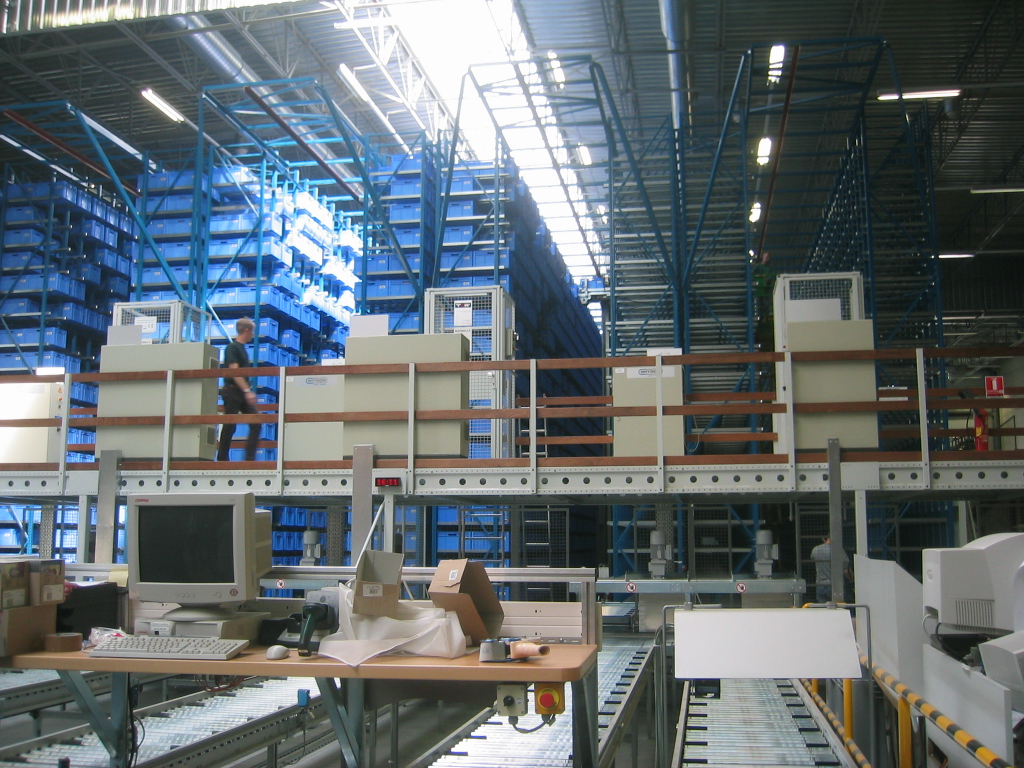
Warehouse automation is no longer priced as a distant technology bet. The market already accepts the basic thesis: labor is expensive, fulfillment expectations are tight, and more distribution centers need machines to handle storage, picking, routing, sortation, and replenishment. The new question is narrower and more investable: which vendors and customers can turn that demand into uptime, not just installed hardware.
That distinction matters because the order book is recovering before the operating proof is uniform. Interact Analysis says warehouse automation order intake rose 7% year over year in 2025, helped by rising steel and labor costs and by large facility investments from retailers, while its global long-run order-growth forecast averages about 6% annually from 2025 to 2030.[3] That is a decent backdrop, but it is not a free multiple. If project values rise because inputs are dearer, investors need to separate real volume from price inflation. If a few large customers carry order intake, they also concentrate execution risk.
The priced view is simple: automation sells because wages, availability, accuracy, and speed keep pressuring warehouse economics. BLS data show average hourly earnings in transportation and warehousing at $32.48 in May 2026, up from $31.37 a year earlier, while warehousing and storage itself was $26.62 in April 2026 versus $25.46 in May 2025.[4] Labor is not the only cost in a distribution center, but it is the line item that makes the payback spreadsheet emotionally easy to sell.
The new signal is that buyers are becoming more disciplined. MHI and Deloitte's 2026 supply-chain report release says 56% of organizations expect to increase supply-chain innovation spending, 52% plan to spend more than $1 million, and 17% plan to spend more than $10 million. It also says robotics and automation rank behind AI as the second most disruptive supply-chain technology, with 39% rating the impact as significant or greater.[5] That sounds bullish. It also means customers are no longer treating automation like a pilot project. They are asking it to carry real operating risk.
Why the order recovery is real
AutoStore gives the cleanest public read on the modular storage-and-retrieval side. In Q1 2026, it reported $165.8 million of revenue, up 92.9% year over year against an unusually weak Q1 2025, and $179.4 million of order intake, up 27.0% year over year. Its gross margin was 72.7%, adjusted EBITDA margin 44.0%, cash conversion 81.9%, and order backlog rose to $570.6 million.[1] Those are not distressed-cycle numbers. They show that a standardized automation platform can still produce software-like margins when the shipment and installation cadence recovers.
Symbotic shows the heavier end-to-end systems version. For the quarter ended March 28, 2026, it reported $676 million of revenue, up 23% year over year, $9 million of net income after a loss in the prior-year quarter, and $78 million of adjusted EBITDA, more than double the year-earlier level. Management also guided Q3 fiscal 2026 revenue to $700 million to $720 million, with adjusted EBITDA of $80 million to $85 million, and said systems in deployment had risen to 70.[2] That is the other side of the theme: large automated systems can scale revenue quickly once projects move through deployment.
Taken together, those two companies explain why warehouse automation remains an investable theme. AutoStore points to repeatable, compact goods-to-person density. Symbotic points to large networks where robotics, software, case handling, and customer-specific workflows become one integrated capital project. Interact Analysis' order data supply the industry frame. The demand is visible; the product categories are not imaginary; customers are still spending.
But the equity question has moved beyond "will warehouses automate?" It is "how much operating friction sits between order intake and cash conversion?"
The payback chain has four weak links
The first weak link is installation rhythm. An automation order is not revenue at the moment a customer signs. It becomes revenue through design, site readiness, equipment delivery, integration, testing, acceptance, and ramp. AutoStore's backlog definition is useful here: backlog is order intake not yet shipped and not yet recognized as revenue, with revenue recognized on shipment or over time depending on the model.[1] In plain English, the backlog is a promise with a construction schedule attached. If buildings, integrators, software configuration, or customer labor readiness slip, recognition slips too.
The second weak link is uptime. A manual warehouse can be inefficient and still improvise. A highly automated building concentrates process risk. When goods-to-person stations, shuttles, lifts, conveyors, sorters, vision systems, and warehouse management software work, the labor saving is obvious. When they stall, the site loses not only machine output but also the manual flexibility it redesigned away. This is why the strongest automation vendors are not selling machines alone. They are selling monitoring, service, spare parts, upgrades, simulation, and operating playbooks.
The third weak link is customer mix. Interact Analysis notes that large facility investments by retail giants helped 2025 order intake, while grocery distribution centers should keep expanding but slow in the Americas as big programs approach completion.[3] That matters for valuation. A market carried by mega-projects can look healthy right up until a few buying cycles mature. Broader adoption across general merchandise, durable manufacturing, food and beverage, third-party logistics, and mid-sized warehouses would be a stronger signal than another single-customer wave.
The fourth weak link is the business case itself. Higher wages make automation more attractive, but rising steel, equipment, software, and capital costs raise the hurdle rate at the same time. MHI's release explicitly lists rising cost of capital among the top 2026 supply-chain trends, while Interact Analysis says rising steel and labor costs inflated project values.[3][5] The same inflation that helps vendors book larger orders can make buyers demand faster, clearer payback.
The counterweight: automation can overfit the last warehouse
The strongest bear case is not that robots fail. It is that buyers overfit automation to a demand pattern, building design, or customer promise that changes before the payback arrives.
E-commerce demand is still structurally larger than it was a decade ago, but fulfillment networks are less naive now. Retailers have learned that speed, inventory depth, returns handling, and local availability all interact. A system optimized for one order profile may be less attractive if the customer shifts SKU mix, delivery promise, store replenishment role, or outsourcing strategy. Automated storage is powerful when the problem is stable enough for density and repeatability. It is less forgiving when the site needs to absorb major process redesigns every year.
That is why the best public data in the sector should be read with a time lag. AutoStore's high margins are attractive, but the deeper proof is whether order intake keeps broadening after the weak 2025 comparison is gone.[1] Symbotic's revenue growth is impressive, but the deeper proof is whether deployment count, margin, and cash stay aligned as more systems move from buildout into everyday production.[2] A vendor can be right about the direction of automation and still disappoint if the deployment engine outruns service capacity.
What would make the theme deserve a premium
The premium case requires three things at once.
First, automation vendors need repeatable deployment. That means fewer bespoke project surprises, faster site commissioning, more standardized software, and a service organization that can support a growing installed base without letting field costs consume gross margin. AutoStore's standardized product language and Symbotic's rising deployment count both point in that direction, but investors should keep demanding evidence.[1][2]
Second, customers need multi-site confidence. One showcase distribution center proves technical viability. A regional or national rollout proves economic trust. The MHI/Deloitte spending data suggest companies are still increasing innovation budgets, but the practical watch item is whether those budgets become fleet-level automation programs rather than scattered proof-of-concepts.[5]
Third, the industry needs broader demand than retail mega-builds. Interact Analysis' forecast of about 6% global annual growth through 2030 is investable if it comes from multiple verticals and regions. It is more fragile if it depends mainly on a handful of large North American retail and grocery programs.[3]
Falsifier
This thesis is wrong if order recovery stays healthy while uptime and deployment problems remain contained. Concretely, if AutoStore keeps backlog above roughly the $570 million Q1 level while holding EBITDA margins near the mid-40s, Symbotic keeps adding systems without margin giveback, and industry order growth broadens beyond large retail projects, then the market is right to price warehouse automation as a durable productivity stack rather than a lumpy capital-equipment cycle.[1][2][3]
The bearish falsifier runs the other way: backlog grows, but cash conversion and margins weaken because projects take longer, customer acceptance slips, spare-parts and service costs rise, or buyers pause after the first wave of facilities. In that case, automation still wins operationally over the long run, but public-market returns get taxed by timing and execution.
Watchlist
- July 2, 2026 BLS labor update: wage pressure is the simplest input in the buyer payback model. If warehousing wages flatten while capital costs stay high, the urgency of some projects may soften.[4]
- AutoStore Q2 2026 report: watch book-to-bill, backlog, adjusted EBITDA margin, and whether Q1's order recovery survives the easy comparison.[1]
- Symbotic Q3 fiscal 2026 results: management guided $700 million to $720 million of revenue and $80 million to $85 million of adjusted EBITDA; the quality test is whether deployment growth and margin expansion arrive together.[2]
- Next Interact Analysis order-intake readout: the key signal is not only growth rate, but whether orders come from a wider customer base instead of a few large facilities.[3]
The practical conclusion is that warehouse automation has moved from concept risk to operations risk. Labor relief is priced. Faster fulfillment is priced. Resilience is priced. What is not fully priced is the discipline required after the sale: deploy the system cleanly, keep it running, prove the labor math, and make the next site easier than the last one.
Sources
- AutoStore, Q1 2026 Report - revenue, order intake, margins, cash conversion, backlog, and backlog definition.
- Symbotic, "Symbotic Reports Second Quarter Fiscal Year 2026 Results" (May 6, 2026) - revenue, net income, adjusted EBITDA, systems in deployment, and Q3 guidance.
- Interact Analysis, "Warehouse automation order intake up by 7%" (February 23, 2026) - 2025 order-intake growth, steel and labor cost effects, vertical commentary, and 2025-2030 growth forecast.
- U.S. Bureau of Labor Statistics, "Employment and Earnings Table B-3a" - May 2026 transportation and warehousing earnings and warehousing/storage earnings table.
- Business Wire / MHI, "New MHI and Deloitte Report Finds AI is Biggest Disruptor of Supply Chains Over the Next Decade" (April 15, 2026) - 2026 MHI Annual Industry Report release, innovation spending plans, robotics/automation impact, and supply-chain trend list.
- Wikimedia Commons, "File:Automatisches Kleinteilelager.jpg" - source page for the article photograph of an automatic small-parts warehouse.