The market already understands the simple story: U.S. HVAC equipment had to move toward lower-GWP refrigerants, so manufacturers and distributors had a regulatory replacement cycle. The more useful finance question is narrower. Priced is the mandate. New is whether distributors can convert a one-time product reset into inventory turns, contractor loyalty, and cash flow rather than letting the transition sit on the balance sheet as expensive stock.
That is why the 2025 low-GWP refrigerant transition is a working-capital story before it is a growth story. EPA's Technology Transitions program put a 700 GWP limit on many residential and light-commercial air-conditioning and heat-pump products from January 1, 2025, and the broader AIM Act framework phases down HFC production and consumption over time.[1][2] Manufacturers then had to redesign equipment around A2L refrigerants such as R-454B and R-32, while distributors had to carry old and new systems, train contractors, update parts catalogs, and manage customer confusion in the middle of a normal replacement season.[3][4][5]
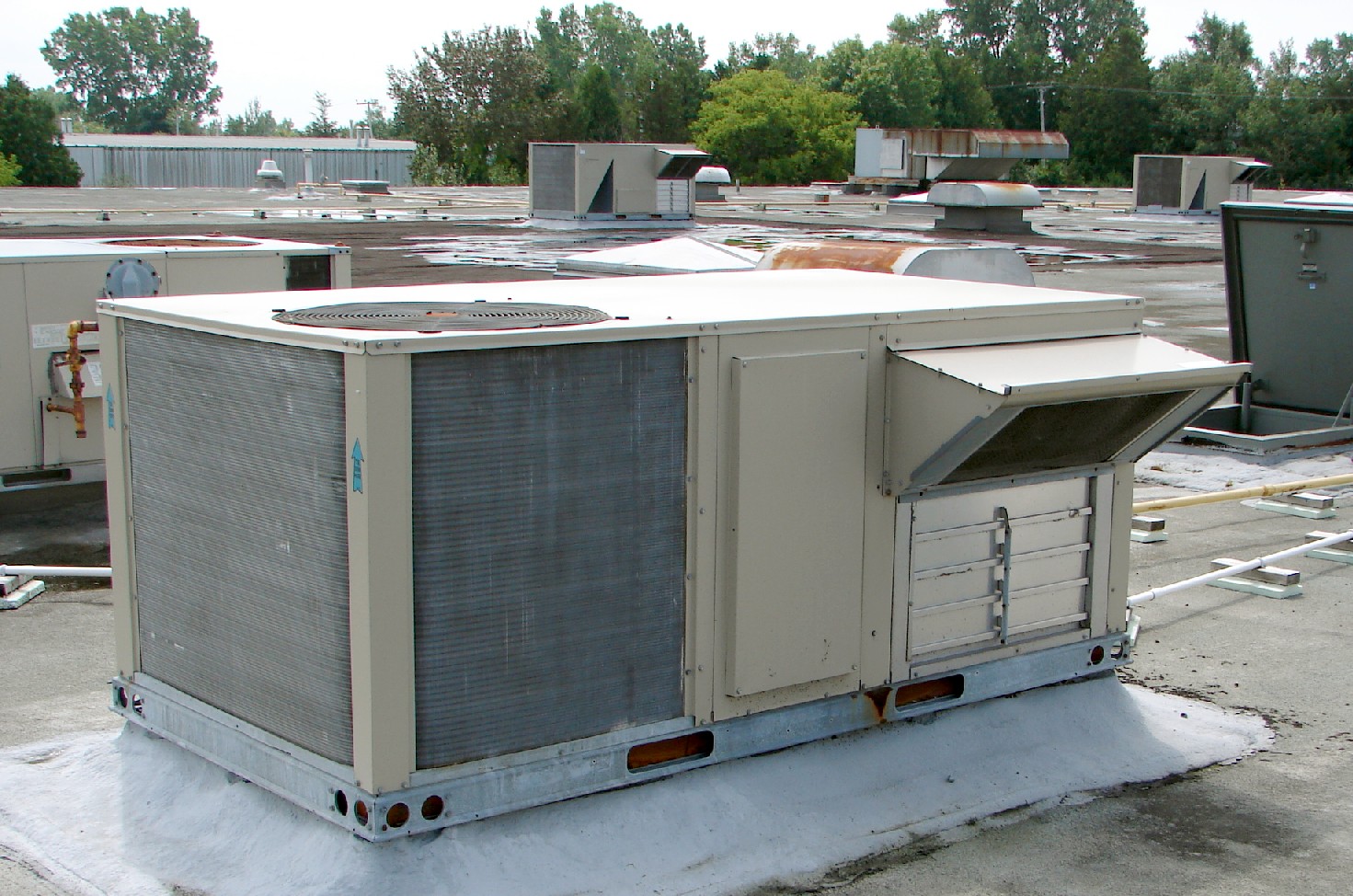
Image context: the cover uses a real photograph of rooftop packaged HVAC units, not a chart or symbolic climate graphic. That matters because the investment issue lives in physical equipment conversion: which units can be sold, which parts match, which refrigerant is available, and how fast warehouses can move through transition inventory.[6]
The Mechanism
The regulatory mechanism is straightforward but operationally awkward. EPA lists a 700 GWP limit and a January 1, 2025 manufacture-and-import compliance date for stationary residential and light-commercial air-conditioning and heat-pump products. It also lists a 700 GWP limit for many stationary air-conditioning and heat-pump systems, with transition details for systems assembled from components made before the cutoff.[1] The rule does not merely tell manufacturers to use a cleaner chemical. It changes the compatibility map across compressors, coils, sensors, cylinders, safety procedures, labels, and service training.
Carrier's homeowner-facing explanation shows why this is not a drop-in substitution. R-454B is a blend of R-32 and R-1234yf, is classified as A2L, and has a much lower GWP than R-410A. Carrier also states that R-410A systems cannot simply be refilled with R-454B because the systems have different pressure and safety requirements.[5] For investors, that incompatibility is the hinge. A normal replacement cycle lets distributors lean on familiar parts and contractor habits. A refrigerant transition forces the channel to sell a new system family while still servicing the installed base.
That creates both margin opportunity and cash risk. The opportunity is that contractors need trusted distributors more when product matching becomes complicated. The risk is that distributors can over-order transition inventory, carry too many slow-moving SKUs, or lose sales when a contractor cannot get the exact unit, coil, cylinder, or accessory needed to finish a job.
Six Anchors
- 700 GWP: EPA's sector table sets this as the relevant limit for many residential and light-commercial AC and heat-pump products and systems.[1]
- January 1, 2025: the key U.S. product-transition date for manufacture and import in those categories.[1]
- 85% by 2036: the AIM Act framework mandates an 85% HFC phasedown by 2036, so the 2025 equipment change is part of a longer refrigerant supply constraint, not a one-day rule event.[2]
- Over $1 billion and nearly 55%: Watsco said the mandate required conversion of over $1 billion of inventory and impacted nearly 55% of products across more than 650 U.S. locations.[3]
- $2.1 billion to $1.4 billion: Watsco said inventory peaked at $2.1 billion during 2025 and fell 30% to $1.4 billion by December 31, 2025.[4]
- $570 million and $400 million: the same update reported $570 million of operating cash flow for 2025 and a record $400 million in the fourth quarter as inventory came down.[4]
Those numbers separate the investment issue from the headline. A regulation that affects 55% of a distributor's product flow can create demand, but it can also soak up cash. The cash-flow signal arrives only when the distributor proves it can move the new inventory, reduce the old inventory, and keep contractors from defecting during the messy middle.
Why Distributors Matter
HVAC distribution often looks boring from the outside because the product is familiar and local. That is precisely why the refrigerant transition matters. The channel's real product is not only equipment; it is availability, match-up knowledge, branch density, warranty navigation, contractor credit, and emergency replacement speed.
Watsco's 2025 update is a useful case because it turns the transition into measurable channel work. The company described additions of more than 10,000 SKUs related to the A2L launch, with product data, dimensions, capacities, literature, warranty information, regulatory match-ups, and bills of material feeding its digital tools. It also said its authenticated HVAC Pro+ app user base rose 15% to about 73,000 users, while e-commerce sales reached about $2.5 billion, or 35% of sales.[4]
That is not just technology marketing. In a transition year, search quality and match-up data can decide whether a contractor chooses the distributor that can answer the job-site question fastest. The distributor that knows which coil pairs with which outdoor unit, which safety feature applies, and which replacement part is compatible with the installed base can defend share even if the underlying equipment is available from several brands.
The counterpoint is concentration. Watsco's 2025 10-K says its top ten suppliers represented 85% of purchases, and Carrier and affiliates accounted for 62% of inventory purchases in 2025.[7] That can be a strength if the leading supplier executes well and gives the distributor a strong product lane. It can also be a constraint if the supplier has product availability, pricing, or transition-friction problems. In a refrigerant reset, dependence on a dominant supplier is not automatically bad, but it raises the importance of fill rates and mix quality.
The Margin Path
The bull case is not that every home suddenly needs a new HVAC system. Existing R-410A systems remain serviceable, and replacement demand still depends on age, weather, housing turnover, consumer financing, contractor availability, and household budgets. The cleaner bull case is that the transition raises the value of distributors that can make replacement less confusing.
That value can show up in three places. First, gross margin can hold if new equipment and parts carry better mix and if contractors value availability more than the lowest sticker price. Second, working capital can improve after the transition stock build unwinds. Third, digital tools can become stickier because contractors need product data, regulatory match-ups, and reorder workflows more during a format change than during a normal season.
The timing matters. A distributor can report good gross margin while still burning cash if inventory is too high. Conversely, a post-transition inventory drawdown can flatter cash flow even if underlying demand is not accelerating. The better test is the combination: stable gross margin, falling inventory, normalizing service levels, and no unusual customer attrition. Watsco's fourth-quarter cash-flow release is notable because it points to the inventory unwind side of the equation, but the 2026 proof still has to come from revenue quality and product availability across the cooling season.[4]
The Counterweight
The strongest bear case is that the refrigerant transition was a pull-forward, not a durable upgrade. Contractors and homeowners may have bought ahead of rule uncertainty, distributors may have carried too much stock, and 2026 could reveal softer unit demand once the channel has normalized. If replacement cycles slow because consumers defer large-ticket purchases, the transition alone will not save volume.
There is also a service-market complication. Because R-410A systems cannot simply be converted to R-454B, the installed base creates a long tail of old-system service demand.[5] That can support parts and refrigerant sales, but it also keeps complexity high. A distributor has to carry enough old-system support without letting legacy inventory crowd out the new platform. The rule creates a bridge period, not an instant fleet replacement.
The broader HFC phasedown adds another risk. As allowances decline over time, refrigerant availability and pricing can become a recurring operating variable rather than a one-time transition issue.[2] That matters for contractors, homeowners, and distributors because service economics depend on both equipment cost and refrigerant cost.
Falsifier
The thesis fails if the 2025 inventory unwind proves to be a one-quarter cash release rather than a sign of healthier channel conversion. Warning signs would include renewed inventory build without matching revenue growth, gross-margin pressure from discounting old equipment, contractor complaints about unavailable A2L parts or refrigerant, or lower customer retention despite better digital tools.
The thesis also fails if regulation becomes the only growth explanation. A good distributor should show that the transition improved its operating position: more contractor engagement, cleaner SKU data, better branch productivity, and cash conversion after the stock build. If results reduce to "the rule forced replacement," the trade has already passed.
Watchlist
- 2026 cooling-season inventory: watch whether distributors can keep inventory lower without losing service levels.
- A2L attachment and service parts: the cleaner signal is not only new outdoor units, but parts, coils, cylinders, sensors, and compatible accessories moving through the channel.
- Gross margin versus cash flow: margin that comes with rising inventory is less valuable than margin that survives a lower-stock model.
- Supplier concentration: the Carrier share in Watsco's purchases makes product availability and transition execution a direct risk variable, not a footnote.[7]
The investable conclusion is deliberately practical. The refrigerant transition is not a magic HVAC demand cycle. It is a forced product-format change that rewards distributors with clean data, branch discipline, supplier access, and contractor trust. The market can price the regulation quickly. It takes longer to prove inventory speed.
Sources
- U.S. Environmental Protection Agency, "Technology Transitions HFC Restrictions by Sector" - sector limits, 700 GWP thresholds, and compliance dates for HVAC and refrigeration categories.
- Federal Register, "Phasedown of Hydrofluorocarbons: Allowance Allocation Methodology for 2024 and Later Years" - AIM Act allowance framework and 85% HFC phasedown mandate by 2036.
- Watsco, SEC Exhibit 99.1, "Watsco Reports Record Third Quarter Gross Profit, Gross Margin and Operating Cash Flow in Challenging Market Conditions" - A2L transition scope, inventory conversion, product impact, locations, and transition-period volatility.
- Watsco, SEC Exhibit 99.1, "Watsco Reports Record Full-Year Gross Margin, Meets Inventory Reduction Target and Generates Record 4th Quarter Cash Flow in Challenging Market Conditions" - 2025 inventory peak and drawdown, operating cash flow, A2L SKU additions, and e-commerce metrics.
- Carrier, "Understanding R-454B Refrigerant" - R-454B composition, A2L classification, GWP comparison with R-410A, and non-compatibility with existing R-410A systems.
- Wikimedia Commons, "File:Rooftop Packaged Units.JPG" - P199 photograph of rooftop packaged air-conditioning and heating units used as the article image.
- Watsco, 2025 Form 10-K, SEC filing - supplier concentration disclosure, including top-ten supplier share and Carrier affiliate purchase share.