The Union Pacific-Norfolk Southern deal is no longer just a map story. Priced is the intuitive appeal of one coast-to-coast railroad: fewer handoffs, broader shipper coverage, and a larger platform for operating leverage. New is that the first regulatory checkpoint already showed what investors have to underwrite next: the Surface Transportation Board rejected the initial application as incomplete, specifically asking for fuller market-share and merger-impact analysis before the merits even begin.[1][2]
That makes the setup a scenario analysis rather than a simple merger-arbitrage note. Union Pacific and Norfolk Southern announced an agreement in July 2025 that valued Norfolk Southern at an implied $320 per share, an $85 billion enterprise value, and a combined enterprise value above $250 billion.[1] The companies also pointed to about $2.75 billion of annualized synergy opportunity and a network spanning more than 50,000 route miles, 43 states, and roughly 100 ports.[1] Those numbers are large enough to matter. They are also large enough to invite a regulator to ask who gains market power, which lanes lose competitive tension, and how much of the promised service improvement belongs to shippers rather than shareholders.[2]
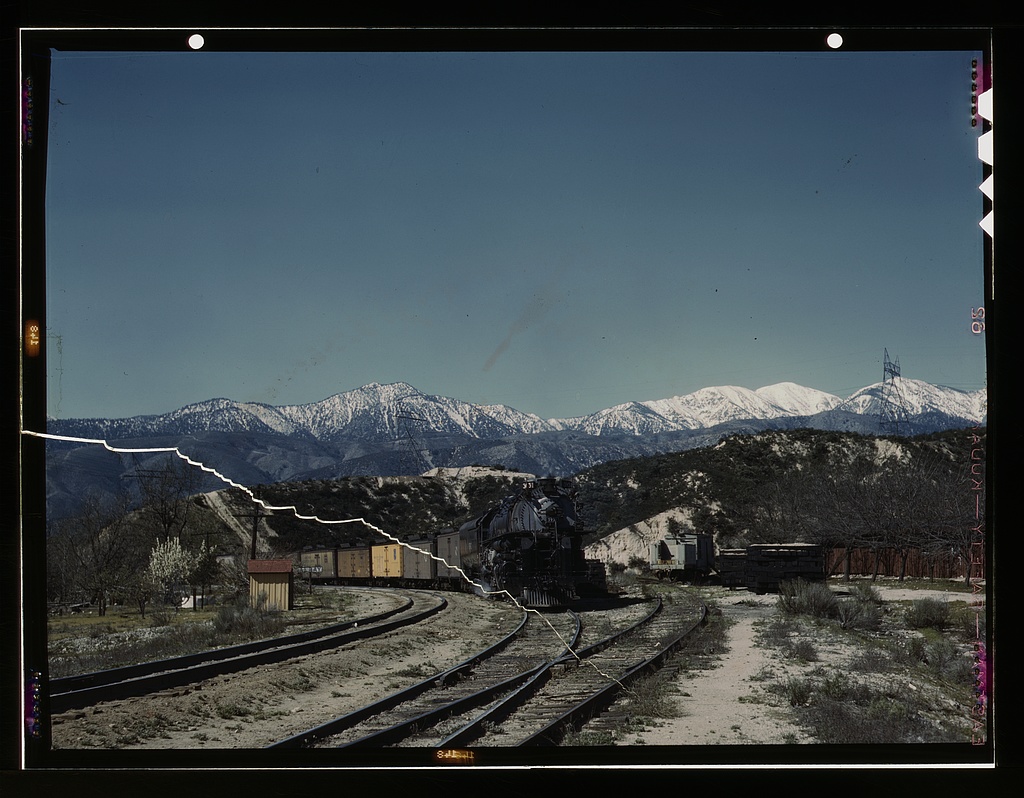
Image context: the cover uses Jack Delano's 1943 Library of Congress photograph of a Union Pacific freight train in Cajon Pass. It is archival, real, and operationally relevant: a railroad merger is finally about track, sidings, route geometry, and freight moving through constrained corridors, not an abstract stock chart.[6]
The Base Case: Approval, But On A Slower And More Expensive Clock
The base case is not that the transaction dies. It is that the approval path stretches, the application becomes more data-heavy, and the headline synergy number gets discounted until the STB has a complete competitive record. The January 16, 2026 STB decision matters because it was procedural and still serious. The Board said the application lacked required "full system" impact analyses, including projected market shares that account for growth, diversions, and merger-influenced market changes.[2] In financial terms, that shifts the deal from announcement math to proof math.
Union Pacific enters that process from a strong operating base. In 2025, it reported full-year diluted EPS of $11.98, adjusted diluted EPS of $11.66, a full-year operating ratio of 59.8%, an adjusted operating ratio of 59.3%, and return on invested capital of 16.3%.[3] Management's 2026 outlook also calls for pricing dollars in excess of inflation dollars, operating-ratio improvement, mid-single-digit EPS growth, and a $3.3 billion capital plan.[3] That gives Union Pacific room to keep funding the process and still argue from operational strength.
Norfolk Southern is also not a distressed seller. In 2025, it reported railway operating revenues of $12.2 billion, operating ratio improvement to 64.2% from 66.4%, adjusted operating ratio improvement to 65.0%, and more than $215 million of annual productivity savings.[4] The operating gap between the two companies is part of the synergy case. If Union Pacific's discipline can be applied across a larger network, the financial bridge has substance.
The investor problem is timing. A merger that needs more filings, more shipper evidence, more corridor analysis, and probably more remedies has a lower present value than the same synergy table closing on a clean timetable. AP's report on shareholder support captured the same split: shareholders backed the deal, but STB approval remains the decisive condition before completion.[5] The base-case rerate therefore comes in stages: first a complete application, then a credible procedural schedule, then evidence that remedies do not consume the operating upside.
The Upside Case: Interchange Savings Become Service, Not Just Cost Takeout
The best version of the deal is bigger than back-office cost cutting. A coast-to-coast network can reduce interchange friction, simplify accountability for shippers, open new single-line lanes, and make rail more competitive against long-haul trucking on selected corridors.[1] That is the part equity investors should care about most, because volume and service quality compound better than one-time expense cuts.
In that upside scenario, the $2.75 billion synergy opportunity is not only a corporate overhead number.[1] It comes through fewer handoffs, better car-cycle consistency, more reliable intermodal service, and stronger industrial routing for commodities that now cross networks. The companies' own examples of steel, food, lumber, plastics, copper, and soda ash are promotional, but the underlying point is real: rail economics improve when cars spend less time waiting for another carrier's connection and more time earning revenue on a through route.[1]
The upside case also depends on Norfolk Southern continuing its self-help before the transaction closes. Its 2025 adjusted operating ratio of 65.0% still sits well above Union Pacific's adjusted 59.3%.[3][4] If Norfolk Southern narrows that gap independently, Union Pacific buys a healthier asset and the combined railroad begins from a stronger service baseline. If self-help stalls, the merger becomes more of a turnaround layered onto an integration program, which is a worse risk-adjusted trade.
The Downside Case: Market-Power Scrutiny Eats The Multiple
The downside case starts with the STB's own language. The Board did not reject the December 2025 application because it had already decided the merger was bad. It rejected it because the application did not include the required projected market-share analysis. But the decision also stated the reason those projections matter: any railroad combination carries a risk that the merged carrier could acquire and exploit increased market power.[2]
That is the valuation risk. If the STB review turns into a lane-by-lane debate over captive shippers, bottleneck pricing, reciprocal switching, gateway preservation, or divestiture-like commitments, the market can no longer capitalize the full synergy number. Remedies can be economically rational and still reduce shareholder upside. They can preserve service commitments for shippers while pushing some integration benefit into operating requirements rather than margin expansion.
There is also deal-cost drag. Norfolk Southern's fourth quarter included merger-related expenses and Eastern Ohio incident effects; adjusted operating ratio was 65.3% versus a reported 68.5%.[4] Those adjustments are explainable, but they show how quickly unusual items can cloud the operating read. If 2026 becomes a year of legal, advisory, labor, and integration planning expense while freight demand stays muted, investors may start valuing the deal as an option rather than a base-case asset.
Six Numeric Anchors
- Deal value: Norfolk Southern was valued at an implied $320 per share and $85 billion enterprise value, creating a combined enterprise above $250 billion.[1]
- Synergy claim: the companies cite about $2.75 billion of annualized synergy opportunity.[1]
- Network scale: the proposed railroad would span more than 50,000 route miles, 43 states, and roughly 100 ports.[1]
- Union Pacific baseline: 2025 adjusted operating ratio was 59.3%, with ROIC of 16.3% and a 2026 capital plan of $3.3 billion.[3]
- Norfolk Southern baseline: 2025 adjusted operating ratio was 65.0%, full-year railway operating revenue was $12.2 billion, and productivity savings exceeded $215 million.[4]
- Regulatory gate: the STB rejected the December 19, 2025 application on January 16, 2026 as incomplete, before reaching the ultimate public-interest merits.[2]
Falsifier
The cautious base case is wrong if the revised application quickly satisfies the STB, shipper opposition stays narrow, and the companies preserve most of the $2.75 billion synergy target without material gateway, pricing, or service remedies. In that case, the market can move from procedural discount to synergy capitalization faster than this scenario analysis assumes.[1][2]
The bullish case is wrong if the next application still fails to quantify market shares and diversions convincingly, if major shipper groups press for heavy conditions, or if Norfolk Southern's operating improvement stalls before approval. Under those conditions, the deal may remain possible, but the shareholder payoff would look smaller, later, and more conditional.
Watchlist
- Revised STB application: the key first event is whether the companies cure the missing full-system impact analysis and projected market-share deficiencies identified by the Board.[2]
- Shipper and competitor filings: watch whether opposition focuses on narrow safeguards or broad claims that the combined railroad could control too much lane-level pricing power.
- Norfolk Southern operating ratio: continued movement below the 65.0% adjusted 2025 baseline would make the asset cleaner before closing; slippage would make integration look heavier.[4]
- Union Pacific 2026 guidance delivery: the deal case weakens if merger work distracts from the company's own mid-single-digit EPS growth, operating-ratio improvement, and $3.3 billion capital plan.[3]
Takeaway
The UP-NS merger has a real industrial logic, but the stock-market logic is now gated by evidence. A single-line transcontinental network can plausibly reduce interchange friction and create a larger operating platform.[1] The STB's first response says investors should not treat that map as self-proving. The next phase has to translate route scale into measurable competition effects, service benefits, and remedies that leave enough economics for shareholders.
For now, the cleanest read is conditional: approval remains plausible, synergy remains valuable, and the regulatory discount deserves to stay in the model until the application proves the merger does more than redraw the railroad map.
Sources
- Union Pacific and Norfolk Southern, "Union Pacific and Norfolk Southern to Create America's First Transcontinental Railroad" (July 29, 2025).
- Surface Transportation Board, "STB Finds UP-NS Merger Application is Incomplete" (January 16, 2026).
- Union Pacific, "Union Pacific Reports Fourth Quarter and Full Year 2025 Results" (January 27, 2026).
- Norfolk Southern, "Norfolk Southern reports fourth quarter and full year 2025 results" (January 29, 2026).
- Associated Press, "Shareholders of Union Pacific, Norfolk Southern support $85 billion rail merger" (November 2025).
- Wikimedia Commons, "File:A east bound Union Pacific railroad freight train waiting in a siding, Alray1a34754v.jpg" (Jack Delano photograph, March 1943; Library of Congress collection).