Elevator and escalator makers are already priced less like ordinary machinery vendors and more like installed-base service compounders. The new question for 2026 is narrower: can modernization and maintenance keep carrying earnings while the China new-equipment market stays weak and labor-heavy service work absorbs wage inflation?[1][2][3]
That gap matters because the best part of the model is not the first installation. A new elevator creates the original customer relationship, but the durable economics arrive later through inspections, repairs, spare parts, code-driven upgrades, energy-efficiency retrofits, and full modernization projects. Otis says it maintains roughly 2.5 million customer units worldwide, and its 2025 results show why that portfolio matters: Service produced $9.4 billion of net sales at a 25.1% segment operating margin, while New Equipment produced $5.0 billion at a 4.8% margin.[1] The installed base is the engine; new construction is the feeder.
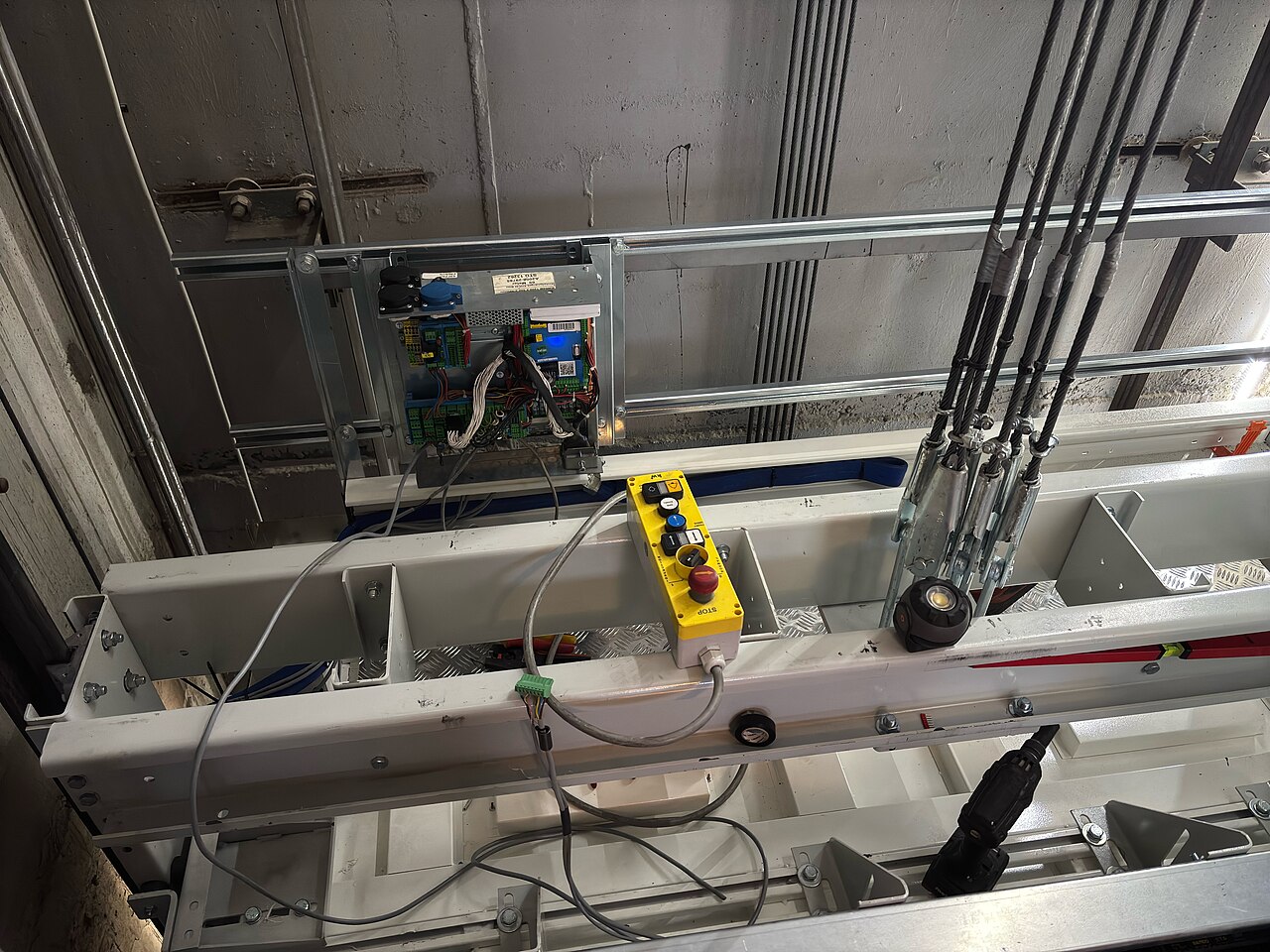
Image context: the cover uses a real maintenance photograph rather than a skyline or abstract infrastructure image because the investment issue is inside the shaft. The thesis turns on recurring field work, upgrade labor, and the economics that follow an installed unit long after a building opens.[5]
Mechanism first: the installed base changes the margin math
The elevator business looks cyclical when viewed from the construction site. New towers, apartment blocks, transit stations, and office renovations drive order intake for new equipment, and that exposure still matters. China has made the risk visible: Otis reported a greater than 20% decline in China New Equipment sales in the fourth quarter of 2025, while KONE said China's New Building Solutions market is expected to decline clearly again in 2026.[1][2]
The reason the sector still earns a higher-quality reading is that the sale does not end at installation. Once equipment is in a building, owners need maintenance contracts, callout response, safety work, parts, controller upgrades, door replacements, cabin refreshes, dispatch software, and compliance upgrades. Otis describes its Service segment as maintenance and repair work on its own and other manufacturers' units, plus modernization that upgrades elevators and escalators already in use.[4] Those services are operationally local, labor-intensive, and sticky. A building can delay a cosmetic refurbishment; it cannot let vertical transport fail repeatedly without angering tenants, shoppers, hotel guests, or transit riders.
Otis makes the split unusually clear. In 2025, total net sales rose only 1% to $14.431 billion, but the mix did the work: Service organic sales rose 5%, while New Equipment organic sales fell 7%.[1] Gross margin still expanded by 40 basis points because Service sales grew while New Equipment sales fell, and the Service margin was more than five times the New Equipment margin.[1] That is the whole finance story in miniature: the cycle can hurt, but mix can still protect the income statement if the installed base keeps converting.
KONE is trying to tell the same story in European language. Its 2025 sales reached EUR11.245 billion, adjusted EBIT margin improved to 12.2%, and management's 2026 outlook calls for 2-6% comparable-currency sales growth with an adjusted EBIT margin of 12.3-13.0%.[2] The stated drivers are Service and Modernization, a solid order book, product-cost reductions, and performance initiatives; the stated headwind is the weak New Building Solutions market in China.[2] That is not a clean construction recovery story. It is a mix repair story.
Schindler adds a third check. Its 2025 revenue was CHF10.947 billion, operating profit reached CHF1.384 billion, and reported EBIT margin improved to 12.6%, with adjusted EBIT margin at 13.3%.[3] The company framed the year as the completion of operational recovery and the move toward profitable growth.[3] For investors, that wording matters less as a slogan than as a hurdle: the margin recovery has to become repeatable through portfolio quality, not just through a one-year efficiency reset.
Five numeric anchors
- Otis is already more service than equipment: 2025 Service net sales were $9.442 billion, compared with $4.989 billion in New Equipment.[1]
- The margin gap is the thesis: Otis Service segment margin was 25.1% in 2025, while New Equipment segment margin was 4.8%.[1]
- Modernization is the near-term proof point: Otis said fourth-quarter modernization orders rose 43% at constant currency and modernization backlog rose 34%, or 30% at constant currency.[1]
- KONE's 2026 guide depends on mix: management expects 2-6% sales growth at comparable exchange rates and an adjusted EBIT margin of 12.3-13.0%, driven by Service and Modernization against a China headwind.[2]
- Schindler has reset the margin bar: 2025 revenue reached CHF10.947 billion, reported EBIT margin was 12.6%, and adjusted EBIT margin was 13.3%.[3]
These anchors make the thesis more bounded than "elevators are defensive." The defensive quality is real only if service attachment, modernization pricing, and field productivity keep showing up in reported margins. Without that conversion, the installed-base story becomes a pleasant narrative wrapped around a still-cyclical equipment business.
Strongest counterweight
The strongest pushback is that investors have already learned this lesson. Otis, KONE, Schindler, and peers have spent years teaching the market that service contracts, digital monitoring, modernization, and installed-base density deserve better multiples than new-equipment cyclicality.[1][2][3] If the sector is already valued on that logic, then another service-led note risks restating consensus.
That objection has force. The reason the file remains open is that 2026 is testing the quality of the mix under less forgiving conditions. China new installations remain soft. Wage inflation still pressures field labor. Tariffs and input costs still show up in company risk language and margin bridges. New-equipment pricing can stay competitive even when service pricing is healthier.[1][2] A service compounder deserves a premium only when the service layer is large enough, priced well enough, and productive enough to absorb those frictions.
There is also a capital-allocation boundary. The business generates attractive cash when service work expands, but modernization is not pure software. It requires technicians, parts availability, project scheduling, customer access, and execution discipline inside working buildings. A large modernization backlog is useful evidence, but it is not earnings until it converts without margin leakage.
Falsifier
This framework breaks if modernization backlog keeps growing while reported Service margins flatten or fall, or if weak New Equipment demand spreads beyond China strongly enough that installation under-absorption overwhelms the installed-base benefit. It also breaks if wage inflation and tariff costs push service-price increases into customer resistance rather than margin expansion.[1][2]
Watchlist
- Otis 2026 quarterly results: watch whether organic Service growth stays in the mid-to-high-single-digit lane that management guided for 2026, and whether New Equipment remains low-single-digit down to flat rather than worsening.[1]
- KONE's 2026 margin path: the 12.3-13.0% adjusted EBIT margin guide is the cleanest test of whether Service and Modernization can offset China and wage pressure.[2]
- Schindler's next margin update: after a 13.3% adjusted EBIT margin in 2025, the question is whether profitable-growth language becomes sustained margin delivery.[3]
- Modernization conversion across the group: order growth and backlog matter, but the more important signal is whether those projects show up as service-heavy revenue and cash rather than as low-margin installation congestion.[1][2][3]
Takeaway
The elevator sector's premium case is still intact, but the easy version is already priced. These companies are not just selling boxes into buildings; they are maintaining, repairing, and upgrading vertical-transport networks that owners cannot let fail.[1][2][3] The 2026 spread sits in conversion: modernization backlog, service pricing, and field productivity have to keep overpowering weak China new equipment, labor inflation, and installation-margin drag. That is where the installed-base story becomes earnings, or stops deserving the multiple.
Sources
- Otis Worldwide Corporation, "Otis Reports Fourth Quarter and Full Year 2025 Results" PDF (January 28, 2026).
- KONE Corporation, "Financial Statement Bulletin of KONE Corporation for January-December 2025" (February 6, 2026).
- Schindler Group, "Ad hoc: Annual Results 2025" (February 11, 2026).
- Otis Worldwide Corporation, 2025 Annual Report PDF.
- Wikimedia Commons, "File:Elevator maintenance 2.jpg."