Uniform rental is easy to dismiss as a sleepy service niche until the margins show up. The priced story is that Cintas has turned recurring workplace needs into a route-density machine. The new question is whether the pending UniFirst acquisition can add more density without creating the two things investors should fear most in this model: regulatory delay and integration friction.
Cintas' third quarter of fiscal 2026 made the quality case almost too clean. Revenue rose 8.9% to $2.84 billion, organic revenue growth was 8.2%, gross margin reached an all-time high of 51.0%, and operating income was 23.2% of revenue.[1] Management also raised full-year fiscal 2026 revenue guidance to $11.21 billion-$11.24 billion, excluding the pending UniFirst acquisition.[1] That is not a cyclical rescue story. It is a business already compounding before the deal.
Why The Model Works
The mechanism is not mysterious. Cintas' annual report says Uniform Rental and Facility Services revenue comes mainly from renting corporate-identity uniforms and other garments, including flame-resistant clothing, plus mats, mops, shop towels, restroom supplies, and related rental services.[2] The same filing defines the cost base in physical terms: production expense, delivery expense, and amortization of in-service inventory, including uniforms, mats, shop towels, and ancillary items.[2]
That cost structure explains the premium. Once a route exists, an extra mat, towel program, restroom refill, first-aid cabinet, or garment set can ride along the same customer relationship. The customer is buying appearance, safety, compliance, cleanliness, and convenience. Cintas is selling a repeated service loop whose economics improve when the truck has more high-value stops, the plant has better throughput, and inventory turns without excess replacement.
The fiscal 2025 annual report shows that loop clearly. Uniform Rental and Facility Services revenue rose 6.8% to $7.976 billion, with 7.0% organic growth. Segment gross margin improved to 49.3% from 48.2%, and segment operating income rose to 23.5% of revenue from 22.2%.[2] The report attributes cost improvement to energy efficiency, better use of in-service inventory, and production efficiency gains.[2] In other words, the margin story is not only pricing. It is plant and route discipline.
The labor backdrop helps explain why demand can hold even when macro data are mixed. FRED's BLS JOLTS series showed the accommodation-and-food-services job-openings rate at 4.5% in April 2026 and 5.0% in March.[5] The same sector's hires rate was 5.6% in April 2026, after 6.0% in March.[6] Those are exactly the kinds of high-turnover, high-touch environments where uniforms, floor care, safety supplies, and facility services are operational rather than cosmetic.
Base Case: The Deal Adds Density
The base case is straightforward: Cintas buys UniFirst, keeps the best local relationships, consolidates overlapping service infrastructure carefully, and lets route density do the work. Cintas and UniFirst announced the definitive agreement on March 11, 2026. The deal values UniFirst at about $5.5 billion of enterprise value, with UniFirst shareholders set to receive $155.00 in cash and 0.7720 Cintas shares for each UniFirst share.[4] Cintas expects approximately $375 million of operating cost synergies within four years, including material cost, production expense, service expense, and SG&A.[4]
Those synergy categories fit the model. Material purchasing matters because garments and service products are inventory-heavy. Production expense matters because laundering, sorting, inspection, repair, and distribution need scale. Service expense matters because route overlap can be valuable if customers are retained and truck time is reduced. SG&A matters because regional density should let a larger platform support more revenue without duplicating every back-office layer.
UniFirst's standalone numbers show why Cintas wants the asset but also why execution matters. In the second quarter of fiscal 2026, UniFirst revenue rose 3.4% to $622.5 million, with organic growth of 2.8% in the core uniform and facility service segment. But consolidated operating margin was only 4.2%, down from 5.2%, and adjusted EBITDA margin slipped to 10.7% from 11.4%.[3] UniFirst also cited planned growth and digital-transformation investments, costs tied to strategic and proxy matters, and legal expenses related to an employee matter.[3]
That creates the spread. Cintas is not buying a peer with Cintas-like margins. It is buying route density, customers, local capacity, and a chance to pull a weaker-margin platform into a stronger operating system. The base case works if Cintas can lift service productivity without disrupting customers who are used to UniFirst's routes, plants, uniforms, and account teams.
Upside Case: Route Math Beats The Deal Discount
The upside case is that investors underappreciate how much route-based services can absorb a merger once customer churn is controlled. Cintas already helps more than one million businesses, according to its Q3 release, and management described all three route-based businesses as producing all-time high gross margins in the quarter.[1] If UniFirst adds stops in geographies where Cintas already has plant and service depth, the acquired revenue can become more valuable inside the larger system than it was alone.
The best version of the deal is not a simple headcount-cut story. It is a utilization story. More garments through a plant, more stops per route mile, more cross-sold facility services per customer, and better in-service inventory control can each add a few points of efficiency. In a business already earning more than 50% gross margin at the company level, small operating improvements matter.
The deal could also widen the customer proposition. Cintas' release frames the acquisition around expanded service capabilities, workday solutions, shared technology, and route networks.[4] Those words are easy to treat as merger language, but they are economically specific here. A customer that rents uniforms may also need mats, first-aid replenishment, restroom supplies, fire-protection checks, and safety products. The more categories that fit the same service cadence, the more durable the account can become.
Downside Case: Regulation And Integration Eat The Spread
The downside case starts with the same facts but changes the timing. Cintas expects the deal to close in the second half of calendar 2026, subject to UniFirst shareholder approval and regulatory approvals.[4] The company also lists transaction risks including failure to receive approvals, possible conditions attached to approvals, integration problems, higher completion costs, customer or employee reactions, share dilution, and management distraction.[1]
Those are boilerplate until they meet a route-density model. If regulators require divestitures in overlapping local markets, the most valuable part of the deal could shrink. If customer-service teams are disrupted, the acquired route base can leak before synergies arrive. If integration requires more plant spending, technology work, garment replacement, or retention incentives than expected, the headline $375 million synergy pool may take longer to translate into earnings.
UniFirst's Q2 also gives the downside case teeth. A 4.2% operating margin is not just a number to improve; it is a warning that investment, digital transformation, legal costs, and merger distraction can sit in the income statement at the same time.[3] Cintas can absorb more of that than most buyers, but the market should not treat the deal as free density before closing conditions and early integration signals arrive.
Counterweight
The strongest pushback to caution is that Cintas has already shown the operating quality investors need to see. It produced $1.268 billion of free cash flow through the first nine months of fiscal 2026, returned $1.45 billion to shareholders through buybacks and dividends, and still lifted guidance.[1] The core engine is strong enough that the UniFirst deal does not need to rescue the story.
The strongest pushback to optimism is valuation discipline. A great route business can still overpay for slower-growth density if regulatory remedies, integration costs, or customer churn dilute the synergy math. The correct read is not "uniform rental is boring and safe." It is narrower: the model is excellent when density compounds, and vulnerable when anything forces the network to carry duplicate cost.
Falsifier
This thesis fails if the UniFirst acquisition closes with meaningful divestitures or restrictive conditions, early integration commentary shows customer or employee disruption, and Cintas' route-based gross margins stop expanding despite the added scale. In that branch, the deal would look less like a density unlock and more like a larger but messier service platform.
The bullish falsifier is also clear. If approvals land without material remedies, UniFirst customers stay, Cintas keeps organic growth near the recent high-single-digit run rate, and synergy capture starts without dragging gross margin below the recent 51.0% company-level peak, the market will have been right to price uniform rental as a premium route-density compounder.[1][4]
Watchlist
- Second half of calendar 2026: expected closing window for the UniFirst transaction and the key regulatory checkpoint.[4]
- Cintas fiscal 2026 fourth-quarter results: the next read on whether the pre-deal engine can hold the raised $11.21 billion-$11.24 billion revenue guide.[1]
- Route-based gross margin: the cleanest operating line is whether the all-time-high gross-margin language persists after the deal starts moving from announcement to execution.[1]
- UniFirst customer retention and service continuity: the merger only creates value if routes stay dense while systems, plants, and account teams are combined.[3][4]
The practical investment frame is simple. Cintas has already earned the premium label. Uniform rental is not just garment delivery; it is a local density, inventory, service, and customer-retention machine. The UniFirst deal raises the stakes because it gives Cintas a bigger route map to optimize. It also gives investors a sharper test: whether a high-quality operator can buy density without paying for it twice, once in purchase price and again in integration drag.
Sources
- Cintas Corporation, "Cintas Corporation Announces Fiscal 2026 Third Quarter Results" (March 25, 2026) - revenue, organic growth, gross margin, operating margin, guidance, free cash flow, capital returns, and acquisition-risk language.
- Cintas Corporation, 2025 Form 10-K - Uniform Rental and Facility Services revenue mix, cost structure, segment revenue, organic growth, gross margin, and operating margin.
- UniFirst Corporation, "UniFirst Announces Financial Results for the Second Quarter of Fiscal 2026" (April 2, 2026) - revenue, organic growth, operating margin, adjusted EBITDA margin, investment costs, merger-related costs, and segment commentary.
- Cintas Corporation, "Cintas to Acquire UniFirst in $5.5 Billion Transaction" (March 11, 2026) - transaction consideration, enterprise value, synergy target, financing, voting support, expected closing window, and approval conditions.
- Federal Reserve Bank of St. Louis FRED, "Job Openings: Accommodation and Food Services (JTS7200JOR)" - April 2026 and March 2026 seasonally adjusted job-openings-rate readings from BLS JOLTS.
- Federal Reserve Bank of St. Louis FRED, "Hires: Accommodation and Food Services (JTS7200HIR)" - April 2026 and March 2026 seasonally adjusted hires-rate readings from BLS JOLTS.
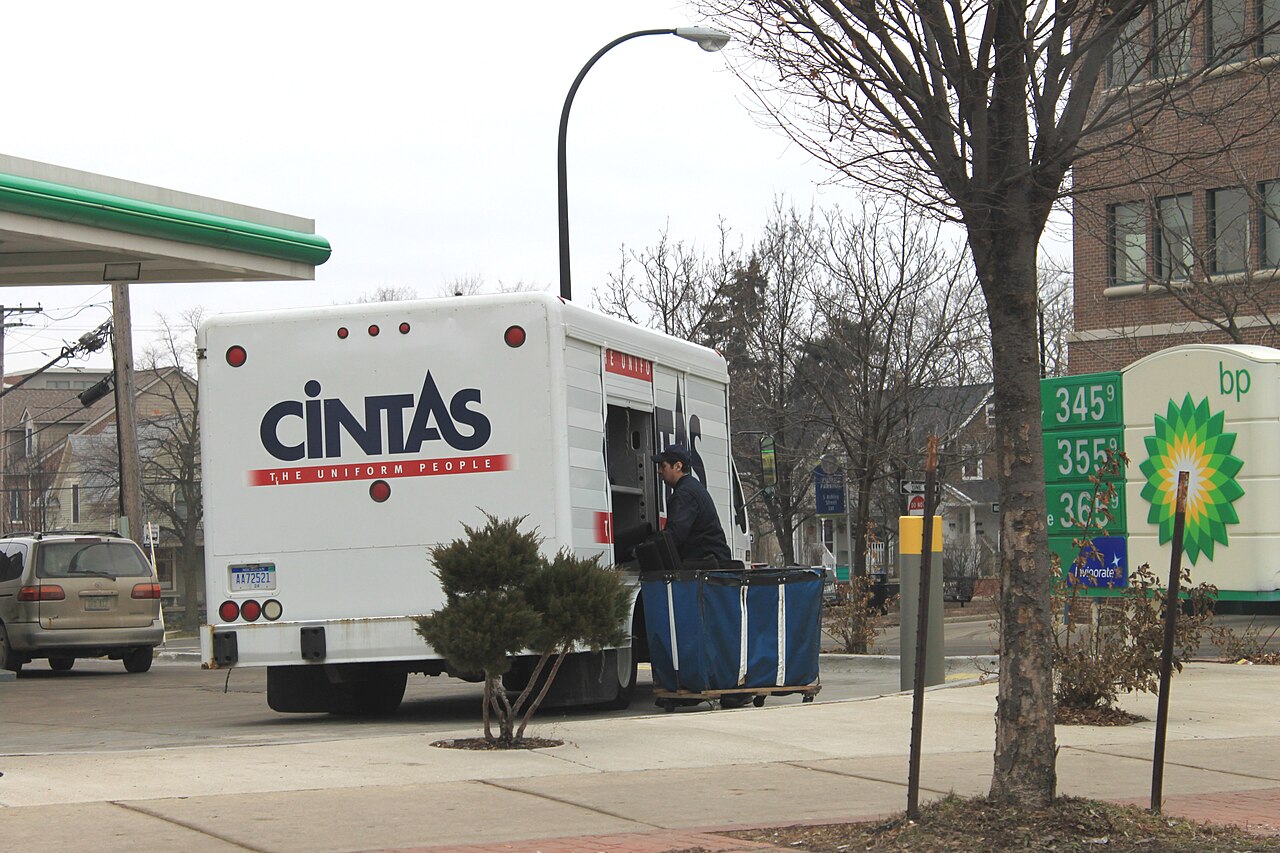
- Wikimedia Commons, "File:Cintas Delivery Truck Ann Arbor Michigan.JPG" - real photograph of a Cintas delivery truck used as the article image.
Editor’s Pick Review
This piece earns the pick because it turns an unglamorous service category into a clean investment mechanism. The argument keeps the Cintas premium grounded in route density, plant throughput, in-service inventory, and customer retention, then uses the UniFirst transaction as a sharp forward test rather than a generic merger catalyst.
The strongest quality signal is discipline: the article separates base, upside, downside, counterweight, falsifier, and watchlist without losing the physical reality of the business. The image policy fit is also stronger than most of the 24-hour pool: the Cintas truck is a real, topic-grounded documentary visual, and it reinforces the route-economics thesis instead of substituting an analytical diagram for the work the prose already does.