RFID labels look like a cyclical component story when the order book slows. The priced view is that apparel destocking, tariff uncertainty, and chip inventory swings can make the category too lumpy for a premium multiple. The new part is that the technology is becoming a toll on inventory uncertainty: retailers, logistics networks, grocery chains, healthcare operators, and manufacturers all want item-level truth without sending people to count boxes by hand.
That does not make every RFID supplier a clean compounder. It does make the profit pool more interesting than a barcode-replacement slogan. The money sits where a cheap physical tag turns into fewer stockouts, lower shrink, better recall control, faster receiving, and cleaner replenishment. The tag is tiny; the operating problem is not.
The Mechanism
A basic RFID label converts an object into a readable identity. Avery Dennison's 2025 report describes a business built around materials, information solutions, branding, and RFID inlays and tags, with its Solutions Group providing item-level RFID, visibility, loss-prevention, ticketing, compliance, and brand-protection products.[1] That matters because the financial question is not whether RFID is clever technology. It is whether the label can attach to enough units, in enough categories, with enough follow-on software and service value to overcome normal hardware cycles.
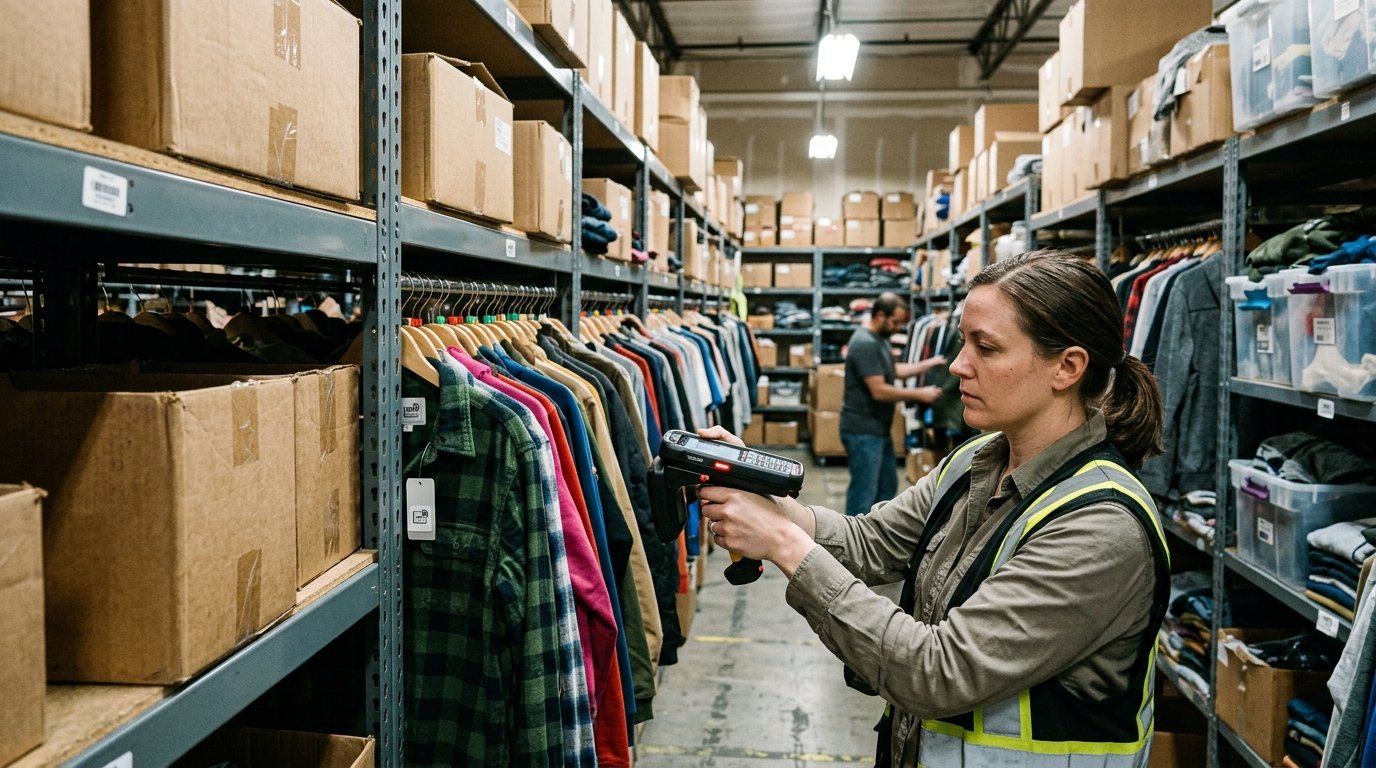
The installed logic is simple. A barcode usually needs line of sight and one-at-a-time scanning. RFID can be read through cases or in groups, depending on tag, reader, and environment. In a store, that can change cycle counts and replenishment. In a warehouse, it can change receiving and picking. In healthcare or food, it can make location, freshness, lot, and recall workflows less dependent on manual reconciliation.
Avery gives the first financial anchor. In 2025, Materials Group and Solutions Group represented about 69% and 31% of total net sales, respectively, and the company identifies intelligent labels that use RFID tags and inlays as part of its high-value category strategy.[1] The mix is important: RFID is not yet the whole company, but it sits inside the portion of the portfolio that management wants to grow faster than the base materials business.
The Cycle Is Messy
The near-term data are deliberately not clean. Avery's first quarter of 2026 showed company net sales of $2.3 billion, up 7.0% as reported, with organic sales up 1.1%.[2] But the Solutions Group line was weaker: reported sales fell 2.8% to $649 million, organic sales were down 0.9%, and Intelligent Labels were down low single digits.[2] That is the bear case in one paragraph. If the category is supposed to be a secular adoption story, investors do not want to see the flagship digital-identification bucket decline.
The counter is that RFID demand is passing through a supply-chain digestion phase, not disappearing. RAIN Alliance reported 42.7 billion RAIN tag chip shipments in 2025, down from 2024's record, and attributed the decline partly to semiconductor inventory cycle effects, tariff uncertainty, U.S. apparel and general retail demand pressure, and retail destocking.[3] At the same time, RAIN said the market had still grown 50% over four years and that deployments were broadening from retail and logistics into healthcare, manufacturing, food, beauty, sports equipment, and electronics.[3]
That distinction is the crux. RFID can have a bad ordering year while the operational need keeps spreading. The tag chip is a component; the adoption decision is an operating-system change for physical inventory.
Where The Toll Forms
The attractive version of the theme has three layers. First is tag volume: if billions of items need unique identities, the label and inlay suppliers get recurring unit demand. Second is systems attachment: readers, gateways, encoding, software, and integration determine whether the tag turns into useful data. Third is workflow lock-in: once a retailer or manufacturer redesigns receiving, replenishment, loss prevention, or recall handling around item-level visibility, switching away becomes harder than changing a label vendor.
Impinj shows the systems layer from the chip and reader side. Its first-quarter 2026 transcript put revenue at $74.3 million, with endpoint IC revenue of $63.2 million and second-quarter revenue guidance of $103 million to $106 million.[5] That guidance step-up is the bull signal: even after a choppy 2025 shipment backdrop, endpoint bookings and customer programs can re-accelerate quickly when channel inventory clears.
The gross-margin profile also matters. Impinj reported GAAP gross margin of 49.1% and non-GAAP gross margin of 52.4% in Q1 2026.[5] Those are not commodity paper-label economics. They reflect a specialized semiconductor and systems layer whose value depends on radio performance, encoding standards, enterprise deployments, and ecosystem position.
VDC's 2025 RAIN RFID market overview frames the long runway more aggressively, projecting annual tag chip shipments above 115 billion by 2029 as adoption expands across retail, healthcare, manufacturing, transportation and logistics, government, and other sectors.[4] Forecasts should never be treated as fact, but the scale is directionally useful. A market moving from tens of billions of annual tag chips toward more than one hundred billion is not simply replacing barcodes; it is trying to digitize more of the physical economy at item level.
Counterweight
The strongest counterweight is that RFID value does not automatically accrue to public shareholders. Retailers may capture much of the benefit through fewer stockouts and less labor. Large customers can pressure tag pricing. Hardware suppliers can overbuild capacity. Standards-based ecosystems reduce some lock-in. Avery itself warns that competitors, customers, distributors, and suppliers may expand in high-value categories or develop competing technologies, putting pricing and share at risk.[1]
There is also an adoption-cost problem. A tag is cheap only after the whole system works. Readers have to be placed correctly. Data has to map into inventory, point-of-sale, warehouse, and supplier systems. Store associates need workflows that trust the reads. Food, beauty, pharma, and logistics use cases each add different packaging, moisture, metal, privacy, and compliance constraints. A failed pilot can burn time without creating a repeatable rollout.
That is why the better thesis is not "RFID will replace barcodes." It is narrower: RFID earns its place when the cost of inventory uncertainty exceeds the cost of tagging, reading, integrating, and maintaining the system.
Falsifier
The thesis fails if the 2025 shipment decline proves to be a demand ceiling rather than an inventory-cycle pause. Specifically, it would be wrong if Avery's Intelligent Labels remain negative through the next major retail buying cycle, Impinj's second-quarter revenue step-up fails to convert into sustained endpoint demand, and RAIN tag shipments do not resume growth as apparel, logistics, healthcare, grocery, and manufacturing programs move from pilots to rollouts.[2][3][5]
The bullish case gets stronger if the opposite happens: tag-chip shipments re-accelerate, Avery's Solutions Group returns to organic growth with Intelligent Labels leading high-value categories, and Impinj's endpoint IC momentum broadens beyond a few large programs. In that branch, RFID stops looking like an apparel-cycle accessory and starts looking like a toll road on physical inventory data.
Watchlist
- RAIN tag-chip shipments for 2026: the cleanest volume check after the 42.7 billion shipment reset in 2025.[3]
- Avery Solutions Group organic growth: the signal is whether Intelligent Labels move from low-single-digit decline back into growth inside the $649 million quarterly Solutions base.[2]
- Impinj endpoint IC revenue and gross margin: sustained endpoint demand with margins near the Q1 profile would support the systems-layer economics.[5]
- New category rollouts: grocery, healthcare, beauty, logistics, and manufacturing matter because they prove RFID can expand beyond apparel cycle counts.[3][4]
The investment frame is therefore disciplined but constructive. RFID labels are not magic, and the 2025-2026 data prove the category is still cyclical at the component level. But the secular problem is real: companies do not know where enough of their physical inventory is, in real time, at item level. Every category that decides that uncertainty is too expensive creates another lane for tags, readers, inlays, software, and integration. That is the toll road investors should watch.
Sources
- Avery Dennison, 2025 Integrated Sustainability and Annual Reports - segment mix, RFID/inlay product scope, high-value category strategy, competition, and capacity investment context.
- Avery Dennison, "Avery Dennison announces first quarter 2026 results" - company sales, organic growth, Solutions Group sales, Intelligent Labels trend, margins, balance sheet, and guidance.
- RAIN Alliance, "RAIN Alliance Reports 42.7 Billion Tag Chip Shipments in 2025" - tag-chip shipment volume, four-year growth, inventory-cycle explanation, and category expansion.
- VDC Strategy, "RAIN RFID Market Report" (November 2025) - shipment forecast and sector expansion framing.
- The Motley Fool, "Impinj (PI) Q1 2026 Earnings Call Transcript" - revenue, endpoint IC revenue, gross margin, and second-quarter revenue guidance.
- Wikimedia Commons, "File:RFID Tags.jpg" - real photograph of RFID tags used as the article image.