Student-loan defaults are back on credit reports, but the investable point is narrower than the headline. Priced is the scary number: New York Fed researchers estimate roughly 1 million federal student-loan borrowers defaulted in Q4 2025, followed by another 2.6 million in Q1 2026.[2] New is the boundary around that shock. The same research says delinquent and newly defaulted student-loan borrowers make up only 2% of the credit population, and that their balances represent 2.7% of auto loans, 2% of credit cards, and 1% of mortgages.[2]
That makes this a repayment-clock story before it is a recession story. The mechanical sequence matters: pandemic relief paused payments and interest; payments resumed in September 2023; most borrowers owed again in October 2023; the 12-month on-ramp through October 2024 kept missed payments from being reported to credit bureaus; the first 90-day delinquencies returned to credit reports in Q1 2025; and because federal default generally requires 270 days of missed payments, new defaults first appeared in Q4 2025.[2]
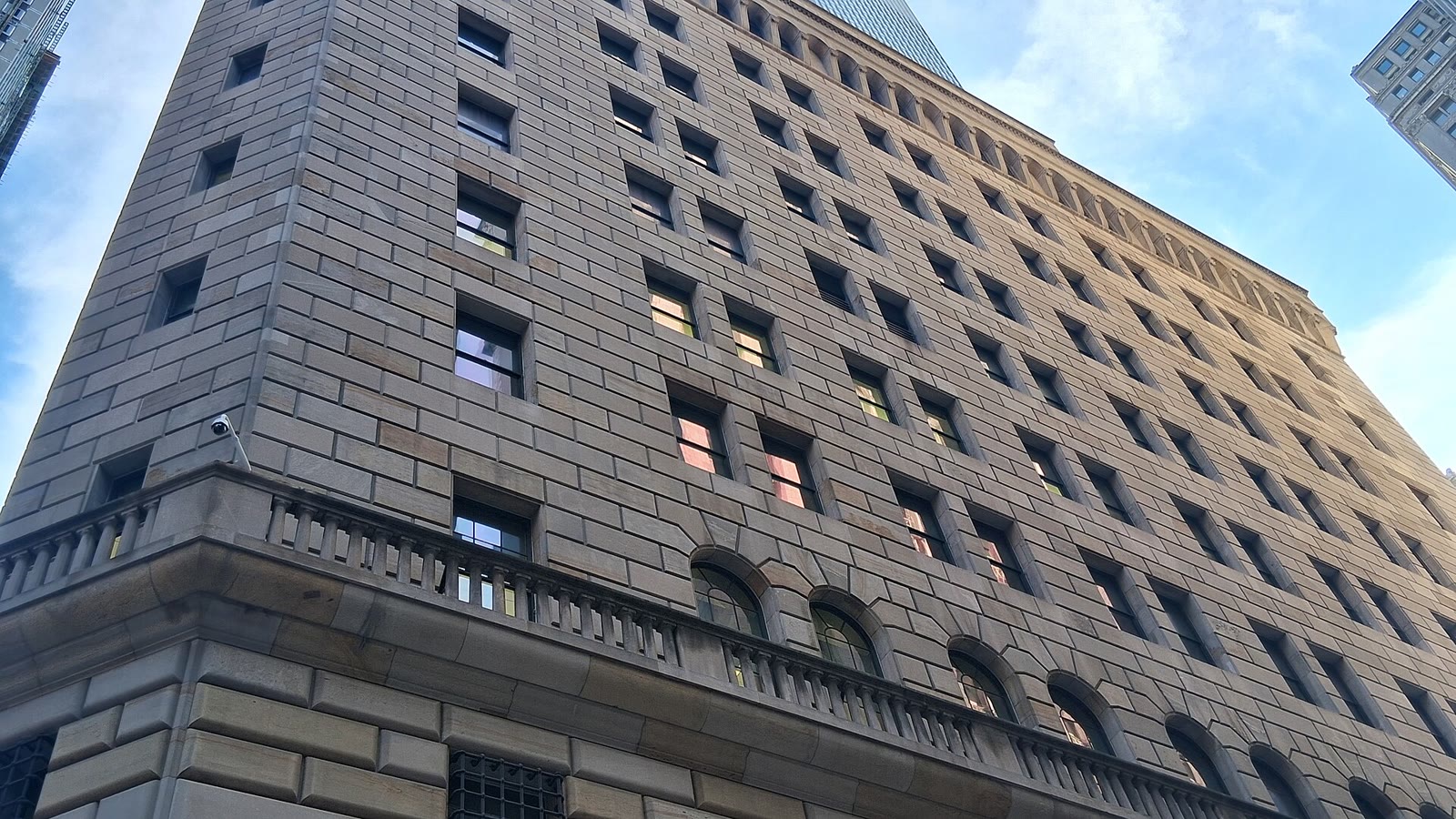
Image context: the cover uses a real Wikimedia Commons photograph of the Federal Reserve Bank of New York building, not a chart or generated credit-score graphic. That documentary choice is deliberate. The article is about how a household-credit data release turns one policy restart into a measurable financial-market signal.[6]
The mechanism: reporting lag, then default lag
The central error is to read the default wave as one sudden deterioration in early 2026. It is really the delayed visibility of missed payments that began earlier. New York Fed researchers note that more than 17% of student-loan borrowers have been at least 90 days past due at least once since delinquency reporting resumed in Q1 2025.[2] That is the first gate. Default is the second gate, because federal student loans do not enter default after one late bill; they move there after a much longer missed-payment clock.[2]
This lag is why the data now looks abrupt. Credit markets spent several years with student-loan risk partly hidden by policy design. Then reporting restarted, late-payment marks appeared, and defaults followed with a delay. The market signal therefore belongs less to new borrowing appetite and more to normalization after a long administrative suspension.
The New York Fed's household-debt release shows the same split. Total household debt rose only $18 billion, or 0.1%, in Q1 2026 to $18.794 trillion.[1] Aggregate delinquency was broadly steady, with 4.8% of outstanding debt in some stage of delinquency.[1] Yet student loans were visibly worse on a stock basis: the 90-plus-day delinquency rate increased to 10.3% of balances, up from 9.6% in Q4 2025.[1]
Those numbers can coexist. Household credit can look broadly stable while one product absorbs a delayed reporting shock.
Why the headline is not automatically contagion
The strongest bearish reading is obvious. Newly defaulted borrowers already show payment stress elsewhere. New York Fed researchers found that among post-pandemic student-loan defaulters who held other debt, nearly 40% with auto loans, 56% with at least one credit card, and 20% with a mortgage were past due in Q1 2026.[2] That is not a clean household-finance picture.
But contagion requires scale as well as severity. The same article draws the important market boundary: delinquent and newly defaulted student-loan borrowers account for a small share of the overall credit population and do not hold enough auto, card, or mortgage balances to make the first wave a systemic consumer-credit event by itself.[2] In plain English, the borrowers in the worst shape are severely stressed, but the affected balance pool is not large enough yet to rewrite the whole consumer-credit tape.
That is the key finance distinction. A social-policy problem can be severe for millions of households without becoming a broad credit-market impairment. Credit-card issuers, auto lenders, mortgage lenders, servicers, and securitization investors should care about the overlap, but the first pass is a targeted stress pocket rather than a universal loss-rate reset.
The Federal Reserve's G.19 release supports that narrower framing from a different angle. Consumer credit increased at a 3.2% seasonally adjusted annual rate in Q1 2026, with revolving credit up 3.8% and nonrevolving credit up 3.0%.[3] Outstanding student loans in the G.19 memo series were $1.8658 trillion in Q1 2026, while motor-vehicle loans were $1.5610 trillion.[3] The credit system is not freezing; it is carrying a large student-loan stock through a messy return-to-repayment process.
The policy clock still matters
The next risk is not only borrower behavior. It is policy timing. The Department of Education said on January 16, 2026 that it would delay involuntary collections on federal student loans, including Administrative Wage Garnishment and the Treasury Offset Program, while repayment reforms were being implemented.[4] That delay reduces near-term cash-flow pressure on defaulted borrowers, but it also means the credit-reporting damage and the collections cash-flow shock are not perfectly synchronized.
This is why the first-wave data can look contained while still leaving a watch item. If involuntary collections resume before borrower cash flow improves, the stress can migrate from credit-score damage into paycheck, refund, or benefit offsets. If collections remain delayed and rehabilitation or consolidation channels work better, the default stock can be ugly without producing the same degree of incremental spending pressure.
The SAVE transition adds another moving part. On March 27, 2026, the Department of Education said 7.5 million borrowers enrolled in SAVE would receive guidance to exit the plan, and that beginning July 1, 2026 servicers would tell borrowers to choose another repayment plan within 90 days or be moved into a standard or tiered standard plan.[5] New York Fed researchers flagged roughly 7 million SAVE borrowers as a possible second-wave risk as they reach the nine-month repayment mark.[2]
That does not mean a second wave is guaranteed. It means the next data releases should be read as a sequence: plan transition, required payment notices, delinquency reporting, then possible default timing. Markets should not compress those into one date.
Five numeric anchors
- $18.794 trillion: total household debt at the end of Q1 2026, up $18 billion from Q4 2025.[1]
- 10.3%: student-loan balances 90-plus days delinquent in Q1 2026, up from 9.6% in Q4 2025.[1]
- 3.6 million borrowers: roughly 1 million newly defaulted federal student-loan borrowers in Q4 2025 plus 2.6 million more in Q1 2026.[2]
- 2% of the credit population: the estimated size of delinquent and newly defaulted student-loan borrowers in the New York Fed's spillover framing.[2]
- 7.5 million SAVE borrowers: the Department of Education's March 2026 count for borrowers being directed out of SAVE and into other repayment plans.[5]
The anchors point to a bounded thesis: the borrower-level damage is real, the credit-reporting wave is no longer theoretical, and the next risk sits in plan transition and collections timing. But the data does not yet justify treating student-loan defaults as a broad household-credit contagion.
Strongest counterweight
The bearish counterweight is that averages can understate stress when the tail is concentrated. Borrowers who newly defaulted are not just late on student loans. Conditional on holding the product, many are also past due on cards, auto loans, or mortgages.[2] That overlap can matter for lenders with exposure to weaker-credit consumers, especially where underwriting already depends on thin cash-flow buffers.
There is also a timing problem. The Department of Education's collections delay is a cushion today, not a permanent write-off.[4] If wage garnishment, tax refund offsets, or benefit offsets restart before repayment-plan transitions stabilize, some households could see a second hit after the credit-score hit. The macro numbers may still look contained, while individual balance sheets feel worse.
Falsifier
This thesis is wrong if student-loan stress starts showing up as a broad deterioration in the next two quarters of non-student credit. The clean falsifier would be a simultaneous move in which credit-card and auto serious-delinquency flows rise materially, student-loan borrowers leaving SAVE miss the 90-day transition window in large numbers, and lenders report tightening tied specifically to cross-product borrower stress rather than normal credit-cycle caution.[1][2][5]
If that happens, the story stops being "student-loan reporting normalized after a policy pause" and becomes "student-loan cash-flow stress is leaking into the wider household-credit system."
Watchlist
- Q2 and Q3 2026 household-debt reports: watch whether the student-loan 90-plus-day rate keeps rising or whether the New York Fed's "initial wave has crested" view holds.[1][2]
- SAVE transition notices after July 1, 2026: the practical question is how many borrowers actively select a new plan before their servicer's 90-day deadline.[5]
- Collections policy: the market impact changes if involuntary collections move from delayed to active.[4]
- Cross-product delinquency: the key spillover test is not only student-loan default counts; it is whether auto, card, and mortgage delinquency flows accelerate among the broader credit population.[1][2]
Takeaway
Student-loan defaults are back, but the market should not over-read the first headline. The wave is large enough to matter: millions of borrowers, a double-digit serious-delinquency rate, and visible credit-score damage inside the affected group.[1][2] It is also bounded enough that it should not be treated as a whole-consumer balance-sheet break without more evidence.
The useful lens is sequence. Reporting returned first. Defaults followed with a lag. Collections are delayed. SAVE borrowers are entering a new transition clock. The next finance signal will come from whether those clocks produce stabilization or cross-product stress. Until then, student loans look less like a new macro crisis than a delayed credit-reporting shock with a second-wave risk attached.[2][4][5]
Sources
- Federal Reserve Bank of New York, "Household Debt Balances Rise Slightly as Delinquency Transition Rates Hold Steady" (May 12, 2026) - Q1 2026 household-debt totals, delinquency rates, student-loan serious delinquency, and product-level balances.
- Zara Jacob, Donghoon Lee, Daniel Mangrum, Joelle W. Scally, and Wilbert van der Klaauw, "Federal Student Loan Defaults Return After Pandemic Pause," Liberty Street Economics, Federal Reserve Bank of New York (May 12, 2026) - default timing, borrower counts, spillover limits, and SAVE second-wave framing.
- Federal Reserve Board, "Consumer Credit - G.19" (released May 7, 2026) - Q1 2026 consumer-credit growth, revolving/nonrevolving rates, and student-loan/motor-vehicle loan memo balances.
- U.S. Department of Education, "U.S. Department of Education Delays Involuntary Collections Amid Ongoing Student Loan Repayment Improvements" (January 16, 2026) - collections delay, wage-garnishment/Treasury-offset context, and default-resolution options.
- U.S. Department of Education, "U.S. Department of Education Announces Next Steps for Borrowers Enrolled in the Unlawful SAVE Plan" (March 27, 2026) - SAVE borrower count, July 1 servicer-notice timing, and 90-day repayment-plan transition window.
- Wikimedia Commons, "File:Federal Reserve Bank of New York Building.jpg" - source page for the lead photograph.