At the April 24, 2026 close, ServiceNow traded at $90.17.[1] Using 1.031 billion shares outstanding at March 31, 2026, that implies an equity value a little above $93 billion.[1][4] The March-end balance sheet still showed about $7.9 billion of cash and marketable securities, but the company also disclosed that it borrowed a new $4.0 billion term loan on April 17, 2026 to fund part of the Armis acquisition.[4] On that rough math, enterprise value sits near $89 billion. Against ServiceNow's updated FY2026 subscription revenue guide of $15.735 billion to $15.775 billion, investors are paying about 5.7x forward subscription revenue for a company still guiding to 31.5% non-GAAP operating margin and 35% free-cash-flow margin.[2]
That is not a distressed multiple, and it is not a fantasy multiple either. Priced is that ServiceNow already owns one of the rare enterprise-software platforms with real workflow depth, high renewal quality, and large-customer density. New is narrower: after Armis, can the company keep compounding at more than 20% while proving that the acquisition is an accelerator rather than a permanent tax on margins and cash conversion?[2][4]
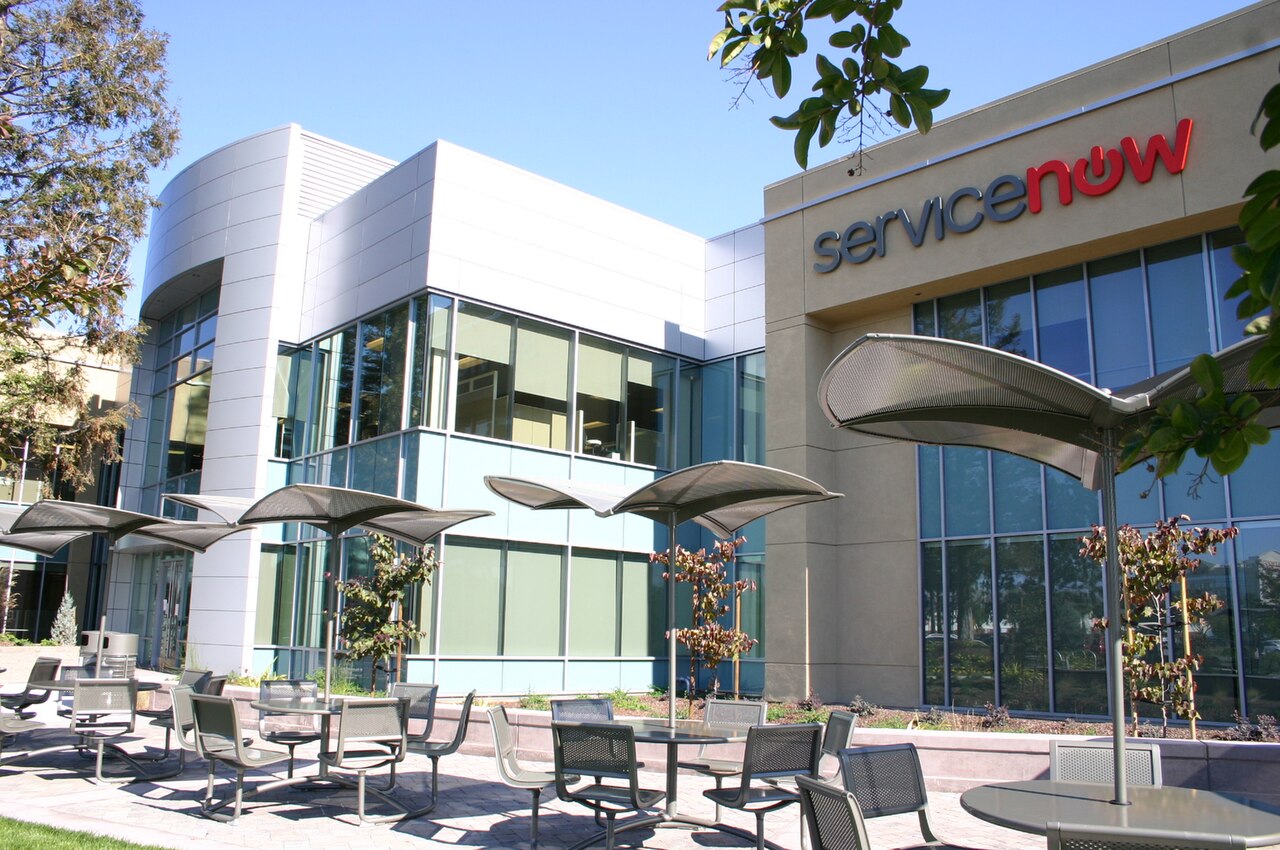
Image context: the cover uses a real Wikimedia Commons photograph of ServiceNow headquarters rather than an AI-themed software collage. That is the right anchor because this finance question is not about "enterprise AI" in the abstract. It is about one real software company, one acquisition, and one capital-allocation decision being tested against an already expensive stock.[5]
Priced vs new
The market has reasons to keep ServiceNow expensive. In the first quarter, subscription revenue reached $3.671 billion, up 22% year over year, while total revenue reached $3.770 billion, also up 22%.[2] Current remaining performance obligations reached $12.64 billion, up 22.5%, and total remaining performance obligations reached $27.7 billion, up 25%.[2] The deal shape also stayed strong: ServiceNow said it had 16 transactions over $5 million in net new ACV in the quarter, up nearly 80% year over year, and ended Q1 with 630 customers generating more than $5 million in ACV, up about 22%.[2]
Those are not "good enough" software numbers. They are large-account platform numbers. Put beside the $12.883 billion of subscription revenue ServiceNow generated in 2025, the Q1 print argues that the company has not merely preserved its base. It has kept adding density on top of it.[3]
The harder question sits in the mix and in the cost shape. Armis helps the growth story immediately. ServiceNow's own guide says Q2 2026 subscription revenue should land between $3.815 billion and $3.820 billion, and full-year subscription revenue should land between $15.735 billion and $15.775 billion.[2] But the same release also says those growth lines each include about 125 basis points of contribution from Armis.[2] In other words, the acquisition does boost the numerator.
The market is now trying to decide what it does to the denominator. ServiceNow said Armis is expected to create headwinds of about 75 basis points to FY2026 operating margin, about 200 basis points to FY2026 free-cash-flow margin, and about 125 basis points to Q2 2026 operating margin.[2] That is the real valuation hinge. If ServiceNow were a cheaper stock, investors might accept acquired growth with less scrutiny. At roughly 5.7x forward subscription revenue, the company has to prove that temporary integration drag really is temporary.
Why the premium still exists
The most defensible part of the bull case is not a generic AI slogan. It is workflow monetization inside very large customers. Q1 showed that the company can still expand at scale while pulling larger contracts into the system.[2] That reading becomes stronger when combined with the AI adoption signal. ServiceNow said customers spending more than $1 million in ACV on Now Assist grew by more than 130% year over year.[2] That does not prove all AI monetization narratives. It does show that the platform is still finding ways to raise wallet share inside serious enterprise accounts.
The capital-return behavior also matters. During Q1, ServiceNow bought back roughly 20.2 million shares through an accelerated share repurchase and another 1.6 million shares for $225 million through open-market purchases; it still had about $4.2 billion of authorization remaining at quarter-end.[2] That makes the valuation a little more resilient because dilution control is no longer theoretical. But it also means investors should separate operating strength from EPS support delivered by repurchases and capital structure.
The term loan is the same kind of separator. The balance sheet is still respectable, but it is less pristine than a plain March 31 snapshot suggests because the $4.0 billion borrowing arrived before quarter-end reporting could fully capture the post-close structure.[4] That is not a reason to turn bearish by itself. It is a reason to move the debate from "great company" to "what exactly is the market paying for now?"
Six numeric anchors
- Stock and size: at the April 24, 2026 close, NOW was $90.17; with 1.031 billion shares outstanding, equity value was a little above $93 billion.[1][4]
- Top-line speed stayed elite: Q1 subscription revenue was $3.671 billion, up 22%, and total revenue was $3.770 billion, also up 22%.[2]
- The future revenue base remained thick: cRPO was $12.64 billion, up 22.5%, and total RPO was $27.7 billion, up 25%.[2][4]
- Large-account density improved again: ServiceNow closed 16 net new ACV deals above $5 million and ended the quarter with 630 customers above $5 million ACV.[2]
- The balance sheet changed after quarter-end: March 31 cash and marketable securities totaled about $7.9 billion, then the company added a $4.0 billion term loan on April 17 to help fund Armis.[4]
- Guide quality remains strong even with integration drag: FY2026 subscription revenue guidance is $15.735 billion to $15.775 billion, with 31.5% non-GAAP operating margin and 35% free-cash-flow margin, even after Armis-related headwinds.[2]
Taken together, those anchors say something precise. ServiceNow is still growing fast enough to justify a premium. The premium now rests on whether acquired growth and AI monetization can coexist with only a temporary step-down in quality.
Strongest counterweight
The strongest pushback is that this framing may already be too cautious. A company growing subscription revenue 22%, expanding cRPO more than 22%, guiding to another year above 20% growth, and still expecting 31.5% operating margin is not obviously over-earning its reputation.[2] If Armis broadens the security and risk platform the way management expects, then the margin headwind could look less like dilution and more like a short bridge into a larger addressable market. The AI layer also matters here: Now Assist's 130%+ growth in million-dollar ACV customers suggests that ServiceNow is not simply adding a security asset to a mature workflow base. It is still thickening the base itself.[2]
Falsifier
This cautious framing is wrong if the next two quarters show that Armis expands growth faster than it bends economics. Concretely, if ServiceNow holds subscription growth near the current guide, keeps large-deal density high, exits 2026 with margin performance better than the announced headwinds imply, and shows that free-cash-flow pressure was a short integration effect rather than a new normal, then the current premium will look justified rather than stretched.[2][4]
Watchlist
- June 30, 2026 quarter close. The next hard operating checkpoint is whether subscription growth and cRPO stay strong enough that Armis looks additive rather than merely dilutive to quality.[2]
- Q2 2026 results versus guide. The clean test is whether subscription revenue lands inside $3.815 billion to $3.820 billion while the operating-margin pressure stays contained to the levels management already laid out.[2]
- Post-close balance-sheet shape. Investors should track how the new $4.0 billion term loan, the continuing repurchase program, and quarter-end cash levels interact once a full post-Armis quarter is reported.[2][4]
Takeaway
ServiceNow is not being valued like a software company that still needs to prove product-market fit. It is being valued like a scaled platform with room for another act. Q1 did not really break that thesis. It narrowed it. The market is now paying for large-account ACV density, durable renewal quality, and the belief that Armis will widen the platform faster than it widens the cost base. If that balance holds, the stock can stay expensive. If not, the multiple stops being a reward for platform quality and starts being a bill for optimism.
Sources
- Stooq, "NOW.US" daily quote line — April 24, 2026 close used for valuation math.
- ServiceNow, Q1 2026 earnings release PDF — subscription revenue, cRPO/RPO, large-deal metrics, guidance, Armis headwinds, and repurchase details.
- ServiceNow, 2025 annual report / Form 10-K — full-year 2025 subscription revenue and reporting baseline.
- ServiceNow, Form 10-Q for the quarter ended March 31, 2026 — shares outstanding, cash and marketable securities, and the April 17, 2026 term-loan disclosure.
- Wikimedia Commons, "File:Servicenow HQ - Santa Clara, CA.jpg" — source page for the headquarters photograph.