Merchant acquiring still gets described with the old script: more payment volume comes through, processors take a small toll, and scale does the rest. That script is no longer wrong enough to be useless, but it is too thin for 2026. Priced is that card and digital-payment growth continue to expand the addressable flow. New is that the better margin floor now belongs to the processors that own more of the merchant workflow than the card swipe itself.[1][2][3][4][5]
That is the layer where the public-company evidence is converging. Fiserv is explicitly framing Clover as a small-business operating platform, not only a payments endpoint.[2] Global Payments has completed the Worldpay acquisition and Issuer Solutions divestiture, then described itself as a pure-play merchant-solutions company whose next task is durable growth and Genius-platform rollout.[3] Adyen's 2025 numbers show point-of-sale volumes growing faster than the wider platform and embedded financial products scaling sharply inside the same stack.[4] Shift4's shareholder letter is even blunter: volume matters, but the company's internal north star is revenue less network fees, supported by software integrations, vertical ownership, and a cross-sell funnel above $1 trillion.[5]
Read together, those sources suggest a narrower finance conclusion. Merchant acquirers do not stop being volume businesses. They become better businesses when volume arrives through owned software, an integrated checkout surface, and adjacent merchant tools that are hard to rip out.
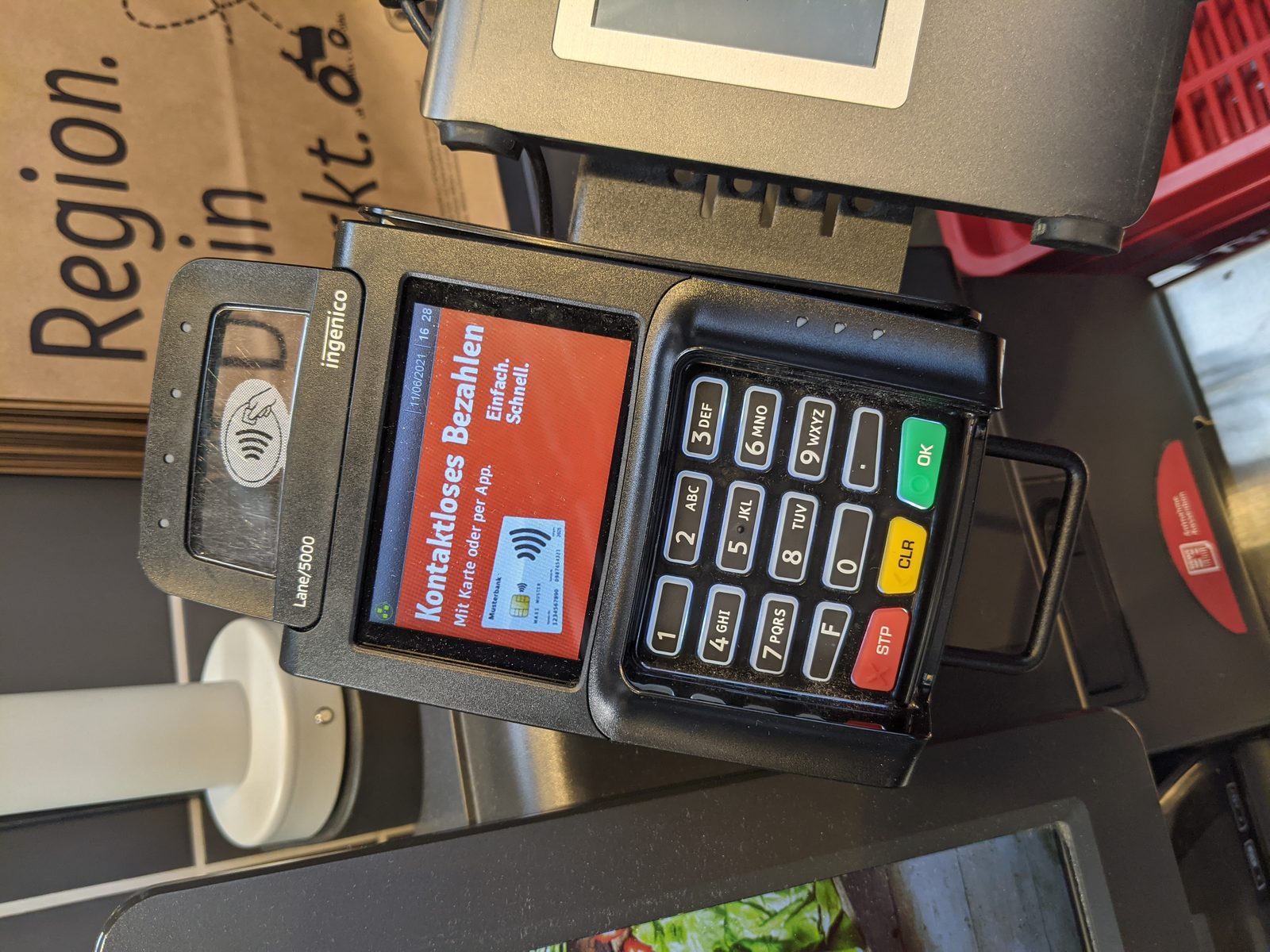
Image context: the cover uses a documentary photograph of a supermarket self-checkout terminal rather than a logo collage or abstract fintech graphic. That is the right visual for this article because the economic question is operational before it is financial. The higher-quality processor usually owns the merchant screen, the acceptance logic, and the surrounding business workflow, not just the packet that reaches the card network.[9]
The economics are moving one layer up
The old acquiring model relied on scale and routing efficiency. The newer model still needs those things, but it earns better economics by embedding itself earlier in the merchant's day. Once the processor also owns the point-of-sale software, order flow, loyalty hooks, payout tools, or vertical operating system, the revenue line stops looking like a simple percentage of card volume and starts looking more like a mixed software-and-payments contract.
Fiserv's recent disclosures are a useful starting point because they show both the mature base and the platform transition. Full-year 2025 organic revenue growth in Merchant Solutions was 6%, and the segment's adjusted operating margin was 37.0%.[1] The separate third-quarter presentation then shows what Fiserv cares about inside that segment: Clover reported volume growth ran 8% in each of the first three quarters of 2025 and was estimated at 8% again for the fourth quarter, while Clover growth excluding the gateway conversion ran 10%, 11%, 11%, and an estimated 11% across the same windows.[2] That is not commodity-acquiring language. It is platform-attach language. The same deck also points to Japan launch plans and a TD Bank merchant-processing transaction that expands Clover's footprint in Canada.[2]
Global Payments is moving through a different route to the same destination. Its 2025 release says the company completed the Worldpay acquisition and Issuer Solutions divestiture, repositioning itself as a pure-play merchant-solutions provider.[3] Management then said Merchant Solutions exited 2025 at slightly more than 6% growth, while full-year adjusted net revenue reached $9.32 billion, adjusted operating margin reached 44.2%, and 2026 guidance called for about 5% constant-currency adjusted net revenue growth excluding dispositions plus about 150 basis points of operating-margin expansion.[3] That combination only makes sense if management believes the merchant relationship can support more than raw transaction forwarding.
Adyen supplies the cleanest international proof. Full-year 2025 processed volume reached €1.394 trillion, net revenue reached €2.364 billion, and point-of-sale volume reached €311 billion, up 34% for the year.[4] Those numbers matter because they show the in-person layer compounding faster than the broader stack. Adyen also said issuing volumes inside embedded financial products rose 8x year over year.[4] The important inference is not that every acquirer should become a bank. It is that once acceptance, data, payouts, and merchant financial tools live in one operating environment, monetization gets thicker and churn usually gets harder.
Shift4's math makes the same point in the most direct way. In the fourth quarter of 2025, payment volume was $59 billion, up 23% year over year, but gross revenue less network fees rose 51% to $610 million, with adjusted EBITDA up 48% to $304 million and a 50% adjusted EBITDA margin.[5] The gap between volume growth and revenue-less-network-fees growth is the whole story. Shift4 is telling investors that the better read is not just more transactions, but better monetized transactions arriving through owned vertical workflows. Its letter also highlights an extensive software-integration library, a payments cross-sell funnel above $1 trillion, and a merchant volume backlog above $32 billion.[5]
Six numeric anchors
- Fiserv Merchant Solutions base: organic revenue growth was 6% in full-year 2025, with a 37.0% adjusted operating margin.[1]
- Fiserv Clover attach signal: reported Clover volume growth held at 8% through the first three quarters of 2025 and an estimated 8% in the fourth quarter; excluding the gateway conversion, the same sequence was 10%, 11%, 11%, and 11%.[2]
- Global Payments reset: adjusted net revenue reached $9.32 billion in 2025, adjusted operating margin reached 44.2%, and Merchant Solutions exited the year at slightly more than 6% growth.[3]
- Adyen platform density: full-year 2025 processed volume reached €1.394 trillion, net revenue reached €2.364 billion, and point-of-sale volume reached €311 billion, up 34%.[4]
- Shift4 monetization spread: fourth-quarter 2025 volume reached $59 billion, while gross revenue less network fees reached $610 million and adjusted EBITDA reached $304 million.[5]
- Shift4 distribution inventory: the company says its payments cross-sell funnel exceeds $1 trillion and its merchant-volume backlog exceeds $32 billion.[5]
Those anchors all point in the same direction. The investable question is not who touches the most gross volume. It is who can keep converting merchant workflow control into higher-quality revenue after network fees and who can defend that position across geographies and verticals.
Strongest counterweight
The strongest pushback is that basic scale still wins. Card acceptance remains a low-friction, high-volume business in which distribution, bank partnerships, routing, fraud tooling, and international reach already create plenty of value. Fiserv's Merchant Solutions margin, Global Payments' scale, Adyen's trillion-euro volume base, and Shift4's accelerating gross-profit bridge all show that simple throughput is still worth a lot.[1][3][4][5]
That counterweight is real. It is why the article is not arguing that software suddenly replaces payments. The narrower claim is that, once scale is already in the model, the next layer of resilience and rerating belongs to the processors that make themselves harder to remove from the merchant's operating stack.
Falsifier
This thematic deep dive is too software-centric if the next few reporting windows show that payment volume keeps compounding while attachment metrics flatten, yet spreads and revenue-less-network-fees still hold up anyway. Concretely, if Clover growth cools without hurting Merchant Solutions quality, if Global Payments expands margins without stronger workflow evidence, if Adyen's point-of-sale and embedded-finance mix stop outgrowing the base, and if Shift4's monetization gap versus volume narrows without damaging cash generation, then workflow ownership matters less than this framework argues.[1][2][3][4][5]
Watchlist
- May 5, 2026: Fiserv first-quarter earnings call. The key check is whether Merchant Solutions quality still leans on Clover and whether management sharpens the small-business operating-platform framing ahead of Investor Day.[1][2][6]
- May 6, 2026: Global Payments first-quarter results. The important proof is whether post-Worldpay integration already shows up as durable merchant growth and margin discipline rather than only transaction-scale rhetoric.[3][7]
- May 7, 2026: Shift4 first-quarter results. The right metric pair is volume versus gross revenue less network fees. If monetization stays wider than volume growth, the workflow thesis keeps gaining credibility.[5][8]
- May 14, 2026: Fiserv Investor Day. This is the cleanest upcoming event for seeing whether Clover, embedded finance, and merchant software get presented as the core merchant strategy rather than as adjacent products.[1]
Takeaway
Merchant acquiring in 2026 should not be read as a pure toll road on rising digital payments. The better lens is operating control. Fiserv's Clover table, Global Payments' post-Worldpay reshaping, Adyen's faster-growing point-of-sale layer, and Shift4's revenue-less-network-fees bridge all suggest the same thing: once a processor owns enough of the merchant workflow, the quality of the revenue starts to matter more than the size of the card volume alone.[1][2][3][4][5]
Sources
- Fiserv, "Fiserv Reports Fourth Quarter and Full Year 2025 Results" (February 10, 2026).
- Fiserv, "Third Quarter 2025 Earnings Presentation" (PDF asset published December 2, 2025) — Clover growth table, Japan launch, CardFree, and TD Bank Canada expansion.
- Global Payments, "Global Payments Reports Fourth Quarter and Full Year 2025 Results" (February 12, 2026).
- Adyen, "Adyen publishes H2 2025 financial results" (February 12, 2026).
- Shift4, Form 8-K with Q4 2025 shareholder letter PDF (filed February 26, 2026) — volume, gross revenue less network fees, adjusted EBITDA, cross-sell funnel, and backlog.
- Fiserv, "First Quarter 2026 Fiserv Earnings Conference Call" event page (May 5, 2026).
- Global Payments, "Global Payments to Report First Quarter Results on May 6, 2026" (April 22, 2026).
- Shift4, "Shift4 Announces Date of First Quarter Earnings Results and Upcoming Investor Conference Participation" (April 23, 2026).
- Wikimedia Commons, "File:Payment terminal at self-checkout.jpg" — documentary photograph of a payment terminal mounted on a supermarket self-checkout machine.