Meta does not need another article proving that digital advertising is still a good business. Priced is that the Family of Apps machine remains enormous, cash generative, and operationally sharp. New is whether 2026 becomes the year when AI infrastructure spending stops looking like ambitious optionality and starts looking like a permanent tax on margins.[1]
That distinction is why the April 29, 2026 first-quarter report matters even before it arrives. Meta's fourth-quarter release showed a business still compounding at scale: revenue rose 24% year over year to $59.9 billion, ad impressions rose 18%, average price per ad rose 6%, and Family of Apps operating income reached $30.8 billion for the quarter.[1] Those are not stabilization numbers. They are proof that ranking, monetization, and user throughput still work. But the same release also reset the cost frame for the year ahead: full-year 2026 expenses are guided to $162-169 billion, and capital expenditures to $115-135 billion, far above the $72.2 billion Meta spent in 2025.[1]
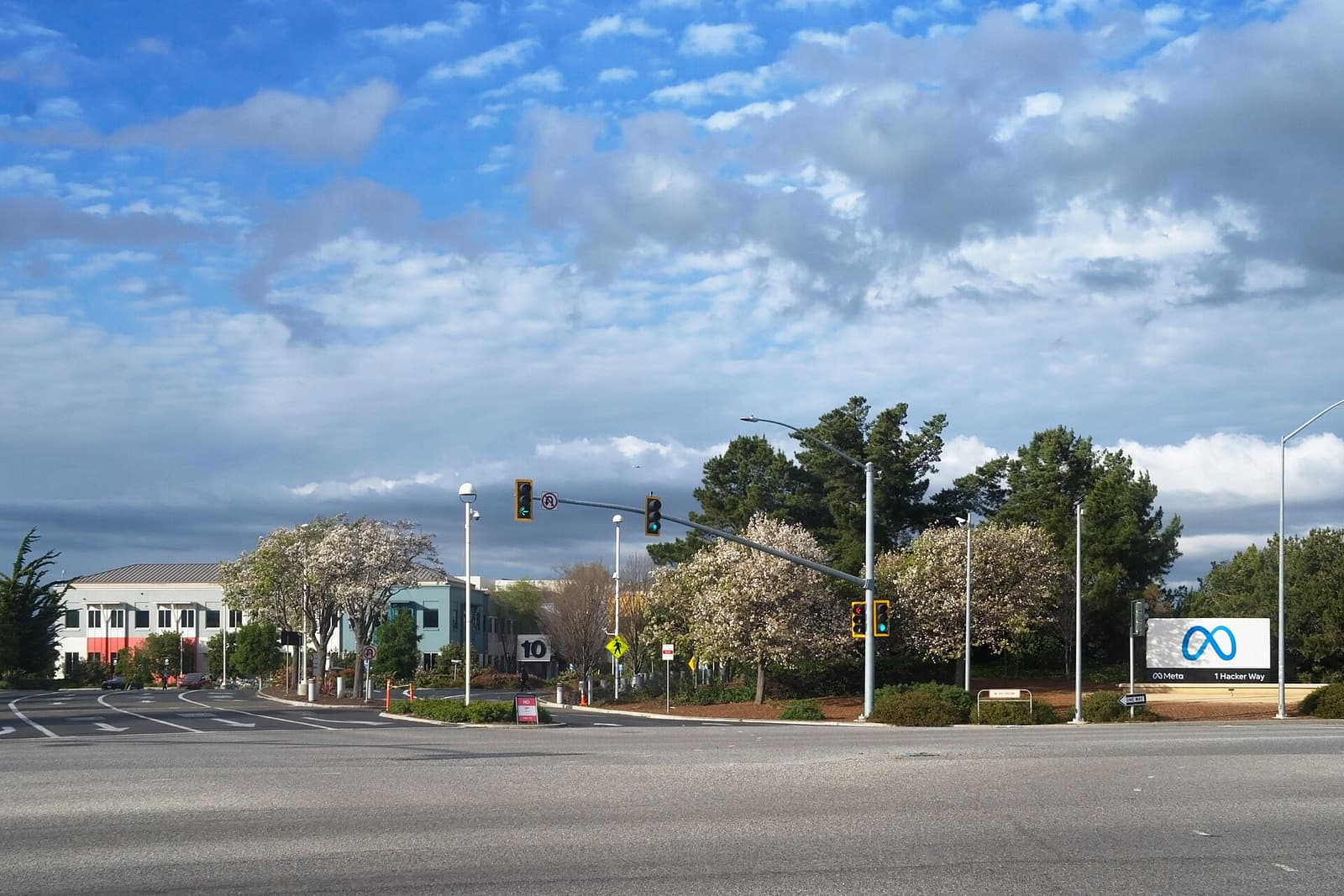
Image context: the cover uses a real Wikimedia Commons photograph of Meta's Menlo Park headquarters rather than a collage of social apps or an abstract AI visual. That is the right anchor because this article is about the operating center of one real company, where advertising economics, technical hiring, and infrastructure budgeting have to coexist inside the same P&L.[5]
Priced vs new
The market has had enough evidence to understand the first half of the thesis. Meta's ad engine is not living off inertia. In the fourth quarter, revenue reached $59.893 billion, advertising revenue reached $58.137 billion, and Family daily active people averaged 3.58 billion in December 2025.[1] The product surface is still broad enough to monetize more usage, and the ad system is still good enough to lift both impression volume and unit pricing at the same time.[1]
The harder part is the second half. Meta is no longer asking investors to fund only incremental recommendation improvements or modest data-center refresh. It is asking them to underwrite a much steeper infrastructure curve. Management's January outlook called for $115-135 billion of 2026 capex and said the year-over-year increase would be driven by investment in both the core business and Meta Superintelligence Labs.[1] That is a different scale question. When a mature ad platform starts spending like an infrastructure company, investors have to decide whether the spend is building a stronger moat or just moving the margin structure lower.
Base case: revenue stays strong enough to carry the buildout, but the stock needs proof each quarter
The base case is not that Meta's business breaks. It is that the business stays strong while the proof burden rises. If ad demand remains healthy, if engagement keeps compounding across Instagram, Facebook, WhatsApp, and Threads, and if AI tools improve advertiser ROI, then the Family of Apps segment can continue to throw off enough operating income to finance the buildout.[1][3]
The numbers support that starting point. Full-year 2025 revenue reached $200.966 billion, operating income reached $83.276 billion, cash flow from operations reached $115.8 billion, and free cash flow still came in at $43.585 billion even after $72.215 billion of capex and finance-lease principal payments.[1] In other words, Meta entered 2026 with real internal funding power.
But this base case also says the market will not keep rewarding spend by default. Once a company guides to $162-169 billion of annual expenses and $115-135 billion of capex, investors start looking less for vision and more for sequencing.[1] The Q1 report does not need to prove that all of Meta's AI bets monetize instantly. It does need to show that revenue growth, operating income, and management commentary still make the cost curve look intentional rather than open-ended.
Upside case: AI spend raises ad quality and keeps the Family of Apps margin engine structurally ahead
The bullish branch is straightforward. If Meta's AI investment keeps improving recommendations, creative generation, ranking, measurement, and advertiser conversion, then the ad machine can keep getting richer even while the infrastructure bill rises. In that world, higher capex is not margin leakage. It is the purchase price of stronger monetization.
This is the branch where the fourth-quarter mix matters most. Meta already showed that it could lift ad impressions 18% and average price per ad 6% in the same quarter.[1] Family of Apps operating income for the full year reached $102.469 billion, which means the core business is still producing enormous surplus before Reality Labs losses are considered.[1] If first-quarter 2026 results show that the ad system remains that productive while management holds the expense narrative together, the stock can absorb a heavier infrastructure year.
The strongest counterweight to caution sits here. Meta's Q1 revenue guide of $53.5-56.5 billion already implies a business entering the quarter with substantial momentum, helped in part by a roughly 4% foreign-exchange tailwind.[1] If reported revenue lands toward the high end and management sounds confident about advertiser returns from AI tools, the market may decide that the bigger budget is simply what dominance costs now.
Downside case: the company keeps growing, but the margin floor starts stepping down
The risk branch is subtler than a demand collapse. It is a quality-of-growth problem. Revenue can stay healthy while the structure underneath becomes less attractive if infrastructure, depreciation, and technical compensation keep scaling faster than monetization benefits arrive.[1] A company does not need to miss revenue badly to rerate lower. It only needs investors to believe that future dollars will require too much capital to earn.
Meta's own reporting shows where that pressure could accumulate. Reality Labs still lost $6.021 billion in the fourth quarter and $19.193 billion for full-year 2025.[1] The annual report leaves no ambiguity about the operating shape: the Family of Apps segment is the profit pool, while newer initiatives still ask for heavy capital and operating support.[1][3] If 2026 turns into a year when core ads remain good but everything around them becomes more expensive, then the stock stops being a clean AI winner and starts being a margin-discipline debate.
Six numeric anchors
- Q4 revenue scale: fourth-quarter 2025 revenue was $59.893 billion, up 24% year over year.[1]
- Ad throughput remained strong: fourth-quarter ad impressions rose 18%, while average price per ad rose 6%.[1]
- The core profit engine stayed very large: Family of Apps operating income was $30.766 billion in Q4 and $102.469 billion for full-year 2025.[1]
- The cost reset is real: Meta guided full-year 2026 expenses to $162-169 billion.[1]
- The capex step-up is even larger: Meta guided 2026 capital expenditures to $115-135 billion, versus $72.215 billion in 2025.[1]
- The near-term check arrives immediately: Meta said first-quarter 2026 results will be released after market close on April 29, 2026, with the annual meeting to follow on May 27, 2026.[4][6]
Taken together, these anchors say the debate is no longer "Is Meta still growing?" The debate is "How expensive will the next layer of growth be?"
Falsifier
This cautious framing is wrong if Meta demonstrates that higher AI spending is already translating into operating leverage rather than diluting it. Concretely, if first-quarter revenue lands strongly, management keeps the full-year cost frame stable, and the company shows that ad performance improvements are arriving quickly enough to protect the operating-income trajectory, then the concern about a lasting margin transfer weakens materially.[1][4]
Watchlist
- April 29, 2026: first-quarter 2026 results. This is the immediate test of whether revenue momentum still looks strong enough to carry the heavier cost year.[4]
- April 29, 2026: management commentary on capex cadence. Investors need to hear whether the infrastructure ramp is front-loaded, evenly phased, or still accelerating into the second half.[1][4]
- May 27, 2026: annual meeting. The proxy already shows AI strategy and infrastructure oversight sitting near the center of board attention; the meeting is the next formal governance checkpoint.[6]
- The next few quarters of Family of Apps vs Reality Labs mix. If the core segment keeps widening faster than newer bets consume capital, the upside case stays intact; if not, the valuation argument narrows.[1][3]
Takeaway
Meta's ad machine does not need defending. It needs measuring against a much larger infrastructure appetite. The core business is already priced as elite. The 2026 proof is narrower: whether AI capex scales like disciplined reinforcement of that machine, or like a slower transfer of margin from today's ad surplus into tomorrow's uncertain payoff.
Sources
- Meta, "Meta Reports Fourth Quarter and Full Year 2025 Results" (January 28, 2026) — quarterly and full-year revenue, ad metrics, segment profit, 2026 expense guide, and 2026 capex guide.
- Meta, "Q4 2025 Earnings Call" event page — official earnings-call materials and transcript hub for the January 28, 2026 results discussion.
- Meta Platforms, Inc., Annual Report on Form 10-K for the year ended December 31, 2025 — full reporting context for segment economics, risk factors, and capital structure.
- Meta, "Meta to Announce First Quarter 2026 Results" (April 13, 2026) — scheduled timing for the next earnings release and conference call.
- Wikimedia Commons, "File:Meta Platforms Headquarters Menlo Park California.jpg" — source page for the article's headquarters photograph.
- Meta Platforms, Inc., 2026 Proxy Statement — annual meeting date, governance agenda, and board oversight framing around AI strategy and infrastructure.