The obvious payoff from a stronger salvage bid is more money for a damaged car. The less obvious payoff comes before the auction: a higher expected recovery can make an insurer declare a total loss on a vehicle it would otherwise repair.[1]
That changes how investors should read the salvage business. Demand at the auction can influence the supply arriving at its gates. A wreck's value is part of the insurer's decision, alongside the repair estimate and the car's value before the accident.
The distinction matters as total losses take a larger share of claims. CCC Intelligent Solutions reported that 23.5% of claims across all loss categories were flagged as total losses through the second quarter of 2026. Its October update also warns that fewer small claims being filed can lift that share.[2] The statistic establishes the backdrop. It does not prove that stronger salvage bids caused the increase.
The car has two prices
For the owner, the relevant asset was a working car. For the salvage buyer, the asset is the damaged vehicle as it stands: perhaps a repair project, perhaps a source of reusable parts.
The insurer compares routes through those markets. Repairing the car incurs the repair bill. Settling a total loss and taking possession incurs the settlement payment, but leaves a vehicle that can be sold. The sale recovery reduces the insurer's ultimate cost.
Texas's Department of Insurance describes the usual economic test as whether repair cost plus salvage value reaches or exceeds the vehicle's pre-loss actual cash value, while emphasizing case-by-case decisions.[1] Rearranging that relationship makes its logic clearer:
Repair cost is compared with pre-loss value minus salvage recovery.
A more valuable wreck makes the second route cheaper. The car need not suffer additional damage for the preferred economic outcome to change.
The bid that changes the decision
Consider a deliberately simplified U.S. example. The car's pre-loss settlement value is $20,000, and the complete repair would cost $13,000. Assume repair is safe and legally available, the insurer receives the damaged vehicle after settlement, and no mandatory rule overrides the economic choice.
Use expected salvage proceeds after disposal costs. Set aside taxes, deductibles and other differences between the routes to isolate the effect of the bid. These are illustrative amounts, not reported auction results.
| Same vehicle, different recovery | Lower recovery | Higher recovery |
|---|---|---|
| Expected net salvage proceeds | $4,000 | $8,000 |
| Settlement less salvage proceeds | $16,000 | $12,000 |
| Cheaper route against the $13,000 repair | Repair | Total loss |
At the lower recovery, repairing costs less than paying the settlement and selling the wreck. At the higher recovery, the ranking reverses. Neither the repair estimate nor the undamaged car's value has changed.
The owner's settlement value has not become the insurer's net cost. The owner gives up both the damaged car and the right to realize its remaining value. That transfer is what makes the recovery possible. When an owner retains a totaled vehicle, Texas's consumer guidance says the insurer subtracts its salvage value from the planned payment.[4] Keeping the asset and receiving its value in cash are different outcomes.
What the auction buyer sees
A salvage bid need not be a bet on scrap metal. Copart's fiscal 2025 annual report identifies demand for rebuildable vehicles and recycled parts, vehicle mix, exchange rates and commodity prices among the influences on auction selling prices. It also explicitly links total-loss frequency to the relationship between repair costs, used-car values and auction returns.[3]
Those connections explain why the yard is more than the final stop in a claims process. A buyer with an economical use for an undamaged component may support a bid that another buyer cannot justify. International demand can matter because a dollar-denominated purchase has a different cost when translated into the buyer's currency.
The investment implication is conditional but useful. Better recovery economics could both improve proceeds on vehicles already headed for auction and tip borderline claims toward total loss. Those are different sources of growth. Treating auction volumes as entirely independent of buyer demand misses the second channel.
It also creates a measurement problem. If the decision threshold changes, the next batch of vehicles sold may differ from the previous batch. A higher average auction price could reflect more valuable vehicles entering the pool, stronger bidding for comparable vehicles, or both. The average alone cannot separate them.
The strongest offset is the other price
Used-car appreciation can work against this mechanism. Copart warns that sharply higher used-car prices can make insurers less inclined to declare total losses.[3] In the example, a rising pre-loss settlement value would increase the cost of the total-loss route and could absorb the benefit of a better salvage recovery.
The relevant comparison therefore tracks both values. A higher bid is not automatically a larger recovery advantage. Disposal charges can consume part of it; a higher replacement-market valuation can consume the rest.
Actual decisions also require more than this stripped-down calculation. Texas's guidance notes that companies may total vehicles even when repairs cost less than the vehicle's value, and that keeping and repairing a totaled vehicle can involve salvage-title requirements.[4] A mathematical preference does not establish roadworthiness or permission to return a car to service.
My working investment thesis is narrower than “higher salvage prices mean more auction volume”: improving net recoveries can expand the economically attractive total-loss pool when repair costs and pre-loss values are otherwise comparable. The thesis fails as an explanation for a particular reporting period if comparable claims show no reduction in settlement value less net recovery, despite higher headline auction prices. Mix, fees or rising vehicle values would then explain away the supposed advantage.
Three disclosures to watch
- At CCC's next claims update: compare total-loss counts with the total-loss share and the repairable-claim population. Its October report explicitly identifies the disappearance of smaller claims as a denominator effect.[2]
- At Copart's next quarterly results: read insurance auction prices beside vehicle volumes and commentary on mix and currency. The question is whether comparable recoveries improved, rather than whether the average vehicle sold for more.
- At the next insurer claims-severity disclosure: look for recovery experience alongside settlement values and repair costs. If the necessary detail is absent, leave the salvage-driven volume explanation unproven.
Sources
- Texas Department of Insurance, “Frequently Asked Questions about Fire/Smoke/Explosion Damage,” Totaled Vehicles section — repair cost, salvage value and the case-by-case total-loss decision.
- CCC Intelligent Solutions, “Crash Course 2026 Mid-Year Update,” October 15, 2026 — total-loss frequency through the second quarter and the effect of changing claims composition.
- Copart, fiscal 2025 Form 10-K — auction-price drivers, total-loss economics and the offset from higher used-car values.
- Texas Department of Insurance, “My car was totaled! Now what?” — insurer decisions, owner-retained salvage and title considerations.
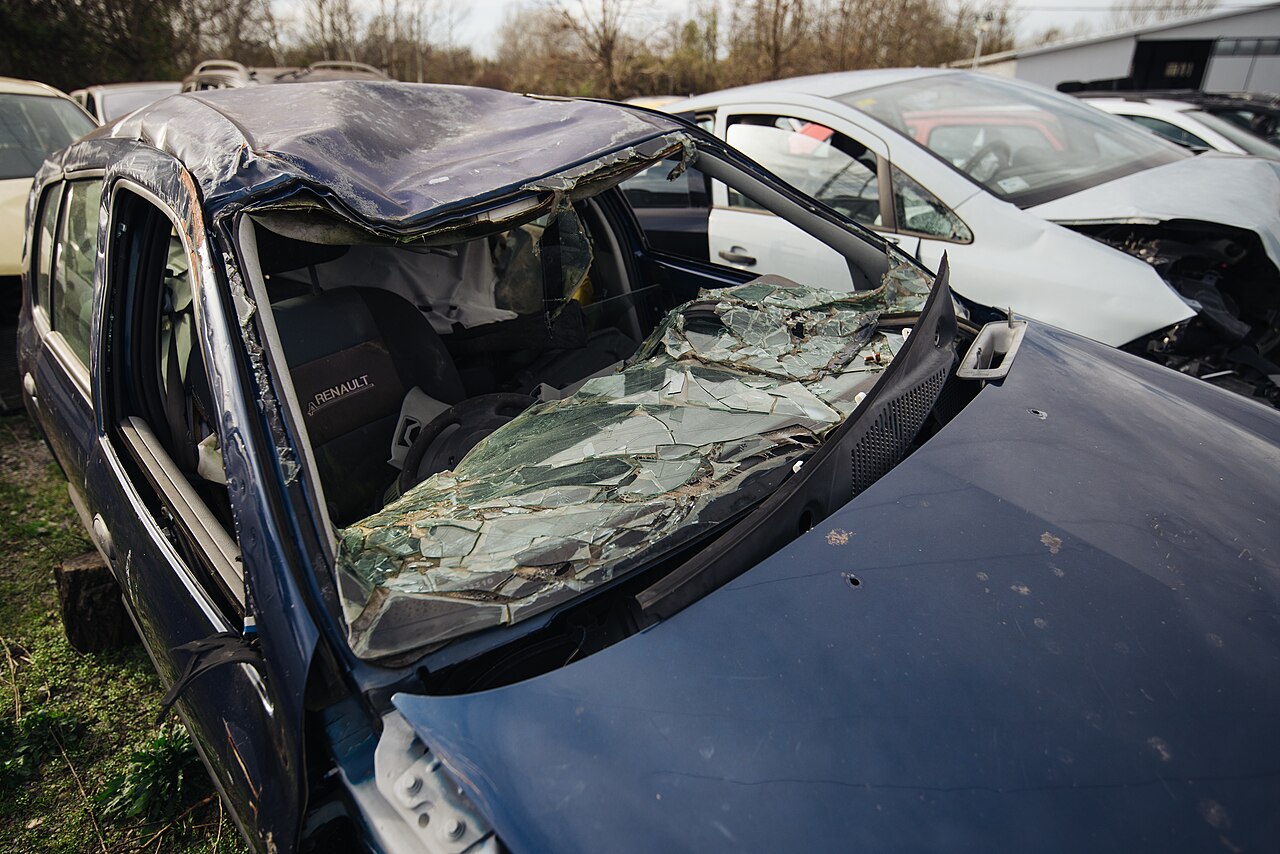
- Nenad Stojković (Shixart1985), “Damaged car in junkyard with a broken windshield,” December 2, 2023 — photograph, Wikimedia Commons, CC BY 2.0; displayed as a reduced-size image.