Priced: road salt still trades in investors' heads as a snowfall lever. New: after a soft North American deicing season, the cleaner question is not whether next winter brings more storms. It is whether suppliers can hold the bid book, keep import and freight costs controlled, and turn price gains into debt reduction before municipalities use full stockpiles to push back.
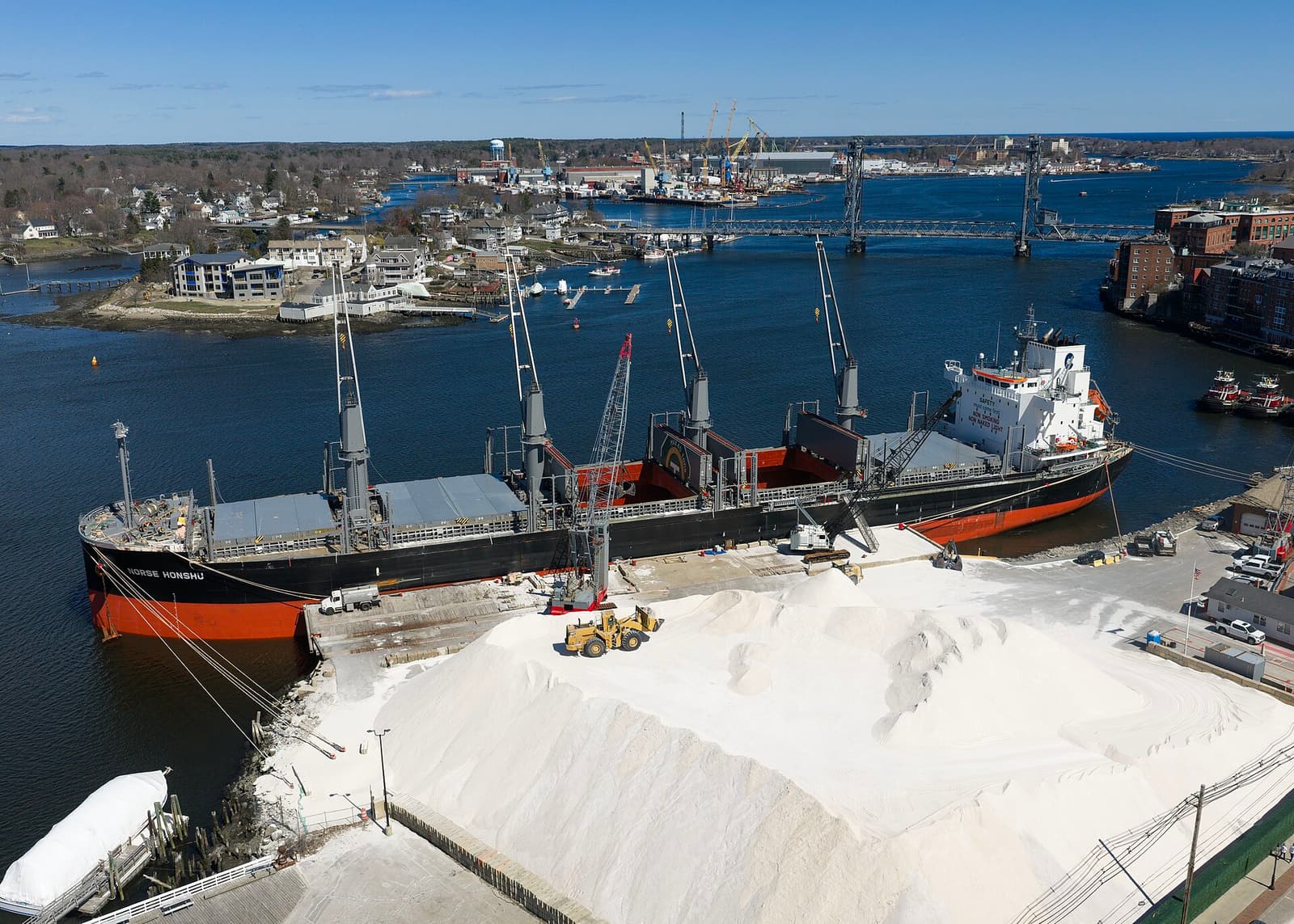
The mechanism is brutally simple. Deicing salt is cheap per pound, heavy to move, seasonal to consume, and expensive to disappoint. A county road department does not buy it because the commodity curve looks attractive. It buys because road crews need physical tons in the dome before ice arrives. That turns the business into a chain: mine or import supply, move it by ship, rail, barge, or truck, store it near the road network, win the bid, then meet delivery windows when every buyer wants salt at once.
The market size is large enough to matter but not large enough to behave like a liquid global commodity. USGS estimated 2025 U.S. domestic salt production at 40 million metric tons, with 39 million metric tons sold or used at about $2.6 billion of value. Chemicals took 42% of reported consumption and highway deicing took 37%. Import reliance was 31%, while rock salt's average unit value was about $54 per metric ton.[1] Those anchors explain why local logistics matter. If the product were high-value and light, distance would matter less. If it were tiny and artisanal, weather would dominate. Salt sits between those poles: big enough for national supply chains, low-value enough for freight and storage to decide local economics.
Compass Minerals is the clean public read on the current trade. In fiscal 2026 second quarter results, management said Salt revenue and adjusted EBITDA declined year over year because highway deicing volumes were lower after mild winter weather across much of North America. At the same time, it emphasized that the Salt platform delivered on commitments and continued to realize pricing gains. Total debt was down 12% year over year to $713.0 million at March 31, 2026, and net debt fell $119.2 million, or 16%, to $638.9 million.[2] That follows a fiscal 2025 reset in which management framed the next year around operational execution and adjusted EBITDA recovery, not just a normal-volume winter.[5] That is the thesis in miniature: if price discipline survives a low-volume winter, the business can still repair the balance sheet.
The counter-reading is in the same release. Compass lowered Salt guidance because regional and product sales mix did not match the forecast, and mine-level production and efficiency gains were not yet where management had expected them to be.[2] That matters because a salt company can look protected by contracts while still missing the mix. A warm winter can leave customers with inventory, reduce urgent replenishment, and shift the next bid season from scarcity psychology toward budget discipline. Pricing can be up in the reported quarter and still be vulnerable if municipalities decide the supplier absorbed less pain than their overtime and snow budgets did.
Bid design is the hidden asset and the hidden risk. Erie County's 2025-2026 road salt bid shows the practical structure better than a commodity chart. The contract period runs from September 1, 2025 through August 31, 2026. The awarded Compass line lists $53.00 per ton for salt plus a $4.79 per ton delivery charge across listed destinations. Participating municipalities guarantee only 70% of their specified quantity, while the vendor must furnish and deliver up to 130% of named quantity. Orders are supposed to be placed at least 48 hours before salt is required, with delivery beginning within two business days and completion generally within three business days.[3]
That structure is why "snowfall was light" is too crude as an investment sentence. The buyer has flexibility. The seller has obligation. The per-ton quote has to cover procurement, storage, availability, dispatch, and optionality around a season nobody can know in September. A supplier that bids too aggressively can win volume and lose economics when storms cluster. A supplier that bids too high can lose share or invite political attention after a quiet winter. The right margin question is not just price per ton; it is price per committed ton after minimums, delivery distance, inventory carry, and emergency call patterns.
Local market structure is also not theoretical. When the FTC challenged K+S's proposed Morton Salt acquisition in 2009, the concern centered on preserving competition in bulk deicing salt sold to state and local governments in Maine and Connecticut. The agency's remedy required divestitures intended to keep competition alive for road-salt buyers.[4] The point for 2026 is not that the same transaction still drives today's economics. It is that the relevant market can be regional, buyer-specific, and logistics-bound. Salt is not priced only in a global spreadsheet. It is priced in lanes, terminals, stockpiles, and procurement offices.
The bullish case is that the market may still be over-weighting weather and under-weighting bid discipline. A weak deicing season hurts volume immediately, but it can also expose whether a supplier has the contract position and cost structure to protect EBITDA per ton. Compass' debt reduction gives that case something tangible: lower leverage widens the margin for another uneven winter and makes future cash flow less captive to interest and refinancing anxiety.[2]
The bearish case is that customers enter the 2026-2027 procurement cycle with too much salt and not enough urgency. Municipal buyers remember a light winter when budgets get tight. If domes are full, bid committees can demand sharper terms, delay orders, or lean harder on guaranteed-minimum language. At the same time, import reliance gives coastal and Great Lakes markets another swing factor: foreign supply can help fill a shortage, but it also means freight, port timing, and currency can decide whether a headline price is actually profitable.[1][3]
The falsifier is concrete. This thesis breaks if 2026-2027 bid tabs show flat-to-down delivered prices while minimum purchase commitments stay loose, and if Compass' next Salt updates show lower deicing volume without offsetting EBITDA-per-ton improvement or further net-debt progress. In that branch, the market was right to treat road salt as a weather volume trade. The price gains would have been cyclical residue, not proof of a better margin base.
The watchlist is short. First, track July-September 2026 municipal and state bid tabs for delivered price, minimum-purchase language, and whether 70%/130% style flexibility remains standard.[3] Second, watch Compass' fiscal third-quarter 2026 report for the quarter ended June 30, 2026, especially Salt mix, production-cost language, and net debt after the softer winter.[2] Third, watch the October 2026 winter-outlook season for freeze-thaw risk rather than headline snowfall, because frequent ice events consume salt differently from one photogenic storm. Fourth, read the 2027 USGS salt update against 2025's 31% import reliance and $54 rock-salt unit value to see whether supply lanes are tightening or normalizing.[1]
Road salt is still a weather-exposed trade. But weather is the first derivative, not the whole model. The margin is made earlier, when suppliers bid the season, position tons, price delivery optionality, and decide how much balance-sheet risk they are willing to carry before anyone knows whether winter will show up.
Sources
- U.S. Geological Survey, Mineral Commodity Summaries 2026: Salt - domestic production, use, value, end-use mix, import reliance, and rock-salt unit-value anchors.
- Compass Minerals, "Compass Minerals Announces Fiscal 2026 Second-Quarter Results" (May 2026) - Salt segment commentary, debt reduction, net debt, adjusted EBITDA, and revised guidance context.
- Erie County Division of Purchase, Bid for Road Salt Materials and Sand, BID #250130-004, 2025-2026 season - contract period, per-ton bid, delivery charge, minimum/maximum quantity terms, and delivery requirements.
- Federal Trade Commission, "FTC Order Preserves Competition in Road Salt Sales to Local Governments in Maine and Connecticut" (September 2009) - regional competition and local-government buyer context for bulk deicing salt.
- Compass Minerals, "Compass Minerals Reports Fiscal 2025 Fourth-Quarter and Full-Year Results" (December 2025) - prior-year operating baseline and management context before the fiscal 2026 deicing season.
- Wikimedia Commons, "File:Bulk carrier unloading road salt in New Hampshire.jpg" - source page for the real photograph used as the article image.