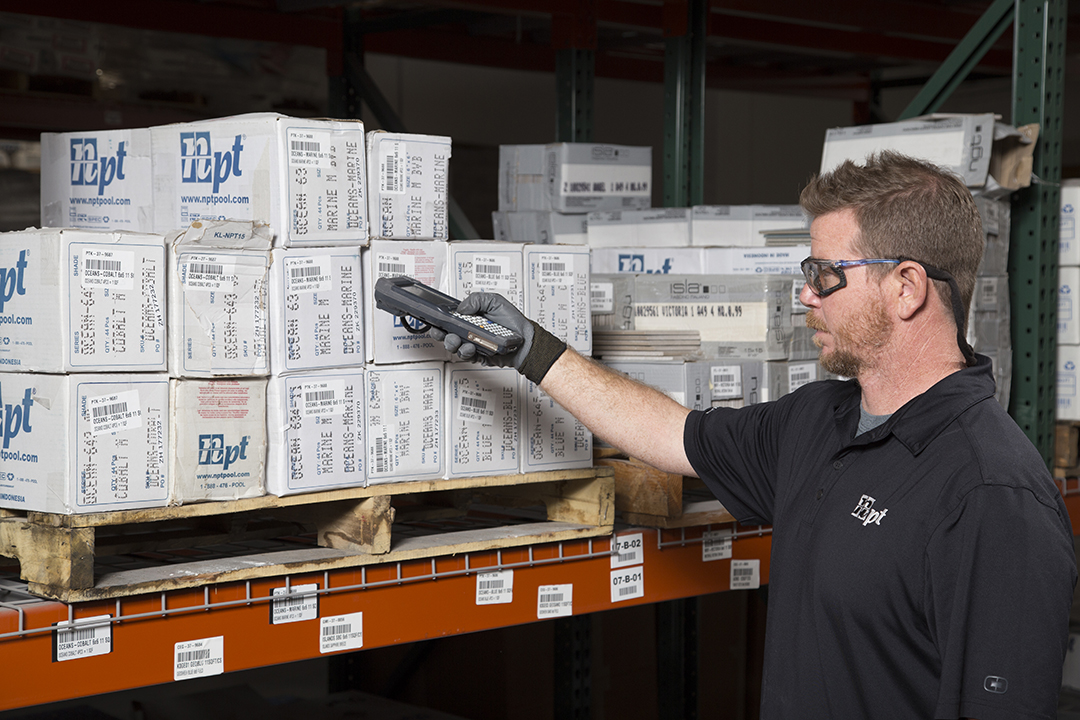
POOLCORP already gets credit for the durable part of the pool economy: maintenance, replacement parts, chemical demand, contractor relationships, and a sales-center network that can keep a backyard asset running through weak housing cycles. The new question is whether that floor is enough for a stock still valued around a high-teens earnings multiple, or whether the next rerating needs a visible recovery in remodel, building materials, and new-pool-adjacent demand.[1][5]
That distinction matters because the business is not a pure leisure-stock call. POOLCORP is a wholesale distributor with 455 sales centers, more than 200,000 products, and roughly 125,000 wholesale customers across North America, Europe, and Australia.[1][3] The core investment case is a route-density and availability case: when a contractor needs tile, pumps, filters, heaters, chemicals, parts, or outdoor-living material in season, the distributor with inventory nearby has pricing and service value. The valuation risk is that a good network can still look expensive if the discretionary side recovers too slowly.
The Six Anchors
First, the market is not paying a distressed multiple. StockAnalysis data had POOL at $211.61 on June 26, 2026, with a market capitalization of about $7.71 billion, a trailing P/E of 19.38, a forward P/E of 18.88, and EV/EBITDA of 14.47.[5] That is not bubble pricing, but it assumes the 2025-2026 lull is cyclical rather than structural.
Second, 2025 was stable, not exciting. POOLCORP reported $5.3 billion of annual net sales, essentially comparable with 2024. Gross margin was 29.7%, while operating income declined to $580.2 million from $617.2 million.[2] The good news is that maintenance sales held steady and discretionary trends improved in the back half. The less flattering read is that the company entered 2026 without much top-line momentum.
Third, Q1 2026 improved, but not enough to end the debate. Net sales rose 6% to roughly $1.1 billion, helped by maintenance products, equipment, price increases, customer early buys, currency, and gradual discretionary improvement. Gross margin slipped 20 basis points to 29.0%, while operating income rose 7% to $82.6 million.[3] That is exactly the mixed signal the stock has to digest: demand is better, but mix and early-buy behavior are not yet a clean margin tailwind.
Fourth, the balance sheet is carrying seasonality and capital returns at the same time. Inventory rose 14% to $1.7 billion at March 31, 2026, and total debt stood around $1.2 billion, with the company noting open-market repurchases over the prior twelve months.[3] In a distributor, inventory is not automatically bad; availability is part of the product. But elevated inventory only helps shareholders if peak-season sell-through converts into margin and cash rather than markdown pressure.
Fifth, housing is still not offering an easy backdrop. Census and HUD reported May 2026 privately owned housing starts at a seasonally adjusted annual rate of 1.177 million, down 15.4% from April, while permits were 1.413 million.[4] POOLCORP is not a homebuilder, and repair/maintenance demand can decouple from starts. Still, new pools, remodel projects, building materials, and outdoor-living upgrades are easier to sell into a confident housing market than into a cautious one.
Sixth, guidance is narrow enough to be testable. After Q1, management confirmed full-year diluted EPS guidance of $10.87 to $11.17, including a small year-to-date tax benefit.[3] Against a stock near $212, the market is effectively asking whether EPS can resume compounding after this transition year, not merely whether the company can defend the current guide.
What The Multiple Is Paying For
The bull case starts with the installed base. A pool is not a one-time consumer purchase after it is in the ground. It needs chemicals, equipment repair, surface maintenance, cleaning tools, safety products, and professional service. That recurring behavior is why POOLCORP's network matters more than a simple category-growth chart. The company can be exposed to discretionary construction while still having a large non-discretionary flow underneath it.[2][3]
The second part of the premium is branch economics. A fragmented contractor base values nearby inventory because downtime is expensive in season. A distributor with hundreds of branches, vendor depth, digital ordering, and service relationships can defend share even when the end market is soft. That is why the valuation should not be judged only by May housing starts. Starts matter, but service levels and availability can keep the company relevant through weaker construction periods.[1][4]
The third part is operating leverage. If discretionary categories are recovering, POOLCORP should be able to put more volume through the same sales-center network and technology base. The Q1 release points to greenfield locations maturing and some operating-expense leverage, which is the right direction.[3] The problem is that a 19x earnings multiple does not just need directionally better commentary. It needs proof that revenue growth can arrive without giving back gross margin to mix, early buys, inflation, or inventory management.
Counterweight
The strongest counterweight is that pool demand may be more normalized than the market wants to admit. The pandemic pulled forward backyard spending, home turnover is still constrained by mortgage-rate lock-in, and a pool remodel is discretionary unless something breaks. The maintenance floor can protect revenue, but it does not automatically restore the richer mix that made prior-cycle earnings look easy.
Cash conversion is the other constraint. In 2025, operating cash flow fell to $365.9 million from $659.2 million, with management pointing to working-capital investment, inventory, and deferred federal tax payments.[2] That explanation is reasonable, but it still raises the hurdle. A distributor can report resilient EPS while cash is temporarily tied up in inventory. Investors should be less forgiving if elevated inventory persists after the selling season and the company needs debt or buyback pacing to smooth per-share optics.
The final counterweight is that the valuation source itself is not screaming cheap. StockAnalysis shows LTM revenue of $5.36 billion, EPS of $10.92, and free cash flow of about $312.7 million.[5] Those figures make POOLCORP look like a quality cyclical, not a bargain-bin cyclical. The right question is not whether the company is good. It is whether the stock is already charging for a recovery that the housing tape and gross-margin mix have not fully delivered.
Falsifier
The clean falsifier is a peak-season pattern where sales growth stays positive but quality does not improve. If Q2 and Q3 show weak discretionary categories, gross margin stuck below the 2025 level, inventory still elevated after the season, and EPS guidance preserved mostly through cost control or capital allocation, then the maintenance-floor thesis is not enough to support the multiple.[2][3][5]
The opposite would strengthen the case. If building materials and discretionary categories keep improving, gross margin moves back toward or above the 2025 level, inventory converts into operating cash, and guidance rises because volume and mix improved rather than because costs were squeezed, the market can treat 2025 as a transition year instead of a new baseline.
Watchlist
- Gross margin versus mix: the stock needs evidence that equipment, early buys, and building-materials growth do not dilute the margin structure.[2][3]
- Inventory sell-through: the $1.7 billion Q1 inventory balance should become service-level advantage and cash conversion, not a year-end overhang.[3]
- Discretionary category language: maintenance is the floor, but remodel and building materials are the rerating lane.[2][3]
- Housing starts and permits: May starts were weak, so single-family permits and builder confidence are useful reality checks for new-pool-adjacent demand.[4]
POOLCORP's valuation is therefore a narrow test. The company has a real distribution moat, a large installed-base service loop, and a network that matters most when customers need product now. But the stock is not priced like the market doubts that floor exists. It is priced as if the floor can turn back into growth. The next proof has to come from margin quality, inventory conversion, and discretionary recovery, not from another reminder that pools need maintenance.
Sources
- POOLCORP Investor Relations, "Investor Relations - POOLCORP" - corporate profile, sales-center scale, product range, and wholesale-customer base.
- POOLCORP, "Pool Corporation Reports Year End and Fourth Quarter 2025 Results; Provides 2026 Earnings Guidance" (February 19, 2026) - 2025 sales, margins, EPS, operating income, operating cash flow, inventory, debt, and 2026 guidance baseline.
- POOLCORP, "Pool Corporation Reports First Quarter Results and Confirms Annual Earnings Guidance Range" (April 23, 2026) - Q1 2026 sales growth, gross margin, operating income, inventory, debt, EPS, guidance, and sales-center count.
- U.S. Census Bureau and U.S. Department of Housing and Urban Development, "Monthly New Residential Construction, May 2026" - permits, housing starts, single-family starts, and construction-cycle backdrop.
- StockAnalysis.com, "Pool Corporation (POOL) Statistics & Valuation" - June 2026 quote, market capitalization, valuation ratios, LTM revenue, EPS, cash flow, and balance-sheet statistics.
- POOLCORP, "Our People" - source page for the real warehouse inventory photograph used as the article image.