Republic Services did not need a heroic macro backdrop to make its 2025 case. The company grew revenue 3.5% to $16.6 billion, lifted adjusted EBITDA 6.9% to $5.31 billion, expanded adjusted EBITDA margin 90 basis points to 32.0%, and increased adjusted free cash flow 11.5% to $2.43 billion.[1] Those numbers already tell you the base business is working.
The priced-vs-new split is therefore narrower than a generic "defensive compounder" story. Priced is that Republic can still push price through a dense disposal network: average yield on total revenue rose 4.1% in 2025 while volume slipped 0.6%, which means the company kept monetizing the core route-and-landfill machine even without broad demand help.[1] New is that the next layer of growth is getting more capital-intensive and more operationally specific. Management spent 2025 completing nine renewable natural gas projects, opening the Indianapolis Polymer Center, and guiding to another year of higher revenue, EBITDA, EPS, free cash flow, and about $1 billion of acquisition spend in 2026.[1] The question is no longer whether Republic can run trash economics. It is whether the sustainability buildout can stay accretive enough to deserve a premium multiple.
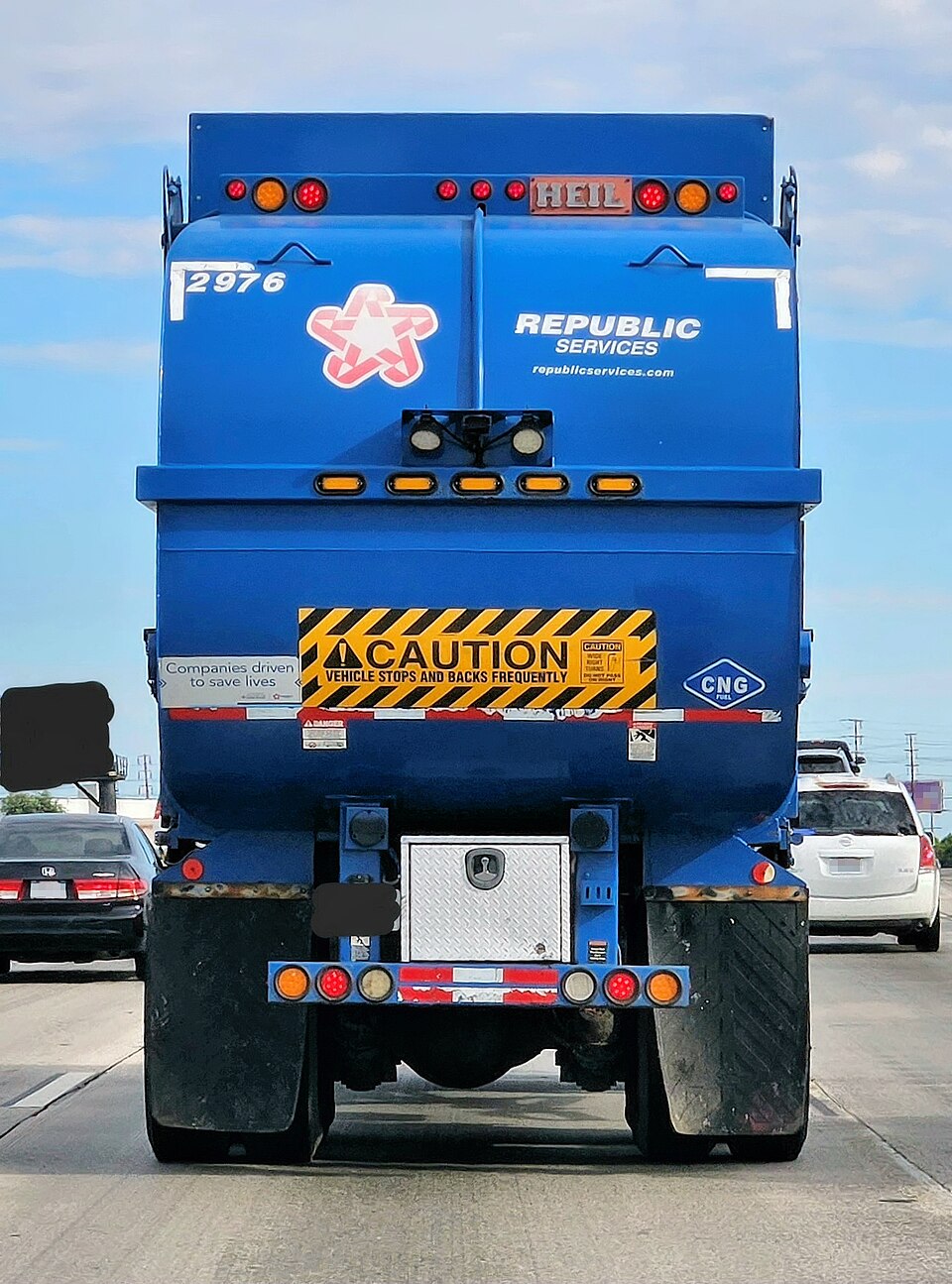
Image context: the cover shows a Republic Services collection truck rather than a symbolic recycling graphic. That is the right anchor because the investment case still begins with route density, transfer, landfill, and collection pricing before it reaches circularity projects.[5]
The results already prove the base machine
The easy part of the 2025 read is operational quality. Republic's related-business core price rose 7.1%, adjusted diluted EPS rose 13% to $6.82, and adjusted free cash flow conversion remained strong enough that the company returned roughly $1.6 billion to shareholders while still funding growth investment.[1] Put differently, the legacy waste franchise is not wobbling. It is still generating the cash that gives management room to build.
That matters because the moat is physical first. In its 2025 Form 10-K, Republic says it operates 377 collection operations, 255 transfer stations, 207 active landfills, 92 recycling centers, 84 renewable energy projects, and 2 polymer centers across the United States and Canada.[2] Investors do not have to imagine the network. It is already there, and it already throws off margins that most industrial businesses cannot match.
Why the debate moved to circularity and RNG
The harder 2026 question sits one layer above collection and disposal. Commodity help was weaker in 2025, not stronger: average recycled commodity prices were $135 per ton, down $29 per ton from the prior year.[1] That is useful because it clarifies what did and did not drive the year. Republic did not post better margins because recycling markets suddenly turned generous. It posted better margins because core pricing, route efficiency, and disposal economics stayed disciplined.
Now management wants the next leg to come from built assets rather than from a simple price-led base business alone. The company says the Indianapolis Polymer Center can process about 175 million pounds annually of recycled plastics for consumer-packaged-goods and other end markets.[3] In the proxy statement, Republic also frames its sustainability program as an operating business, not a branding exercise: Blue Polymers and Blue Sky are positioned as vertical extensions of the recycling network, while landfill-gas-to-RNG projects are meant to turn disposal sites into higher-value energy assets.[4]
That is where the incremental proof sits. These projects can deepen the moat if they scale cleanly off an already advantaged collection-and-landfill system. They can also absorb capital and management attention if returns come in slower than the market expects.
Six numeric anchors
- 2025 revenue: $16.6 billion, up 3.5%.[1]
- 2025 price-volume mix: average yield on total revenue up 4.1%; volume down 0.6%.[1]
- 2025 profitability: adjusted EBITDA $5.31 billion, up 6.9%; adjusted EBITDA margin 32.0%, up 90 bps.[1]
- 2025 cash generation: adjusted diluted EPS $6.82, up 13%; adjusted free cash flow $2.43 billion, up 11.5%.[1]
- Network scale: 377 collection operations, 255 transfer stations, 207 active landfills, 92 recycling centers, 84 renewable energy projects, and 2 polymer centers.[2]
- 2026 proof points: revenue guidance $17.05 billion-$17.15 billion, adjusted EBITDA $5.475 billion-$5.525 billion, adjusted diluted EPS $7.20-$7.28, adjusted free cash flow $2.52 billion-$2.56 billion, plus roughly $1 billion of acquisition spending; the Indianapolis Polymer Center adds about 175 million pounds of annual plastics-processing capacity.[1][3]
Those anchors keep the case honest. Republic is not a fragile recycling turnaround. It is a strong base business trying to add higher-value growth lanes without giving up the discipline that made the base attractive in the first place.
Strongest counterweight
The best pushback is that the company may not need much extra proof at all. Republic already showed in 2025 that price can outrun volume softness, margins can rise while commodity prices fall, and cash generation can support both buybacks and capex.[1] If that remains true, then polymer centers, RNG, and tuck-in acquisitions are upside layers on top of an already premium-quality business rather than make-or-break dependencies.
That counterweight is real. It is the main reason this is not a skeptical short-thesis read. The point is narrower: once the core business is plainly proven, the market naturally shifts its attention to the incremental capital. That is the capital whose return profile now matters most.
Falsifier
This recap becomes too cautious if the next few reporting windows show that the buildout is already compounding cleanly. Concretely, if Republic sustains price-led revenue growth, keeps adjusted EBITDA margin around or above the low-32% area, converts the 2026 free-cash-flow guide, and shows that sustainability-investment earnings are arriving without new margin noise, then the current "prove the accretion" frame would be too conservative.[1][3][4]
Watchlist
- Next quarterly results: the key lines are core price, volume, adjusted EBITDA margin, and free cash flow against the 2026 guide.[1]
- Sustainability asset ramp: investors should watch for utilization and earnings commentary around the Indianapolis Polymer Center and additional Blue Polymers or Blue Sky projects.[3][4]
- RNG cadence: the relevant question is not the headline number of projects alone, but whether renewable-energy projects keep adding profitable output rather than just asset count.[1][2][4]
- Acquisition discipline: management expects about $1 billion of acquisition spend in 2026, so the next proof is whether purchased growth arrives at the same return quality as the legacy network.[1]
Takeaway
Republic Services already answered the easy 2025 question. The collection, transfer, landfill, and pricing machine is intact, and it is still generating high-quality cash. The better 2026 question is about incremental capital: can polymer, RNG, and acquisition spending widen the franchise without making margins, conversion, or execution quality noisier? That is the part of the story that still has to earn the premium.
Sources
- Republic Services, "Republic Services, Inc. Reports Fourth Quarter and Full Year 2025 Results" (SEC Exhibit 99.1, February 13, 2026).
- Republic Services, Annual Report on Form 10-K for the year ended December 31, 2025 (filed February 13, 2026).
- Republic Services, "Republic Services and Blue Polymers Celebrate the Opening of Indianapolis Plastics Recycling Complex" (March 18, 2025).
- Republic Services, Definitive Proxy Statement on Schedule 14A (March 26, 2026), including sustainability and circularity discussion.
- Wikimedia Commons, "File:Republic Services garbage truck.jpg."