ADP already earned the right to trade above an ordinary business-services multiple. In fiscal 2025, revenue reached $20.6 billion, adjusted diluted EPS reached $10.01, adjusted EBIT margin reached 26.0%, Employer Services new business bookings rose to a record $2.1 billion, and Employer Services client retention held at 92.1%.[1] That is the kind of operating base investors are willing to pay for.
The valuation question is narrower now. Priced is that ADP remains a durable payroll-and-HCM control point with sticky clients, recurring revenue, and meaningful cash generation. New is that, at about $201.28 per share on 2026-04-01, the company sits near an $81.9 billion equity value and roughly 20x trailing adjusted EPS.[2][4] From here, the next leg higher needs more than admiration for quality. It needs bookings, client-funds yield, and payroll volume to keep offsetting a U.S. employment backdrop that no longer looks like an effortless tailwind.
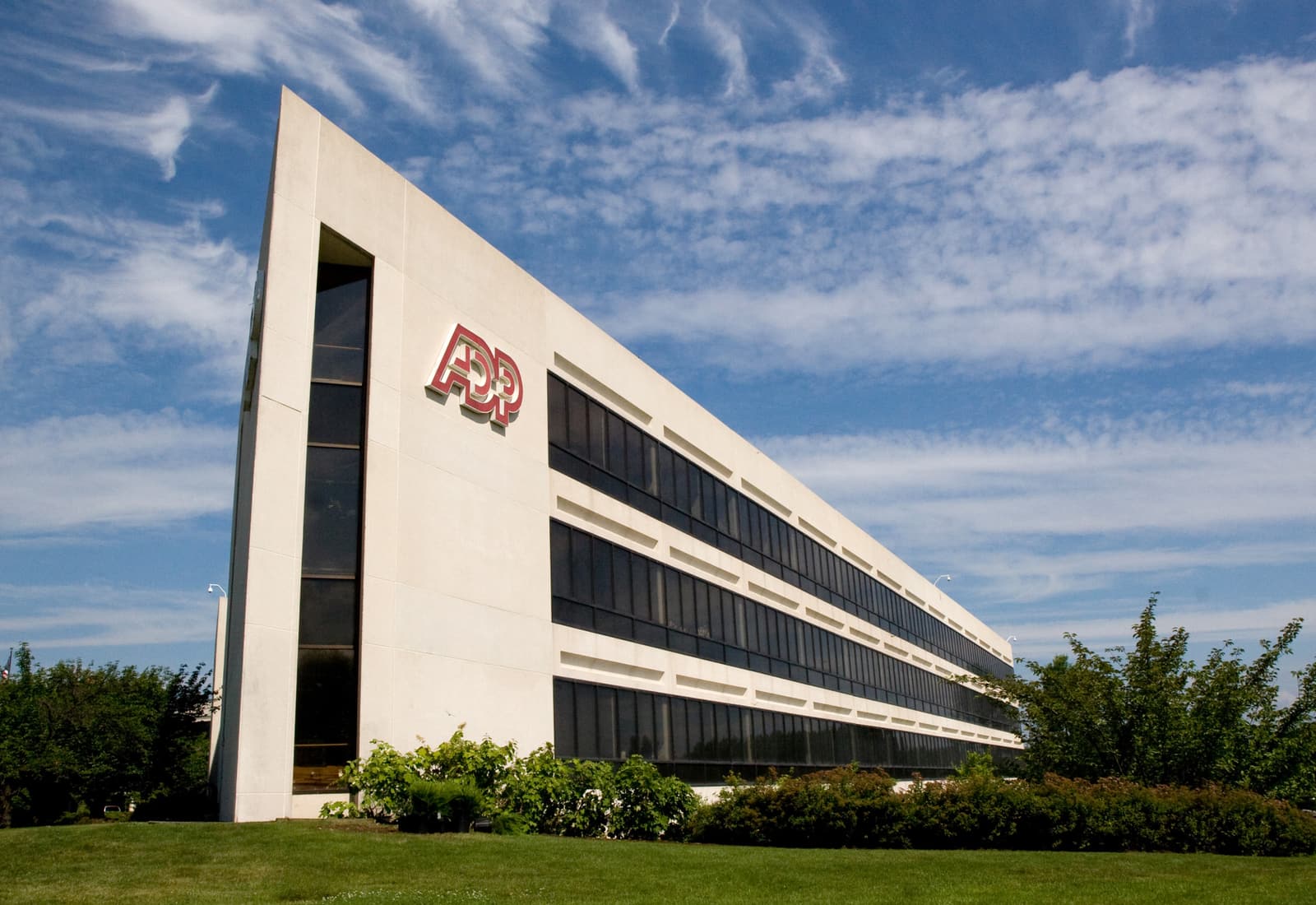
Image context: the cover uses a documentary photograph of ADP headquarters rather than a symbolic software graphic. That fits the article because the investment case is about a concrete operating system for payroll and HR, not about abstract fintech mood lighting.[7]
Why the premium exists
The easy part of the case is operating quality. ADP's fiscal 2025 results describe a business that still compounds through several lanes at once: recurring Employer Services revenue, PEO scale, pricing, and interest income on client funds.[1] The company also used that base to return $3.7 billion to shareholders in fiscal 2025, including $2.4 billion of dividends and $1.3 billion of repurchases.[1]
That same structure carried into the first half of fiscal 2026. For the six months ended December 31, 2025, revenue rose 8% to $9.88 billion, adjusted EBIT margin expanded 90 basis points, and adjusted diluted EPS rose 12% to $4.69.[2] ADP also said its U.S. pays-per-control metric rose 2%, while PEO average worksite employees rose 3%.[2] Those are not heroic numbers, but they are exactly the kind of steady operating signals that keep a premium franchise premium.
What the multiple still has to earn
The harder part is that some of the current support comes from variables investors should treat as strong, but not eternal. Interest on funds held for clients contributed $526.1 million in the first half of fiscal 2026, up from $427.1 million a year earlier, helped by an average interest rate earned of 3.1% on average client funds balances of $35.3 billion.[2] That income stream is real. It is also partly a rate-and-reinvestment story, not only a software-quality story.
ADP's own 2025 investor-day deck makes that split clearer. Management's medium-term objectives call for 6% to 7% revenue growth, about 50 to 75 basis points of annual margin expansion, and 9% to 11% adjusted EPS growth, while roughly $13 billion of client-funds assets mature in fiscal 2026 and fiscal 2027 at reinvestment rates above the older book.[3] That is the bull case in one frame: the core HCM machine stays sticky, the client-funds ladder keeps helping, and margin discipline remains intact.
The valuation discipline is that some of those positives are already embedded in the stock. If ADP is worth about $81.9 billion at roughly 20.1x trailing adjusted EPS, then investors are already paying for durable compounding, not for a turnaround.[1][2][4] The next re-rating therefore needs proof that bookings and payroll volume keep refreshing the base even if the employment backdrop cools from very healthy to merely decent.
Six numeric anchors
- Fiscal 2025 base quality: revenue $20.6 billion, adjusted diluted EPS $10.01, and adjusted EBIT margin 26.0%.[1]
- Fiscal 2025 commercial engine: Employer Services new business bookings $2.1 billion and Employer Services client retention 92.1%.[1]
- First-half fiscal 2026 growth: revenue $9.88 billion, up 8%, with adjusted diluted EPS $4.69, up 12%.[2]
- First-half fiscal 2026 activity: U.S. pays per control up 2% and PEO average worksite employees up 3%.[2]
- Client-funds tailwind: interest on funds held for clients $526.1 million, average interest rate earned 3.1%, average client funds balances $35.3 billion.[2]
- Current valuation frame: about $201.28 per share on 2026-04-01, about 406.9 million shares outstanding, roughly $81.9 billion of equity value, and about 20.1x trailing adjusted EPS.[2][4]
Those anchors point to the same conclusion. ADP is a high-quality franchise. The stock is priced like investors already know that.
Strongest counterweight
The best pushback is that ADP may deserve this valuation even with a softer employment clock, because the company has more than one compounding lever. The investor-day deck argues for a model that can still produce 6% to 7% revenue growth and 9% to 11% adjusted EPS growth through scale, product mix, margin discipline, and a positive client-funds reinvestment differential.[3] If that framework keeps landing, then 20x trailing adjusted EPS is not obviously stretched for a business of this quality.[1][3][4]
That counterweight is real. It is why this is not a short-thesis article. The claim is narrower: once a premium multiple is already in place, the burden shifts from proving resilience to proving a fresh acceleration layer.
Falsifier
This walkthrough becomes too cautious if the next two reporting windows show that ADP is still expanding cleanly through all three key lanes at once: bookings, payroll volume, and client-funds income. Concretely, if bookings growth re-accelerates, pays per control stays positive, and client-funds yield remains favorable without a giveback in margin, then the current multiple would look less full than this framework suggests.[2][3][5]
Watchlist
- 2026-04-03 U.S. employment report: a cooling but still positive labor market can keep payroll volumes healthy; a sharper slowdown would pressure the pays-per-control layer that supports Employer Services growth.[6]
- 2026-04-29 ADP fiscal Q3 2026 results: the cleanest company-specific check is whether bookings, pays per control, PEO worksite-employee growth, and client-funds income still line up in the same direction.[5]
Takeaway
ADP still looks like what investors think it is: a disciplined payroll-and-HCM franchise with strong retention, good margins, and a useful client-funds income stream. The narrower valuation question is what remains new. At roughly 20x trailing adjusted EPS, the stock no longer needs to prove it is good. It needs to prove that bookings, employment-linked volume, and client-funds reinvestment can keep the compounding slope high enough to justify paying up from here.
Sources
- ADP, Annual Report 2025 (fiscal year ended June 30, 2025).
- ADP, Quarterly Report on Form 10-Q for the quarter ended December 31, 2025.
- ADP, 2025 Investor Day Presentation (June 11, 2025).
- Yahoo Finance chart API, ADP 5-day daily-price endpoint, accessed 2026-04-01.
- ADP, "ADP to Announce Third Quarter Fiscal 2026 Financial Results on April 29, 2026."
- U.S. Bureau of Labor Statistics, "Employment Situation News Release Schedule."
- Wikimedia Commons, "File:ADP Headquarters.jpg."