Renewable diesel is already priced as a policy-supported volume story. The new problem is that the next margin dollar is less about whether refiners can make the fuel and more about whether they can prove the feedstock deserves the credit.
That distinction matters in 2026 because the policy stack has stopped being a simple growth tailwind. The Renewable Fuel Standard now points to larger biomass-based diesel demand, California is tightening how much crop-oil diesel can earn full LCFS credit, and 45Z has moved the federal subsidy from a broad blender-style habit toward a producer credit tied to lifecycle emissions and sourcing rules.[1][3][5] The trade is no longer "renewable diesel capacity grows." It is "which gallons keep the best after-credit spread when low-carbon feedstocks are scarce and paperwork matters."
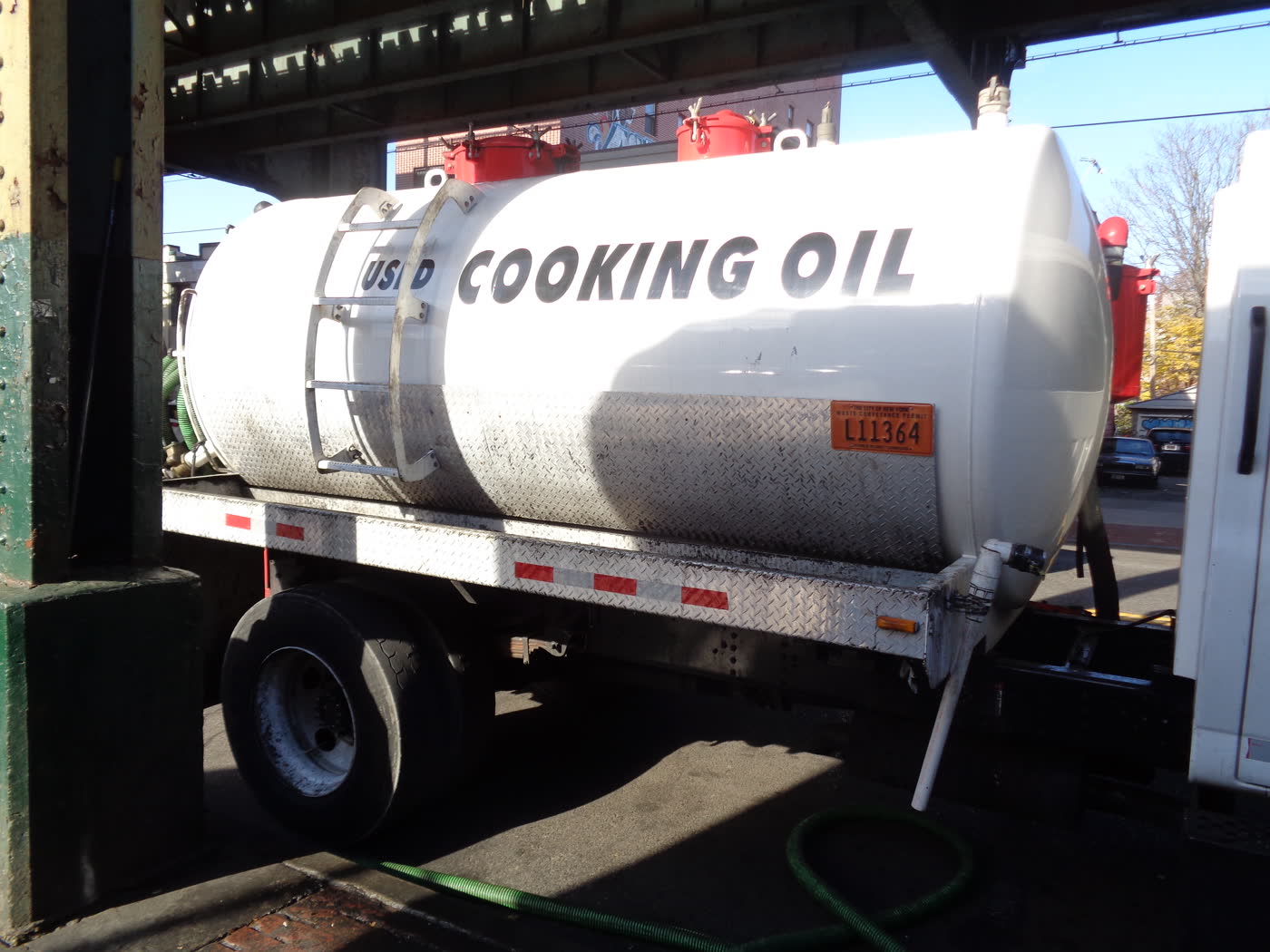
The cover image, a used-cooking-oil collection truck in Woodside, Queens, is mundane on purpose: the economics of low-carbon diesel increasingly start with physical collection, aggregation, and origin records rather than with a refinery headline.[7]
Base Case: Mandates Support Volume, Feedstock Decides Margin
The demand floor is stronger than it was a year ago. EPA's final Set 2 RFS fact sheet puts biomass-based diesel requirements at 9.07 billion RIN gallons for 2026 and 9.20 billion for 2027, after small-refinery-exemption reallocation volumes are included.[1] That is the clearest bullish input: obligated parties need compliance gallons, and biomass-based diesel is the category with the largest step-up.
Capacity also exists. EIA's 2025 renewable diesel and other-biofuels capacity table lists large installed bases in California at 1.684 billion gallons per year and Louisiana at 1.450 billion, with additional capacity in Texas, Wyoming, North Dakota, Montana, New Mexico, Washington, Oklahoma, and Kansas.[2] Summed across the listed states, the table implies roughly 4.7 billion gallons per year of annual capacity. The market is not waiting for a science project to become industrial.
The margin issue sits underneath that capacity. Renewable diesel can use soybean oil, canola oil, tallow, corn oil, yellow grease, used cooking oil, and other fats and oils. EIA's March 2026 feedstock table shows the mix is already stretched: total soybean oil use for biofuels reached 1.283 billion pounds, with 587 million pounds consumed at renewable diesel plants, while tallow was 559 million pounds and yellow grease, which includes used cooking oil, was 314 million pounds.[6] The feedstock book is no longer a minor procurement line. It is the economic control surface.
That makes the base case straightforward: volumes can keep moving, but the premium belongs to producers with advantaged sourcing, flexible pretreatment, and documentation systems that can keep waste-oil, tallow, and North American feedstocks inside the highest-value lanes.
Upside Case: Traceable Waste Oils Become A Defensible Spread
The upside branch is not just higher RINs or higher LCFS prices. It is better segregation. If producers can lock in traceable used cooking oil, tallow, and other low-carbon feedstocks while competitors are forced back toward crop oils, then the spread can widen even if headline renewable diesel production grows.
USDA's February 2025 Oil Crops Outlook explains why this is powerful and fragile at the same time. Used cooking oil imports surged enough that, assuming all imported UCO went to biofuel use, they represented 13% of total biomass-based diesel feedstocks in marketing year 2023/24, up from 7% the prior year; China alone accounted for 55% of U.S. UCO imports in that period.[4] That import surge helped feed the industry, but it also made origin proof a policy issue rather than a back-office detail.
The 45Z proposed regulations sharpen that point. Treasury and the IRS said they were concerned about reliably distinguishing imported UCO from palm oil, and for fuel produced after December 31, 2025, 45Z generally requires transportation fuel to be derived from feedstock produced or grown in the United States, Mexico, or Canada.[5] The proposal also says foreign-feedstock pathways, including UCO, will not be available in the 45ZCF-GREET model until further guidance.[5] In market terms, a cheap cargo is not cheap if it knocks the finished fuel out of the richer credit lane.
California adds a second filter. CARB's adopted LCFS update moved forward with a 20% companywide cap on biobased diesel fuels from virgin crop oils such as soybean, canola, and sunflower-seed oils, with the cap for companies that already have certified pathways taking effect in 2028.[3] It is not a physical volume cap, but it changes the credit math. If crop-oil gallons exceed the creditable share, the incremental economics can fall back toward benchmark treatment.
The upside case is therefore a sourcing moat. Producers with domestic or North American waste-oil networks, robust aggregator audits, and flexible feedstock pretreatment can protect carbon intensity, credit eligibility, and utilization. Producers buying whatever oil is cheapest on the spot market may still run, but they may not earn the same all-in economics.
Downside Case: Capacity Runs, But The Best Credits Thin Out
The downside branch is not a collapse in renewable diesel demand. It is a compression in the premium between a good gallon and an ordinary one.
Three things would drive that. First, low-carbon feedstock supply could prove too small relative to capacity. A waste stream cannot expand like a planted acre. Restaurants can collect used oil more efficiently, but they cannot fry their way into unlimited feedstock. If the best waste oils are bid away by renewable diesel, biodiesel, and sustainable aviation fuel at once, input cost rises until part of the credit benefit leaks to collectors and aggregators.
Second, policy could make imported waste oils harder to monetize. EPA proposed an imported-RIN reduction in the 2025 Set 2 proposal, but the final rule did not implement that exact lever for 2026 and 2027; 45Z, however, still creates a separate sourcing gate for post-2025 fuel.[1][5] That leaves producers in an awkward middle ground. Imported feedstocks may still help physical supply, but they can be less useful for the federal producer-credit strategy unless and until guidance gives a clean pathway.
Third, soybean oil may become the balancing feedstock. EIA's March 2026 data already show soybean oil is the largest listed biofuel feedstock by a wide margin.[6] It is scalable, liquid, and tied to the domestic crush system. But California's 20% LCFS cap for soy, canola, and sunflower-seed oils makes it harder to treat crop oil as an unlimited high-credit substitute in the key West Coast market.[3] If producers are pushed toward more soybean oil just as crediting rules favor waste and traceability, utilization can stay healthy while margin quality deteriorates.
Falsifier
This scenario analysis is too cautious if three things happen together: EPA's higher RFS volumes are absorbed without a durable feedstock price squeeze, Treasury/IRS guidance creates administrable North American UCO documentation rather than a compliance bottleneck, and LCFS credit values reward low-carbon diesel enough to offset higher feedstock costs. In that branch, installed capacity and policy support can still convert into strong cash margins.
The bearish confirmation is different. If renewable diesel plants keep running but disclose weaker capture from 45Z, higher delivered costs for waste oils and tallow, or more reliance on crop oils that earn less LCFS value, then the market will have overpaid for nameplate capacity and underpriced feedstock quality.
Watchlist
- June 30, 2026 EIA feedstock update: March is the latest EIA release in the table; the next report should show whether soybean oil keeps carrying the marginal gallon or whether tallow/yellow grease rebounds.[6]
- 45Z final guidance and GREET updates: the key language is not only the dollar amount, but how UCO, Canada/Mexico sourcing, aggregators, and substantiation are treated.[5]
- California LCFS pathway filings: watch whether producers adapt before the 2028 existing-pathway crop-oil limit bites.[3]
- RFS compliance-year pricing: EPA's 2026 and 2027 BBD volumes are supportive, but RIN price behavior will reveal whether the physical market is tight or merely administratively larger.[1]
The conclusion is narrower than the renewable-fuels slogan. Renewable diesel still has mandate support, real infrastructure, and a large addressable diesel pool. But the public-market read has shifted from capacity to proof. The better gallon is traceable, low-carbon, eligible, and sourced before competitors arrive. The weaker gallon is just a hydrotreating run looking for a subsidy it may no longer fully earn.
Sources
- U.S. Environmental Protection Agency, Detailed Fact Sheet: EPA's Final "Set 2" Rule Under the Renewable Fuel Standard (RFS) Program (March 2026) - final 2026 and 2027 RFS volume requirements, including biomass-based diesel RIN gallons.
- U.S. Energy Information Administration, "U.S. Renewable Diesel Fuel and Other Biofuels Plant Production Capacity" (2025 table) - state-level renewable diesel and other-biofuels capacity.
- Ron Kotrba, "California updates LCFS program, moves forward with 20% cap on biofuels from crop oils," Biobased Diesel Daily (updated February 19, 2025) - report on CARB's adopted LCFS update and crop-oil cap timing.
- USDA National Agricultural Library, Oil Crops Outlook (February 13, 2025) - publication page for USDA ERS OCS-25B, including the report with used-cooking-oil import shares, China import share, and biomass-based diesel feedstock context.
- Federal Register, "Section 45Z Clean Fuel Production Credit" proposed regulations (February 4, 2026) - 45Z applicable amount, emissions-factor mechanics, and foreign-feedstock/UCO substantiation discussion.
- U.S. Energy Information Administration, "U.S. Feedstocks Consumed for Production of Biofuels" (release date May 29, 2026) - March 2026 feedstock consumption by category.
- Wikimedia Commons, "File: Roosevelt Av Woodside 01 - Used Cooking Oil.jpg" - source photograph for the article image.