FactSet no longer trades as if the financial terminal is dead. At the latest regular close before this article, June 12, 2026, FDS was at $241.16, with an $8.79 billion market value, 15.51x trailing earnings, and 13.06x forward earnings.[4] That is not a software-bubble multiple, but it is also not distressed. Priced is that FactSet still owns a durable subscription workflow franchise. New is whether second-quarter 2026 ASV acceleration can become margin repair rather than only more spending on data, compensation, AI, and platform plumbing.[1][2][4]
The company gave investors a cleaner growth signal in the February quarter. Q2 revenue rose 7.1% to $611.0 million, organic revenue rose 6.8%, and organic annual subscription value reached $2.449 billion, up 6.7% year over year.[1] That is the reason the stock deserves a second look after a difficult prior year. The terminal-style business has not stopped compounding; clients are still renewing, users are still being added, and the company is still embedding more data and analytics into institutional, wealth, dealmaker, and market-infrastructure workflows.[1][2]
Six Anchors
- $241.16: FDS's June 12, 2026 close, versus a 52-week range of $185.00 to $453.41.[4]
- $611.0 million: Q2 fiscal 2026 revenue, up 7.1%, with organic revenue up 6.8%.[1]
- $2.449 billion: organic ASV at February 28, 2026, up 6.7% year over year and up $38.0 million over three months.[1]
- 35.0%: Q2 adjusted operating margin, down 230 bps year over year, even as adjusted diluted EPS rose 4.2%.[1]
- 9,101 clients and 241,352 users: the operating footprint at quarter end, with annual ASV retention above 95%.[1]
- $163.0 million: Q2 repurchases at an average price of $250.14, leaving $697.1 million authorized.[1]
Those anchors make the stock more interesting than a simple "cheap data vendor" note. FactSet's multiple has already compressed. The valuation question is whether the business is entering a cleaner phase where growth acceleration, client retention, and buybacks flow through to earnings, or whether the company must keep spending heavily just to defend the desktop and enterprise-data position.
Why The Franchise Still Matters
FactSet's strongest asset is not one screen. It is client habit. The company describes its platform as financial data, analytics, AI-powered tools, and enterprise solutions embedded in the workflows of investment professionals.[5] The 10-Q frames the business across Institutional Buyside, Dealmakers, Wealth, and Market Infrastructure, with three geographic segments: Americas, EMEA, and Asia Pacific.[2] That matters because the bear case often treats FactSet like a single workstation threatened by cheaper data and AI summarization. The actual model is wider: portfolio analytics, screening, private-capital monitoring, risk, reporting, research distribution, market data, client datasets, and managed services.
The Q2 operating details support that view. Client count rose by 98 over three months, user count rose by 1,489, and management said growth was driven by corporate, wealth management, and dealmaker users.[1] FactSet also announced a multi-year Barclays agreement, expanded Kepler Cheuvreux aftermarket research on the platform, launched AI Doc Ingest for Cobalt, and after the quarter added AI-driven financial-crime risk-management capabilities inside the Workstation through ComplyAdvantage.[1] None of those items alone changes valuation. Together, they show that the product surface is still moving from "terminal" toward "workflow layer."
This is the bull case: if FactSet keeps the data contract, the workflow integration, and the user relationship, AI becomes a feature amplifier rather than a pure substitution threat. A private-capital user does not only need a large-language-model answer. They need messy portfolio-company documents ingested, normalized, permissioned, and routed into monitoring workflows. A bank user does not only need a generic risk summary. They need screening and onboarding tools inside a controlled workflow. FactSet's opportunity is to make those jobs less manual while keeping the data entitlement and audit trail.
The Margin Question Is Not Cosmetic
The problem is that growth did not yet convert cleanly into operating leverage. Q2 adjusted operating margin fell to 35.0% from 37.3% a year earlier, and GAAP operating margin fell to 30.3% from 32.5%.[1] The company cited higher employee compensation, technology-related expenses, professional fees, and amortization, with revenue growth partly offsetting the pressure.[1] That is the entire investment debate in one sentence.
Investors can tolerate investment spending when ASV accelerates. They become less forgiving if the spend begins to look like a permanent tax. Fiscal 2025 already showed the tension: the annual report shows revenue rising 6.2% to $2.29 billion, adjusted operating margin at 36.3%, and adjusted diluted EPS at $16.98.[3] Q2 2026 guidance now points to $2.45 billion to $2.47 billion of fiscal-year revenue and adjusted EPS of $17.25 to $17.75.[1] That is progress, but it is not yet a dramatic operating-leverage story.
The charitable reading is that FactSet is investing through a platform transition. More content engineering, AI product work, data rights, private-capital tools, and enterprise integration can depress margins before they widen the moat. The harder reading is that the competitive bar has simply gone up. Bloomberg, LSEG, S&P Global, MSCI, Morningstar, banks' internal data stacks, specialist alt-data vendors, and AI-native research tools all compete for slices of the same budget. Under that branch, FactSet must spend more merely to keep its seat.
Buybacks Help Only If The Base Holds
Capital allocation looks opportunistic. FactSet repurchased 651,750 shares in Q2 for $163.0 million at an average of $250.14.[1] With the stock below that average at the June 12 close, buybacks can still make sense if management is right that ASV growth and margin repair are coming.[1][4] The company also paid a $1.10 quarterly dividend in March and later announced a dividend increase in May.[1][5]
The repurchase argument is strongest because the valuation is no longer stretched by FactSet's own history. A 15.51x trailing P/E and 13.06x forward P/E are not demanding for a company with above-95% ASV retention, a global user base above 241,000, and an S&P 500 market-data franchise.[1][4] The market is effectively asking whether FactSet is ex-growth or only temporarily margin-constrained. Q2 gives management evidence for the second answer.
But buybacks are not a substitute for product proof. If ASV slows, client retention slips, or margin keeps falling, a cheaper multiple will have been a warning rather than an opportunity. Repurchases work best when they shrink the share count around a business whose unit economics are stabilizing. They do not fix a workflow franchise that must overinvest forever.
What Has To Be True
For the stock to rerate, three things have to happen together. First, organic ASV growth has to stay near the raised fiscal 2026 guide of $130 million to $160 million, rather than sliding back toward the prior lower range.[1] The important detail is not just the full-year number; it is whether the $38.0 million sequential Q2 ASV increase becomes a cadence, not a one-quarter catch-up.[1]
Second, margin has to stop leaking. Management kept fiscal 2026 adjusted operating-margin guidance at 34.0% to 35.5% even while raising revenue and EPS guidance.[1] That means Q2's 35.0% margin was not a disaster, but it also did not prove operating leverage. The next useful evidence is whether revenue growth can pay for compensation and technology investment without holding adjusted margin near the bottom of the historical range.[1][3]
Third, AI has to attach to paid workflow rather than remain a press-release layer. AI Doc Ingest for Cobalt, the chief AI officer appointment, and Workstation financial-crime integration are credible signals because they target specific work: private-capital document extraction, enterprise platform strategy, onboarding, screening, and risk monitoring.[1] The stock needs those features to support ASV, retention, or seat expansion. If they only raise engineering cost, the AI story becomes margin dilution with better vocabulary.
Counterweight
The strongest bearish counterweight is that FactSet may be structurally caught between larger data platforms and narrower specialists. LSEG owns Refinitiv and post-trade assets. S&P Global and MSCI own benchmark and index toll roads. Bloomberg owns the iconic terminal network. AI-native tools can attack research summarization and document handling from below. FactSet's middle position is valuable only if it keeps winning workflow depth.
The bullish counterweight to that is client inertia plus integration. Financial-data budgets are not switched like consumer apps. Permissioning, compliance review, portfolio models, Excel links, APIs, third-party data, historical identifiers, user training, and internal reporting all create friction. A vendor that is embedded across those layers can keep compounding even without owning every glamorous data category. Q2's retention and user growth suggest that inertia still has economic value.[1]
Falsifier
The thesis fails if FactSet's raised ASV outlook does not turn into margin stabilization. The concrete break point is this: organic ASV growth falls below the low end of the $130 million to $160 million fiscal 2026 guide, adjusted operating margin stays near or below 34%, client or ASV retention drops below the above-95% zone, and management continues repurchasing stock without evidence that AI and workflow investments are lifting paid adoption.[1][4]
Under that branch, FactSet would still be a real company with a real client base. It would not deserve to be treated as a discounted compounder. It would be a mature data vendor spending hard to defend a slowing franchise.
Watchlist
- July 1, 2026 Q3 webcast: the next print should show whether Q2 ASV acceleration carried into the quarter ended May 31.[5]
- Adjusted operating margin: the fiscal guide allows 34.0% to 35.5%; investors should care where the result lands inside that range, not only whether revenue beats.[1]
- User and client additions: wealth, dealmaker, and corporate growth need to keep adding users without weakening retention.[1]
- AI product monetization: watch for management tying AI Doc Ingest, Workstation integrations, and platform strategy to ASV, not just engagement anecdotes.[1]
FactSet's setup is narrower than "AI saves the terminal" and better than "the terminal is obsolete." The business is still adding ASV, users, clients, and workflow surface. The stock has already given up enough multiple that growth does not need to be heroic. What it does need is proof that the same investments making the platform more relevant can also let margins recover. In 2026, that is the valuation bridge.[1][3][4]
Sources
- FactSet, "FactSet Reports Results for Second Quarter 2026" (March 31, 2026) - Q2 revenue, organic ASV, margins, EPS, free cash flow, users, retention, buybacks, guidance, and product updates.
- FactSet, Form 10-Q for the quarter ended February 28, 2026 - segment structure, geographic revenue, operating income, capital expenditures, and risk disclosures.
- FactSet Research Systems Inc., 2025 Form 10-K - fiscal 2025 revenue, adjusted operating margin, adjusted EPS, liquidity context, and longer operating baseline.
- StockAnalysis.com, "FactSet Research Systems Inc. (FDS) Stock Price & Overview" - June 12, 2026 close, market cap, valuation multiples, 52-week range, shares outstanding, and earnings date.
- FactSet Investor Relations overview - company positioning, fiscal 2025 highlights, news feed, and July 1, 2026 third-quarter webcast date.
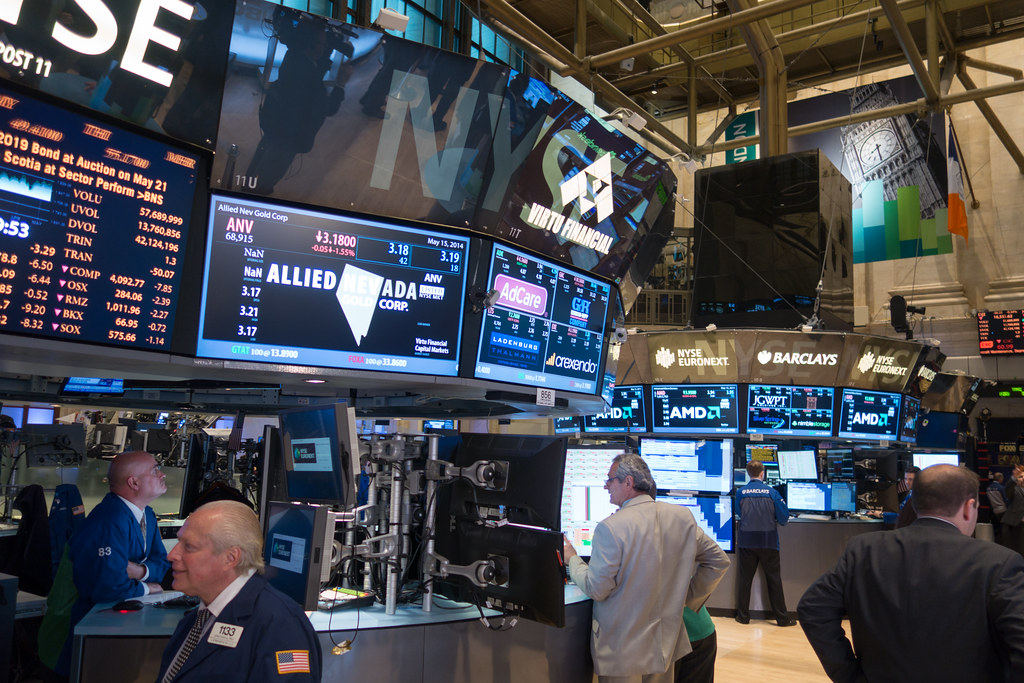
- Wikimedia Commons, "File:Trading Floor at the New York Stock Exchange.jpg" - Scott Beale photograph of the NYSE trading floor, June 24, 2014, used as the article's real photographic image source.