A remanufactured engine component can carry a compelling discount and still require the buyer to find as much cash as a new one. The missing part of the comparison is the refundable deposit: some of the saving depends on sending the old component back in acceptable condition.[1][2]
That makes the worn engine block more than workshop scrap. It is part of the payment, with an inspection still to pass.
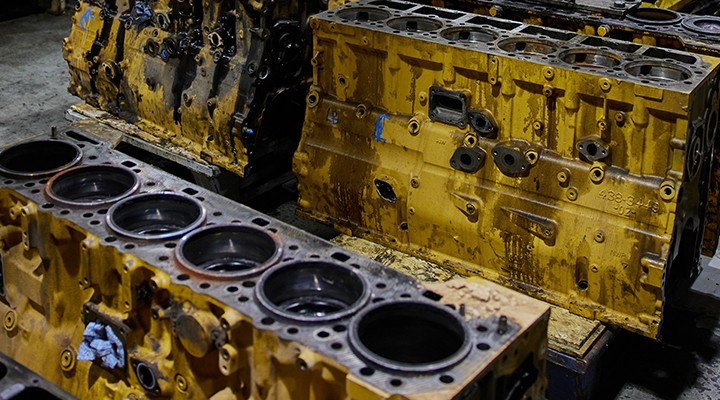
The part moving in the opposite direction
Caterpillar describes an exchange business. A customer buys a remanufactured component at a price below new, pays an additional core deposit and receives that deposit back when the used component returns. The company tracks returns and determines credits through its core-management system.[2] The term core means the used component that can enter the remanufacturing process.
The economic bargain runs in both directions. The customer receives a replacement; the manufacturer recovers material with useful engineering already embodied in it. Caterpillar describes restoring worn components through salvage processes, reducing the need for new parts and raw material.[2] The deposit gives the owner a reason to put that material into the return network instead of leaving it behind the workshop.
But a failed part and an acceptable core are different categories. Caterpillar's published criteria generally require a complete, assembled component with an acceptable part number, without visible cracks or damage from mishandling or excessive corrosion. Criteria vary by component, and some allow partial refunds.[1] The refund therefore depends on what reaches inspection, not simply on whether the replacement has been installed successfully.
A discount that arrives after the invoice
Consider an illustrative cash purchase, not a manufacturer quotation. A new component costs $10,000. A remanufactured alternative costs $7,000, plus a $3,000 refundable core deposit. Ignore tax, installation and transport initially, and assume the buyer pays before returning the old unit.
Both choices require $10,000 at checkout. If the old core qualifies for the full refund, the remanufactured part's net cash cost falls to $7,000. The saving is real, but the buyer has had to fund the deposit until it comes back. Counting the refundable amount as a permanent expense would overstate cost; omitting it from the payment budget would understate the cash needed.
Now suppose inspection produces only $1,500 of credit under this hypothetical contract. The net component cost becomes $8,500. The unrefunded portion consumes part of the expected saving. A rejected core would leave the buyer paying the entire initial bill, before any extra return costs. These are different outcomes from an otherwise valid refund that is merely slow to arrive.
A fair comparison also asks what the old component could fetch independently. Buying new may leave the owner free to sell it elsewhere. That realizable value belongs in the new-part alternative; the same old block cannot both earn a separate sale price and secure the exchange refund. Freight, handling and the cost of funding the deposit then belong alongside the component prices.
This is why the cheapest quotation can be an incomplete guide to the cheapest repair. The meaningful comparison follows both the replacement and the old part to their final destinations.
The return journey has financial terms
GM's published automotive core policy illustrates how ordinary workshop details become payment conditions. It requires the return to be received within six months of purchase. Full credit depends on inspection, completeness and the specified packaging; an improperly packaged part can be rejected. For pickup orders and dealer-installed parts, the return goes to the dealer that supplied or installed it.[3]
Those are GM's terms, not an industry-wide deadline or a Caterpillar rule. They show why a buyer needs the terms for the particular transaction. A boxed component awaiting collection is still different from an accepted return. A shipping receipt proves dispatch, while a credit confirmation resolves the financial claim.
For a fleet with repeated replacements, the useful management record therefore connects the purchase invoice, the removed component, proof of receipt and the credit issued. A workshop can clear its floor before the finance team clears the outstanding deposit. Faster physical handling helps only if it also advances acceptance and settlement.
The manufacturer has a different clock
The supplier's accounting makes the distinction unusually clear. In its 2025 Form 10-K, Caterpillar says that deposits collected on remanufactured products sold to dealers initially enter current liabilities. It separately records the expected returned core as an asset at estimated replacement cost. Acceptance triggers repayment of the deposit and a transfer of the core asset into inventory.[4]
If an acceptable core fails to arrive within the specified period and the deposit is forfeited, Caterpillar records the deposit in sales and the core's cost in cost of goods sold.[4] This describes its relationship with dealers; it does not establish an end customer's refund timetable.
The analytical implication is that deposit cash, product demand and profit need separate readings. A forfeiture can create reported sales without another replacement unit being shipped, and an associated cost enters the accounts too. Keeping a deposit also means the expected usable core has not arrived. It cannot automatically be read as either pure profit or evidence of a healthier supply cycle.
When the bargain works cleanly
The strongest counterweight is a well-organized exchange. Caterpillar describes on-the-spot inspection by dealers.[1] Where the old part is available, accepted and credited against the purchase immediately, the buyer need not fund a separate deposit interval. A readily available replacement can also be worth more than its price difference if it brings productive equipment back into service sooner.
The claim that the deposit creates an additional funding need is invalidated for a transaction if full, unconditional credit offsets it before payment is due. That condition removes the cash gap. It does not remove the need to compare total repair costs or the value surrendered with the old part.
Three events reveal whether the advertised bargain survives contact with the workshop:
- At the next replacement order: separate the component price from the deposit and establish whether acceptance and credit can occur before the invoice is payable.
- At return receipt and inspection: compare the credit actually approved with the amount budgeted, and identify any rejection, deduction or approaching contractual deadline.
- At the next monthly accounts close: reconcile outstanding deposits to accepted returns and posted credits. A growing balance may reflect more replacement work, slower settlement or disputed cores; the total alone cannot distinguish them.
Sources
- Caterpillar, "Turn End-of-Life Core Into Savings With Cat Reman," April 9, 2025 — conditional savings, acceptance criteria, dealer inspection and the engine-block photograph.
- Caterpillar, "The Benefits of Remanufacturing" — the exchange model, deposits, core management and restoration of used components.
- General Motors, "About Core Charge" — automotive core-return conditions, packaging, inspection and the six-month receipt deadline.
- Caterpillar, 2025 Form 10-K, Note 2A, printed page 67 — accounting for dealer core deposits, returned-core assets and forfeitures.