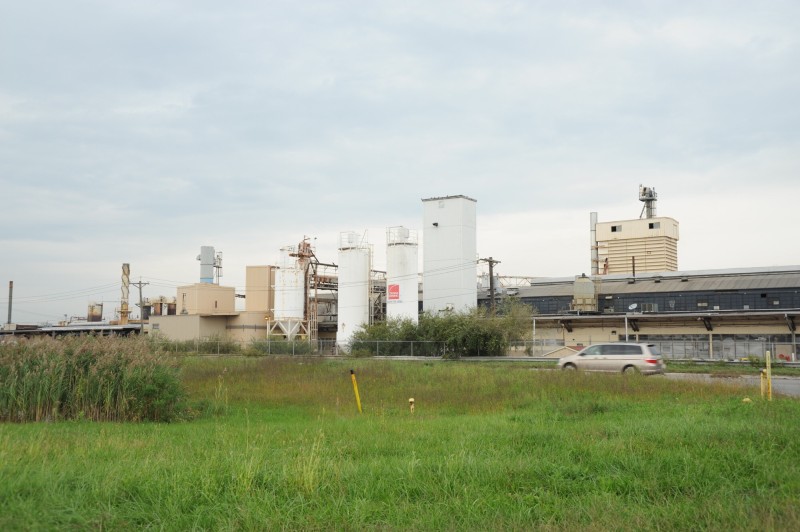
Owens Corning has already won credit for becoming a cleaner building-products company. Priced is the part investors can see: roofing remains the profit anchor, insulation is still a high-return companion, Masonite added a branded doors platform, and the glass reinforcements exit reduces the sense that this is a mixed industrial portfolio with a building-products business attached. New is the narrower test that now matters. After the portfolio shift, the valuation case is no longer "will management simplify the company?" It is "can the simplified company make Doors behave more like Owens Corning's better franchises while housing starts are weak and tariffs are still a cost variable?"[1][2]
That distinction keeps the thesis from becoming a generic quality-company story. Owens Corning's first-quarter 2026 continuing-operations sales were $2.265 billion, down from $2.530 billion a year earlier, and adjusted EBITDA fell to $369 million from $565 million.[1] The company can plausibly call the quarter resilient because the strategic portfolio is now clearer. But a lower sales base and lower EBITDA also show why the market should not pay indefinitely for simplification alone.
The valuation hinge
The six anchors I would use for the stock are these.
First, Roofing is still the economic center. In 2025, Roofing generated about $4.4 billion of sales and represented roughly 43% of company sales in the continuing building-products portfolio.[3] Full-year Roofing adjusted EBITDA was $1.411 billion, a margin of about 32%.[3] That is the franchise investors are already underwriting: brand, contractor channels, storm and repair demand, capacity discipline, and pricing power.
Second, Insulation is meaningful enough to matter but less dominant. It contributed about $3.7 billion of 2025 sales, or roughly 36% of the portfolio mix, with $848 million of adjusted EBITDA and a margin near 23%.[3] The segment gives Owens Corning a second way to monetize building-code requirements, energy efficiency, nonresidential work, and residential construction. It also carries more visible volume sensitivity when new construction pauses.
Third, Doors is the proof asset. The Masonite acquisition was a roughly $4 billion bet that Owens Corning could extend its building-envelope position and add roughly $27 billion of addressable market.[2] In 2025, Doors produced about $2.125 billion of sales and $232 million of adjusted EBITDA, implying a margin near 11%.[3] That is not broken, but it is visibly below Roofing and Insulation. If Doors merely stays a lower-margin add-on, the acquisition is strategic tidiness. If margins climb through integration, manufacturing discipline, mix, and channel leverage, it becomes a real valuation leg.
Fourth, the glass reinforcements sale helps the market focus. Owens Corning said the transaction closed on April 30, 2026, with approximately $280 million of cash proceeds and an expected additional $50 million to $70 million from excess alloy sales.[1] The dollars are useful, but the cleaner story matters more: investors can now judge the company through three building-products segments instead of blending in a different materials cycle.
Fifth, the end-market mix is not pure new housing. Owens Corning's investor materials estimate that the 2025 revenue base had exposure to non-discretionary repair, residential repair and remodel, new residential, and nonresidential demand.[3] That is why a weak starts tape does not automatically erase the thesis. A roofing replacement cycle can keep earning money while homebuilders hesitate.
Sixth, the macro tape is still a headwind. The U.S. Census Bureau reported May 2026 housing starts at a seasonally adjusted annual rate of 1.177 million, down 15.4% from April, while permits were 1.413 million.[4] Those figures are not a complete read-through to Owens Corning, but they are a reminder that the company is trying to prove its upgraded portfolio during a choppy construction cycle, not at the easy point of a housing upturn.
What the market is probably paying for
The reasonable bull case is that Owens Corning deserves a higher-quality building-products multiple than it used to. Roofing has earned that right. A low-30s Roofing EBITDA margin is not a commodity signature; it points to a branded distribution system, replacement-driven demand, and industry behavior that has historically protected price better than many construction inputs.[3] Insulation adds another scaled franchise with code, energy, and retrofit logic behind it.
The Masonite transaction also changed the story in a way that screens can understate. A doors business sits closer to the customer-facing building-products channel than glass reinforcements did. It can share some commercial discipline with the rest of the portfolio, and it gives management a larger platform for repair, remodel, and builder relationships. If Owens Corning can raise Doors margins by even a few hundred basis points over time, the acquired earnings base becomes more valuable without needing a heroic housing forecast.
The issue is that markets usually price the obvious simplification before they price the difficult integration work. By mid-2026, investors know the company bought Masonite, sold glass reinforcements, and has a segment map that is easier to explain. What they still need to see is a sequence of quarters in which Doors margin expansion, Roofing price discipline, Insulation volume stabilization, and cash conversion all show up together.
Counterweight
The counterargument is not that Owens Corning is low quality. It is that quality can be expensive when its next driver depends on execution. First-quarter 2026 already showed margin compression in continuing operations.[1] Tariffs and trade policy add another layer of uncertainty; Owens Corning has told investors it expects to partially offset enacted tariffs through supply-chain adjustments, productivity, and cost savings, but "partially" is doing work there.[1] If price-cost turns less favorable, even a good portfolio can spend several quarters proving that discipline.
The housing backdrop is the other constraint. Roofing replacement demand can decouple from new starts, especially after storms or aging-stock pressure. Doors and parts of Insulation are harder to fully detach from residential activity. A weak starts environment can make the Masonite integration look slower than the strategic deck promised, even if management is doing the right operational work.
The strongest version of the bull case accepts that risk. Owens Corning does not need a boom in new homes to justify the portfolio. It needs Roofing to keep acting like a premium franchise, Insulation to avoid a deeper volume-price squeeze, and Doors to show that the Masonite platform can be run with Owens Corning's manufacturing and channel playbook. That is a narrower, more testable claim than "housing will recover."
Falsifier
The thesis breaks if the portfolio looks cleaner but not better. A clean falsifier would be a 2026 pattern in which Doors remains stuck around low-double-digit or worse EBITDA margins, Roofing cannot move back toward its full-year 2025 margin profile, Insulation keeps losing volume without price-cost relief, and cash from the glass reinforcements sale is absorbed by working capital, restructuring, or debt service without improving per-share economics.[1][3]
The opposite would strengthen the case: Doors margin expands sequentially, Roofing holds price through the season, Insulation stabilizes despite weak starts, and management uses the post-sale balance sheet to support returns without stretching leverage.
Watchlist
- Doors margin: this is the clearest proof that Masonite was more than a scale acquisition.[2][3]
- Roofing price and mix: the premium case weakens if the segment cannot defend something close to its historical margin gap over the rest of the company.[3]
- Insulation volume versus housing starts: May's starts decline is the macro pressure point to compare against segment commentary.[4]
- Glass reinforcements proceeds: the cash is less important than whether the exit simplifies capital allocation and improves return on invested capital.[1]
- Tariff offset language: partial offset is acceptable for a quarter or two; persistent leakage would challenge the quality-multiple argument.[1]
The practical conclusion is that Owens Corning is not mainly a bet on whether building materials are cyclical. They are. The better valuation read is whether a now-focused company can convert a strong Roofing core, a solid Insulation platform, and a still-underproven Doors segment into steadier margins than the housing tape would normally allow. The stock deserves credit for the cleaner portfolio, but the next rerating has to be earned in Doors and cash flow, not in another slide about strategic focus.
Sources
- Owens Corning, "Owens Corning Delivers Resilient First-Quarter Revenue and Margin Results from Continuing Operations While Completing Portfolio Shift to Branded Building Products Leader" (PDF, May 2026) - Q1 continuing-operations results, segment commentary, glass reinforcements sale proceeds, and tariff-offset context.
- Owens Corning, Owens Corning Makes Transformative Moves (PDF, February 2024) - Masonite transaction terms, strategic rationale, and addressable-market expansion.
- Owens Corning, Q1 2026 Investor Presentation (PDF) - 2025 segment sales, adjusted EBITDA, margins, sales mix, and revenue exposure by end market.
- U.S. Census Bureau and U.S. Department of Housing and Urban Development, "Monthly New Residential Construction, May 2026" - housing starts, permits, and construction-cycle backdrop.
- Center for Land Use Interpretation, "Owens Corning Shingle Plant" - real photographic source and site note for the article image.