Car rental looks like a travel-demand trade, but that is only the surface. Priced is that airport volume, leisure trips, and business travel can still support higher rental rates. New is the sharper 2026 test: whether operators can keep enough of that pricing after vehicle depreciation, recall downtime, fleet funding, and used-car resale values have taken their share.[1][2][3]
Hertz made the point bluntly on June 24. The company said second-quarter fleet size, revenue, revenue per day, and rental days were tracking in line with or slightly above prior expectations, helped by healthy demand and better-than-expected capacity utilization. That would normally sound constructive. The same filing then reset the earnings story: unexpected softness in the used-car market caused losses on May vehicle sales after April gains, pushed expected second-quarter net depreciation per unit per month to about $300, and left adjusted corporate EBITDA expected in the $50 million to $80 million range, toward the low end of its prior range.[2]
That is the whole sector in one paragraph. Demand can be fine and the equity can still be wrong if residual values move against the fleet. A rental company is not a hotel chain with wheels. It is closer to a rolling asset manager with a travel brand attached.
Six Anchors
- $2.0 billion: Hertz Q1 2026 revenue, up 11% year over year, its strongest revenue growth in three years.[1]
- 5.5%: Hertz Q1 total revenue per day growth, with utilization at 79% and net depreciation per unit per month at $312.[1]
- $50 million to $80 million: Hertz's June 24 preliminary Q2 adjusted corporate EBITDA range, with net DPU expected around $300 after used-car sale softness.[2]
- $2.53 billion: Avis Budget Q1 2026 revenue, up 4%, alongside a $113 million adjusted EBITDA loss.[3]
- 70.1%: Avis Budget total vehicle utilization in Q1, a first-quarter record over more than fifteen years, while total per-unit fleet cost excluding FX stayed flat at $351 per month.[3]
- 212.6: the May 2026 Manheim Used Vehicle Value Index, up 3.6% year over year but only 0.3% month over month, below the typical May seasonal increase.[4]
These anchors make car rental a scenario analysis, not a simple earnings recap. The stocks work if revenue per day, fleet utilization, and fleet-cost discipline improve together. They struggle if demand indicators look healthy while depreciation and vehicle financing absorb the spread.
Scenario One: Pricing Outruns Fleet Cost
The constructive case starts with rate discipline. Hertz's first-quarter release showed total revenue per day up 5.5%, total revenue per unit per month up 5%, and revenue up 11% despite a still-negative adjusted corporate EBITDA line.[1] Avis showed a similar operating signal: revenue per day excluding currency rose 3% in both Americas and International, and utilization reached about 70% in both segments.[3]
That matters because car-rental companies have only a few clean levers. They can raise rate, improve fleet utilization, lower direct operating expense per transaction day, buy vehicles better, hold them for the right period, and sell them without taking too much residual-value damage. None of those levers works alone. A car rented at a better daily rate still disappoints if it sits idle too often, is tied up by recalls, or is sold into a weak residual market.
In the bullish branch, the industry keeps the fleet tight enough that pricing stays rational through summer travel. Hertz's Q1 release framed its strategy as "Buy Right, Hold Right, Sell Right," with North Star targets around sub-$300 depreciation per unit, revenue per unit above $1,500, and direct operating expense per transaction day in the low $30s.[1] Avis's version is less slogan-driven but similar in substance: tighter fleet discipline, improving pricing, higher utilization, and flat ex-FX per-unit fleet costs.[3]
If those pieces line up, demand does not need to boom. The better scenario is more modest and more valuable: mid-single-digit rate improvement, normal seasonal utilization, less vehicle idle time, and used-car disposal that does not reverse the rental margin. That is enough to make the sector look like a disciplined fleet operator rather than a levered bet on vacation days.
Scenario Two: Demand Is Fine, But Residuals Take The Spread
The base case is less clean. Travel demand remains healthy enough to support rental days and revenue per day, but the resale market refuses to cooperate. Hertz's June 24 update is the warning template. The company did not say rental demand had fallen apart. It said the used-car market had softened unexpectedly, causing losses on vehicle sales in May after gains in April and pushing Q2 net DPU to roughly $300.[2]
That is why the Manheim data needs to be read carefully. May's official index was still up 3.6% year over year, but the month-over-month gain of 0.3% was weaker than the average May pattern, and non-adjusted wholesale values fell 1.2% against April.[4] The mid-June read then showed the index at 213.9, up 0.6% from May and 2.6% from June 2025, a better short check but still only a mid-month checkpoint rather than the official monthly print.[5]
For a used-car dealer, those moves may look manageable. For a rental fleet rotating hundreds of thousands of units, small changes in sale proceeds can move the income statement. Hertz had 514,163 average vehicles in Q1, while Avis had a 619,669 average rental fleet.[1][3] When fleets are that large, the difference between a vehicle sold with a modest gain and a vehicle sold with a modest loss is not a rounding error. It is operating leverage in reverse.
This branch produces frustrating financial statements. Revenue grows, rate improves, and utilization looks respectable, yet EBITDA disappoints because the fleet-cost line and vehicle interest absorb the gains. Investors then learn that "travel demand" was the wrong primary variable. The better variable was net revenue after fleet depreciation and funding cost.
Scenario Three: The Fleet Becomes The Balance-Sheet Problem
The downside case is a balance-sheet squeeze. Vehicle values soften, recall activity or parts delays keep more units out of service, fleet debt costs stay elevated, and operators need external financing or asset-backed capacity to keep the fleet correctly sized for peak periods.
Hertz's Q1 already contained an operational version of that risk. Recall activity was about 300% higher year over year, reduced utilization by roughly 200 basis points, affected about 930,000 transaction days, and cost around $50 million of revenue, with more than $25 million of adjusted corporate EBITDA impact.[1] That is not a normal price problem. It is a fleet-availability problem. The company can have customers and cars on the balance sheet, yet fewer rentable cars in the right markets.
Avis has a different signal. Its Q1 liquidity was $915 million, with an additional $2.9 billion of fleet funding capacity, while vehicles net of depreciation stood at $18.093 billion and vehicle-program debt at $18.391 billion.[3] That funding stack is normal for the business model, but it explains why investors should care about fleet cost and residual values so much. Car rental is asset intensive by design. A wrong fleet decision does not fade like a bad marketing campaign. It sits in depreciation, debt, utilization, and disposal channels until the fleet is corrected.
In this branch, the stocks should not get credit for revenue growth alone. They need evidence that fleet resizing, vehicle acquisition, remarketing, and financing are getting better at the same time. Otherwise, the sector becomes a high-beta used-car residual trade with airport counters attached.
Counterweight
The bearish case can overstate the fragility. Hertz and Avis have already spent the post-pandemic period relearning fleet discipline after the extreme swings of shortage, inflation, electric-vehicle residual pressure, and normalization. Avis's flat ex-FX per-unit fleet cost in Q1 and record first-quarter utilization argue that the model can improve when fleet is tight.[3] Hertz's Q1 DPU improvement to $312, down 13% year over year, also shows that fleet rotation can produce real progress before the next used-car wobble hits.[1]
There is also a demand floor that matters. Airport rental desks, insurance replacement, business travel, local rentals, rideshare supply, and leisure trips do not all move together. A diversified rental base gives operators more ways to place cars, adjust fleet by geography, and preserve utilization if one channel softens.
Falsifier
The thesis fails if better demand stops translating into better unit economics. The warning set is concrete: Hertz net DPU remains stuck around or above $300 while adjusted corporate EBITDA misses the summer setup; Avis per-unit fleet costs rise from the $351 ex-FX level without matching revenue-per-day gains; utilization falls despite normal travel demand; and Manheim's official monthly data weakens enough that vehicle-sale losses become recurring rather than episodic.[1][2][3][4]
The constructive case is equally measurable. If Hertz can bring DPU below the current $300 neighborhood while holding RPD momentum, and Avis can keep utilization high with flat fleet cost, investors can start treating the group as a disciplined fleet-cycle recovery rather than merely as a fragile travel reopening echo.
Watchlist
- Hertz Q2 2026 results: the key checks are final adjusted corporate EBITDA, net DPU, RPD, rental days, liquidity, and whether June vehicle sales improved after May softness.[1][2]
- Avis Budget Q2 2026 results: watch revenue per day, utilization, per-unit fleet cost, adjusted free cash flow, and fleet funding capacity through peak season.[3]
- July 8, 2026 Manheim official release: the June official index will test whether mid-June firmness survived the full month.[5]
- Recall and OEM updates: any persistence in recall-related idle fleet would make utilization and transaction-day comparisons lower quality.[1]
Car rental is still a recovery story, but it is not only a travel story. The sector's real spread sits between what a rented car earns per day and what the same car costs to own, finance, idle, repair, recall, and sell. In 2026, investors should follow the counters less and the fleet math more.
Sources
- Hertz Global Holdings, Exhibit 99.1, "Hertz Announces Q1 2026 Results, Strongest Revenue Growth in Three Years" (May 7, 2026) - Q1 revenue, RPD, utilization, DPU, recalls, liquidity, and fleet metrics.
- Hertz Global Holdings, Form 8-K current report (June 24, 2026) - preliminary Q2 demand, used-car sale softness, expected net DPU, and adjusted corporate EBITDA range.
- Avis Budget Group, Exhibit 99.1, "Avis Budget Group Reports First Quarter 2026 Results" (April 29, 2026) - Q1 revenue, adjusted EBITDA, revenue per day, utilization, per-unit fleet costs, liquidity, and fleet funding capacity.
- Cox Automotive, "Manheim Used Vehicle Value Index: May 2026 Trends" (June 2026) - official May MUVVI level, month-over-month change, year-over-year change, and non-adjusted wholesale price movement.
- Cox Automotive, "Manheim Used Vehicle Value Index: Mid-June 2026 Trends" (June 2026) - mid-month June MUVVI checkpoint and release timing for the next official monthly data.
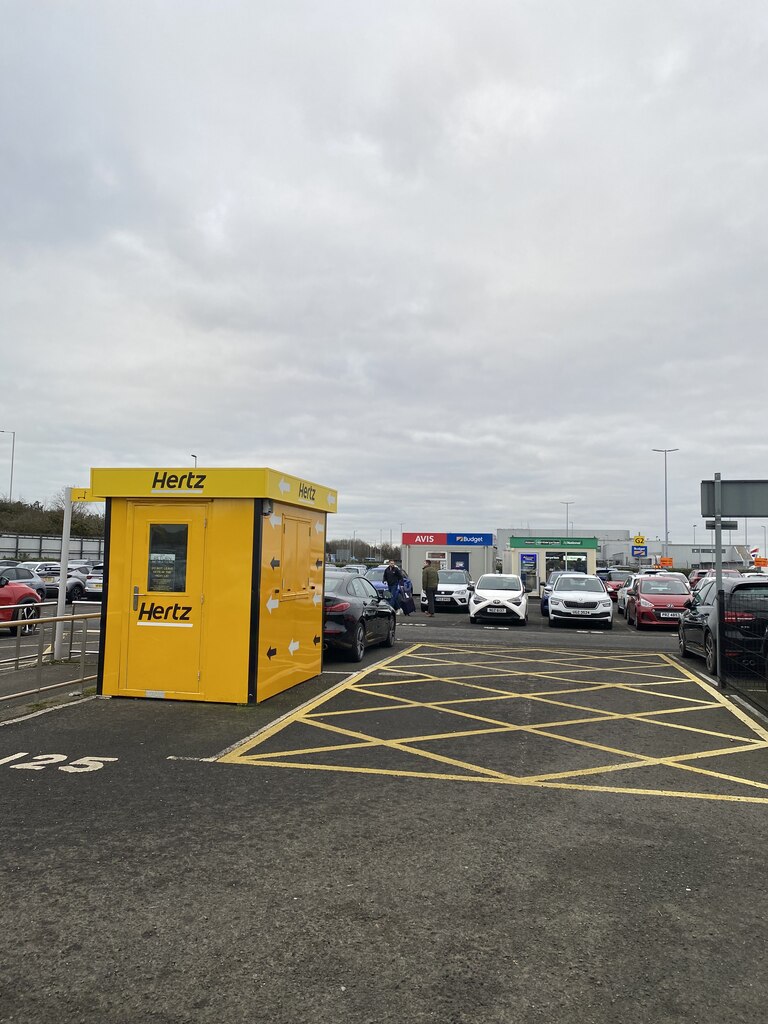
- Geograph Britain and Ireland, "Hertz Rental Car Park Belfast City Airport" by thejackrustles (photographed February 6, 2023) - Creative Commons photograph used as the article image.