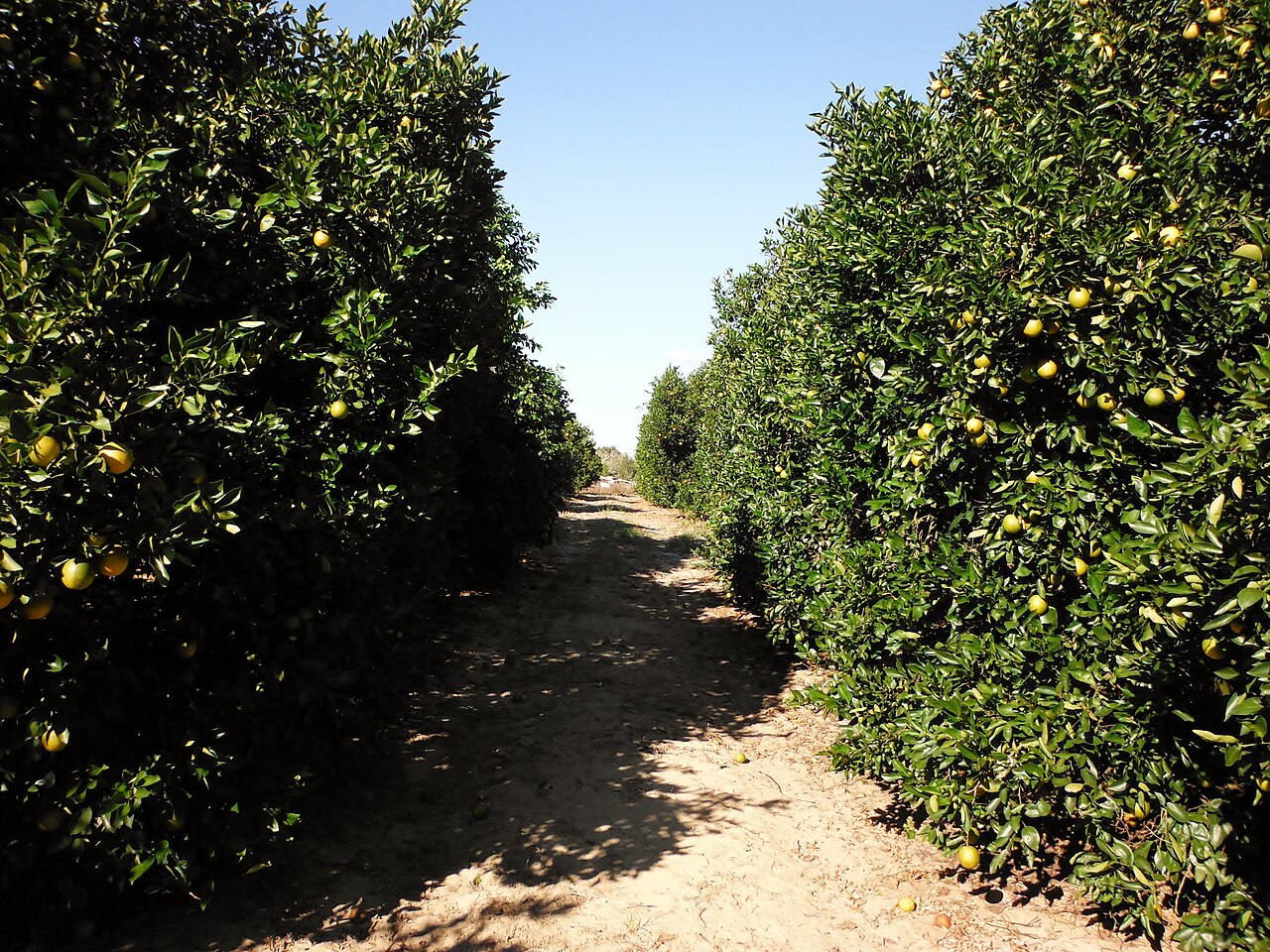
Orange juice futures look cheap or expensive only after deciding what is actually being priced. The obvious story is retail demand: fewer households treat juice as a daily breakfast default, and USDA ERS notes that U.S. per-capita orange juice availability fell from about 5 gallons in 2000/01 to a forecast 2 gallons in 2022/23.[5] The market story is sharper. FCOJ is now a supply-constrained tree asset with weather optionality attached.
What is already priced is scarcity. Florida is no longer a large, flexible shock absorber for processed orange supply. What is new, or at least newly visible, is that a small April improvement in the 2025-26 crop forecast does not restore that buffer. USDA's April forecast put Florida all-orange production at 12.2 million boxes, up 200,000 boxes from January but still 1 percent below last season's revised production.[1] For a market that once leaned on Florida processing volume, "less bad" is not the same as loose supply.
The Contract Makes The Physical Constraint Visible
The ICE FCOJ-A contract is not a loose symbolic bet on supermarket cartons. It is a physically settled contract for U.S. Grade A juice in licensed warehouses, with allowed origins including the United States, Brazil, Costa Rica, and Mexico.[2] Each contract is 15,000 pounds of orange juice solids, quoted in cents per pound, with delivery locations in Florida, New Jersey, and Delaware.[2] That matters because a physically deliverable contract has to care about origin, grade, storage, and logistics, not just a consumer-price narrative.
The exchange design also explains why the commodity can move violently without much change in the grocery aisle. A futures trader is not buying a half-gallon carton; they are buying exposure to a narrow deliverable stream. ICE lists daily price limits that can range from 10 to 30 cents per pound, a reminder that the contract has enough volatility potential to require explicit movement rails.[2]
The practical interpretation is simple: FCOJ is a weather-and-tree-health market first, a breakfast table market second. Retail demand can mute the long-run price effect, as ERS observed in real consumer prices, but it cannot create fruit that disease, hurricanes, freeze, or grove attrition removed from the system.[5]
Five Numeric Anchors
- 12.2 million Florida boxes: USDA's April 2026 all-orange forecast is the live domestic supply anchor, and it is still slightly below last season despite improving from January.[1]
- 7.5 million Valencia boxes: Valencia oranges are the juice workhorse in the current forecast, but the crop has below-average final fruit size and 46 percent final droppage.[1]
- 15,000 pounds per ICE contract: the futures unit ties price moves to deliverable orange solids, not broad citrus sentiment.[2]
- 1.351 million metric tons: USDA FAS forecasts global orange juice production at roughly this level for 2025/26, up less than 1 percent.[3]
- 390,000 metric tons: U.S. orange juice imports are forecast near that level in 2025/26, larger than the United States' own 72,000-ton production forecast.[3]
Those numbers frame the thesis. Orange juice futures can fall if Brazil's crop normalizes and import flows rebuild inventories. But the U.S. side of the market remains import-dependent, and Florida's processing role has become too small to dismiss disease and storm risk as local color.
Why Florida Still Sets The Risk Premium
The most important supply fact is not simply that Florida production is low. It is that the remaining crop has fragile operating characteristics. USDA's April forecast says Valencia fruit size is below average and requires 257 pieces to fill a 90-pound box, while final droppage is above average at 46 percent.[1] In commodity terms, that is not a clean volume story. It is a yield-quality-delivery story.
Citrus greening explains much of the persistent pressure. APHIS describes Huanglongbing as one of the world's most serious citrus diseases, spread in the United States by the Asian citrus psyllid, with infected trees producing poorly colored, lopsided, bitter fruit and eventually dying; APHIS also states that there is no cure.[4] For a futures market, that changes the shape of risk. A bad weather year is a shock. A disease that weakens trees and reduces fruit quality is an impairment of productive capital.
That impairment shows up in how growers behave. WLRN's March 2026 reporting from Central Florida described a farm that once sold wholesale by the truckload and now often sells directly because there is too little fruit for the old industrial channel.[6] The article's useful financial signal is not nostalgia. It is channel migration: when supply gets scarce, growers try to capture more value close to the farm gate, while processors and juice brands lose the easy scale that used to make Florida a dependable input base.
Brazil Is The Relief Valve, But Not A Free Hedge
The bull case for lower FCOJ prices starts with Brazil. USDA FAS expects Brazil orange juice production to rise slightly to about 1.032 million metric tons in 2025/26 as more oranges go to processors and efficiency improves.[3] Brazil also dominates exports, with USDA FAS forecasting 973,000 metric tons of orange juice exports, compared with 25,000 for the United States.[3]
That is the counterweight every long-scarcity thesis has to respect. If Brazil has normal weather, enough processing fruit, and clean logistics, the global balance can loosen even while Florida remains historically diminished. The United States is already structurally dependent on imports: FAS forecasts U.S. domestic consumption at 440,000 metric tons, imports at 390,000, and production at only 72,000 for 2025/26.[3] In other words, the American juice market is not waiting for Florida alone.
But Brazil is not a perfect hedge against Florida. The ICE deliverable-origin list includes Brazil, yet deliverability still depends on grade, storage, freight, inventory, and commercial willingness to move product into exchange warehouses.[2] More fundamentally, a Brazil-led relief valve makes the market globally concentrated rather than broadly diversified. It reduces Florida-specific risk, but it does not eliminate crop risk.
The Counterweight
The strongest bearish argument is that the consumer has already left. If U.S. households keep drinking less juice, then supply tightness can be real without generating a durable price squeeze. ERS's long-run observation is important here: despite disease and weather damage, inflation-adjusted orange juice prices rose only modestly over the two decades it reviewed because declining demand muted the supply effect.[5]
That means the right trade frame is not "scarcity always wins." It is "scarcity matters most when inventories, import timing, or a weather shock make the physical market care about deliverable supply right now." A slow-demand product can still have violent futures moves if the deliverable pool is narrow. It just may not sustain a permanently higher real consumer price if households keep substituting away from juice.
Falsifier
The falsifier is a Brazil-led replenishment cycle that rebuilds U.S. import availability and ending stocks while Florida avoids fresh storm or disease deterioration. If USDA's next global citrus updates show rising orange juice production, stable exports, and easier U.S. imports without a matching demand surprise, then the scarcity premium should compress. In that case, Florida's long-term decline would remain true but less immediately tradable.
Watchlist
- USDA July 10, 2026 Florida citrus forecast: the next scheduled state forecast is the cleanest near-term check on whether the April bump holds or fades.[1]
- Brazil processing and export revisions: FAS's Brazil line is the global relief valve; any downgrade would matter more than a small Florida revision.[3]
- U.S. import pace and warehouse deliverability: because ICE delivery can use several origins, watch whether physical juice actually reaches licensed warehouse channels.[2]
- Disease and storm season language: APHIS's no-cure framing makes greening a persistent capital problem, while Florida hurricane exposure can still turn tree weakness into acute supply loss.[4]
Orange juice futures are not just a quirky corner of soft commodities. They are a small, physically specific market trying to price a damaged tree base, imported supply dependence, and the chance that weather turns a tight balance into a squeeze. Breakfast demand explains the ceiling. Trees explain the floor.
Sources
- USDA National Agricultural Statistics Service, Citrus April Forecast and Fruit Size (April 9, 2026) — Florida orange forecast, Valencia fruit size, droppage, and next forecast date.
- ICE Futures U.S., FCOJ-A Futures Contract Specifications (accessed June 2, 2026) — contract size, physical delivery, allowed origins, delivery locations, quotation, and daily price-limit framework.
- USDA Foreign Agricultural Service, Citrus: World Markets and Trade (January 2026) — global orange juice production, Brazil exports, U.S. production, imports, consumption, and stocks.
- USDA APHIS, "Citrus Greening and Asian Citrus Psyllid" (last modified January 13, 2026) — disease mechanics, symptoms, spread, and treatment boundary.
- USDA Economic Research Service, "Inflation-adjusted orange juice prices up 12 percent over 20 years" (October 24, 2023) — long-run demand, availability, and real-price context.
- Tom Hudson, "The fruit that made Florida is quickly disappearing." WLRN Public Media (March 23, 2026) — reporting on Florida grove economics, grower channel shifts, disease, and crop decline.
- Mmacbeth, "Florida orange grove.JPG." Wikimedia Commons (photograph, December 16, 2013) — source image for the article photograph.