Priced: the market already understands that off-price retailers benefit when shoppers want branded goods without full-price department-store tickets. New: first-quarter 2026 results suggest the better question is no longer whether TJX, Ross, and Burlington can capture trade-down demand. It is whether they can keep finding enough desirable inventory while adding stores and raising traffic at the same time.[1][2][3]
That changes the investment frame. Off-price is often discussed as a consumer-defensive format, but the stronger financial mechanism is a procurement flywheel: buyers wait closer to need, vendors need discreet exits for excess goods, flexible stores can absorb mixed lots, and fresh assortments create repeat visits. TJX's own first-quarter language points to the same loop: stronger transactions, "off-price fundamentals," a treasure-hunt shopping experience, and outstanding availability of branded merchandise.[1] The spread is therefore not simply "cheap wins." The spread is whether inventory access remains abundant as the biggest chains get bigger.
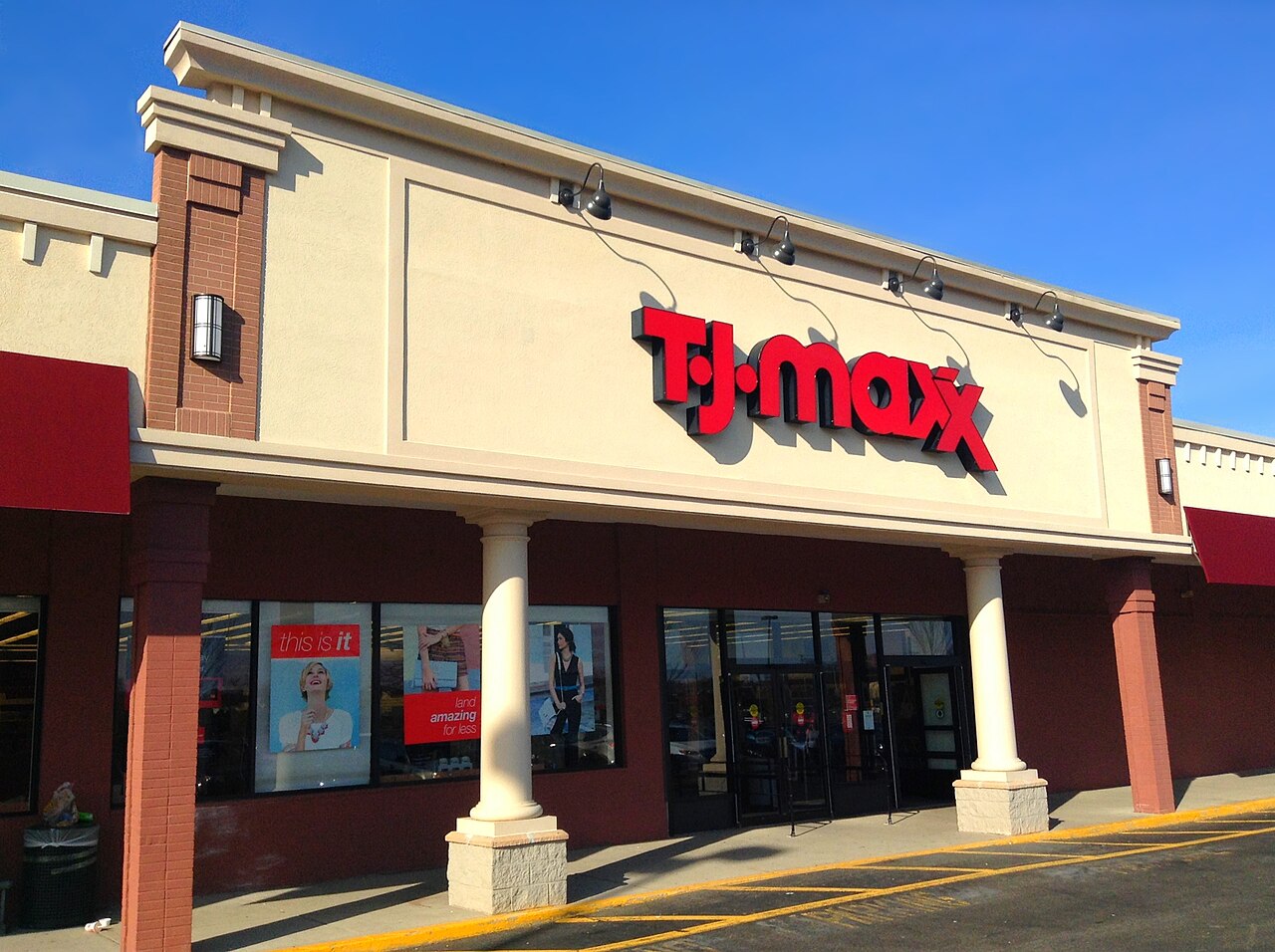
The cover photo is intentionally plain: a T.J. Maxx storefront sign, not a chart or symbolic retail graphic. The bull case here lives in real stores, racks, trucks, buyers, and customer trips, not in an abstract discount logo.[5]
The Mechanism
Traditional apparel retail carries the burden of prediction. Buyers place seasonal orders months in advance, mark down misses, and hope the customer still wants the color, cut, or price point when the goods arrive. Off-price turns that timing problem into an advantage. It buys later, accepts irregular lots, changes departments quickly, and lets the store feel less planned than a full-price chain.
That sounds operational, but it is financial. Later buying lowers markdown risk, raises the chance of a visible value gap, and makes vendor relationships more important than any single fashion call. Retail Dive framed the same tension from the outside: as the large off-price chains keep opening stores, investors should ask when the competition shifts from taking share from department stores to competing for the same customer trips and the same desirable inventory.[4]
The latest numbers show the same mechanism running hot. TJX reported a 6% consolidated comparable-sales gain in Q1 fiscal 2027, with customer transactions up across divisions and management saying branded merchandise availability was "outstanding."[1] More important, inventories per store, excluding goods in transit and e-commerce, were also up 6% on a constant-currency basis. That is the good version of inventory growth: not stale stock backing up, but fresh buying capacity being carried into spring and summer.[1]
Ross showed a more explosive version of the traffic cycle. Its Q1 fiscal 2026 comparable sales rose 17%, and operating margin reached 13.4%, far above its plan, because sales leverage did the work that retailers usually struggle to manufacture.[2] Burlington's quarter was less dramatic but still confirmed the format: comparable sales rose 6% and gross margin was 44.1%, with management lifting the full-year outlook.[3]
Those six numbers are the core anchor. Demand is not the weak point today. Store traffic, merchant execution, and available inventory are all pointing in the same direction. The risk is that the three stop compounding together.
Why The Easy Thesis Is Too Easy
The lazy version of the trade is simple: inflation pinches households, department stores lose relevance, and off-price keeps taking share. That is broadly true, but it is not enough. Retail Dive's March 2026 readout framed the next debate better: as TJX, Ross, and Burlington keep adding stores, the question may become whether they eventually compete not only for customers, but also for the same branded closeouts and irregular inventory.[4]
That is the right counterweight because off-price depends on controlled scarcity. The customer returns because the deal is not guaranteed to be there tomorrow. The vendor sells because the channel can clear product without training full-price customers to wait for permanent promotions. The retailer wins because the buy is opportunistic, not a scheduled commodity input.
Scale can strengthen that loop, but it can also stress it. TJX's size gives it unmatched absorption capacity: it can take large lots, move them through a global buying network, and place them across concepts. Ross and Burlington, meanwhile, can still add stores without needing to be everything to everyone. Retail Dive noted that the major chains continue to plan meaningful store expansion, with the share shift still coming mainly from mainstream retail rather than from one another.[4] That is the base case.
The danger case is more subtle. If too many stores chase the same vendor pool at the same time, the best closeouts get bid up, quality gets thinner, or buyers have to accept merchandise that keeps racks full but weakens the value promise. That would show up first in merchandise margin and conversion, not in headline sales.
The Counterweight
The strongest counterargument is that supply is structurally on off-price's side. Full-price retail still over-orders. Fashion cycles still miss. Tariffs, late shipments, weather shifts, bankruptcies, brand resets, and cautious wholesalers all create stray inventory. A growing off-price channel may simply be meeting a larger stream of goods that traditional retailers no longer clear well.
There is evidence for that view. TJX called merchandise availability outstanding, and Burlington said reserve inventory was a smaller share of total inventory than a year earlier even as total merchandise inventories rose with new stores.[1][3] In other words, the sector is not obviously stuffing warehouses to fake growth. It is turning available goods into sellable assortment.
The other counterweight is customer segmentation. TJX, Ross, and Burlington overlap, but not perfectly. TJX has a broader income reach and stronger home exposure; Ross leans into value apparel and dd's Discounts; Burlington is rebuilding store experience while opening smaller, more productive boxes. The more differentiated the customer trip, the less the chains have to fight for the same exact basket.
That is why the view is not bearish on off-price. The sector still has the cleanest retail mechanism in a messy consumer tape. The point is narrower: after a strong first half of 2026, the multiple deserves more scrutiny on inventory quality than on trade-down headlines.
Falsifier
The thesis breaks if the second half shows that inventory access is still plentiful while margins hold. Specifically, if TJX keeps comping above plan without per-store inventory swelling into markdown risk, Ross sustains high single-digit comp guidance with operating margin near recent levels, and Burlington opens stores while gross margin expands, then the feared inventory bottleneck is premature.
The thesis is confirmed if sales stay good but quality of growth deteriorates. Watch for merchandise-margin pressure, heavier markdown language, weaker conversion despite traffic, or management comments that branded availability is becoming less attractive. In that branch, off-price demand remains real, but the procurement spread narrows.
Watchlist
First, watch TJX's Q2 fiscal 2027 report for the gap between its guided 2% to 3% comparable-sales growth and actual traffic, along with whether per-store inventory still looks intentional rather than bloated.[1]
Second, watch Ross's quarter ending August 1, 2026. Management guided to 6% to 7% comparable-sales growth, so the key test is whether that strength still carries operating leverage or starts to require more promotional help.[2]
Third, watch Burlington's fiscal 2026 store-opening and margin cadence. Its guidance calls for roughly 115 net new stores and a full-year comparable-sales increase of 2% to 4%; the clean version is new units plus stable gross margin, not new units funded by looser buys.[3]
The practical conclusion is simple. Off-price retail still deserves a premium to weaker discretionary formats because the model converts retail disorder into inventory opportunity. But the premium should be earned through evidence that traffic growth, new stores, and branded supply can all scale together. The new spread is not whether shoppers want value. It is whether the chains can keep sourcing value before their own success makes the best inventory harder to buy.
Sources
- The TJX Companies, "TJX Reports Q1 FY27 Results; Comp Sales up 6%, Pretax Profit Margin of 12.0%, and Diluted EPS of $1.19..." - Q1 fiscal 2027 results, inventory, margin, and guidance.
- Ross Stores, "Ross Stores Reports Robust First Quarter Sales and Earnings Results, Significantly Exceeding Guidance" - Q1 fiscal 2026 results, comp sales, margin, buybacks, and Q2 guidance.
- Burlington Stores, "Burlington Stores Reports Strong First Quarter Sales and Earnings Growth..." - Q1 fiscal 2026 sales, comp sales, gross margin, inventory, liquidity, and outlook.
- Daphne Howland, "Could off-price retailers start grabbing market share from each other?" Retail Dive, March 11, 2026 - secondary context on store expansion, market-share shift, and inventory competition risk.
- Wikimedia Commons, "File:TJ Maxx (13932751151).jpg" - source page for the Mike Mozart photograph used as the article image.