Nike's quarter was better than the old bear case and still not clean enough for a simple turnaround victory lap. Priced is that Elliott Hill's "Win Now" reset is already visible in North America wholesale, running, and inventory cleanup; new is that the company still guided to another revenue decline, another tariff-hit margin quarter, and a much deeper China reset before investors get a fuller long-term plan in the fall.[1][2]
That makes this an earnings recap about sequence. The Q3 print says the first repair lanes are working: revenue was $11.3 billion, gross margin was 40.2%, diluted EPS was $0.35, wholesale revenue rose 5% reported, and inventories fell 1% even with higher product costs from tariffs.[1] The forward guide says the repair is not yet self-funding. For Q4, Nike expects revenue down 2% to 4%, Greater China down about 20%, and gross margin still down 25 to 75 basis points, including 250 basis points of North America tariff pressure.[2]
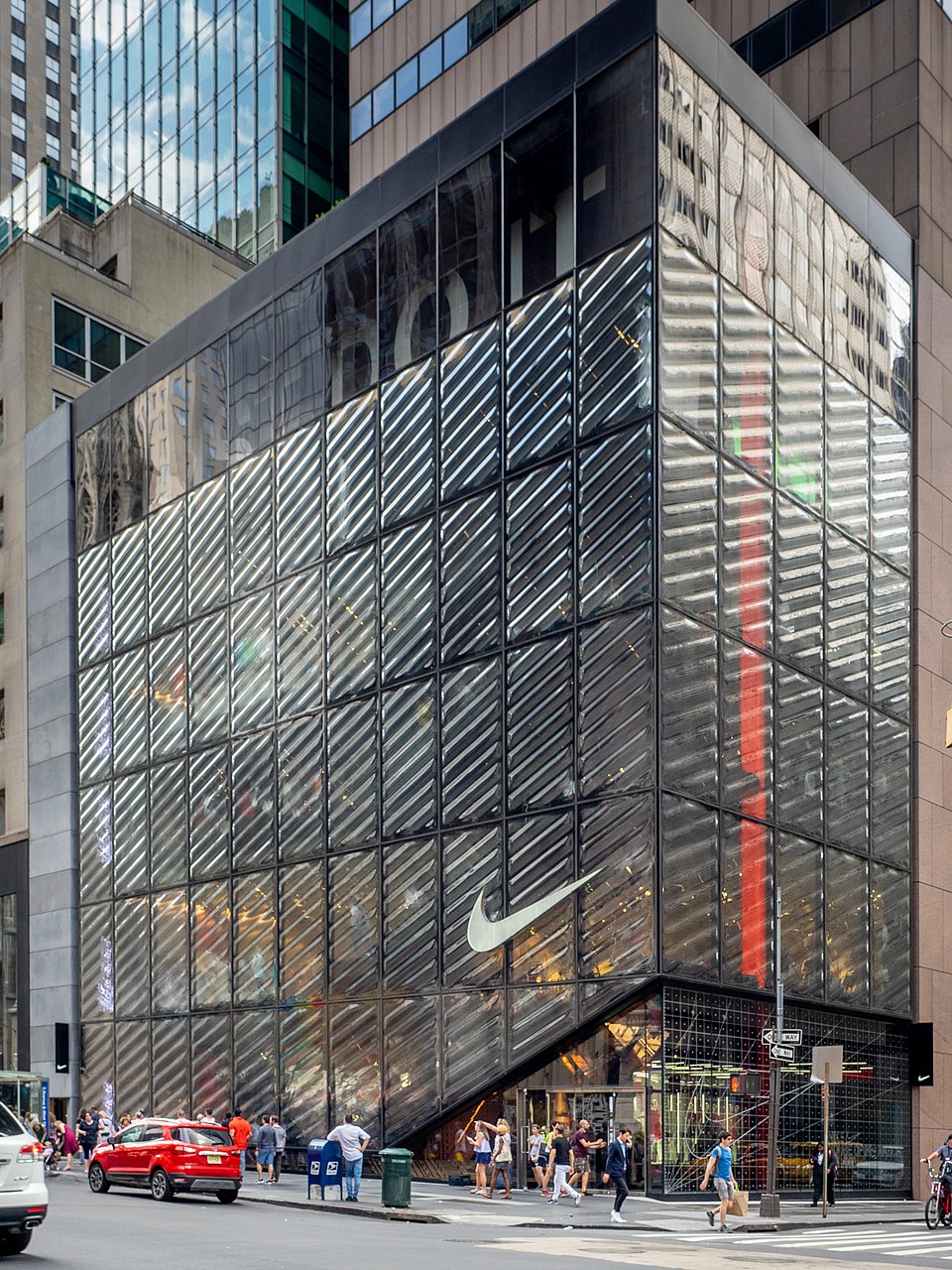
Image context: the cover uses a real photograph of Nike's New York flagship rather than a logo or chart. That matters because Nike's current finance question lives inside stores, partner shelves, digital traffic, local assortments, and inventory flow. The brand problem is abstract; the margin repair is physical and operational.[6]
What the quarter actually proved
The clearest positive was that Nike is no longer talking about wholesale repair as an aspiration. In Q3, companywide wholesale revenue reached $6.5 billion, up 5% reported and 1% currency-neutral.[1] In North America, the signal was stronger: revenue grew 3%, wholesale grew 11%, and management said it delivered positive growth in all channels in the geography for the first time in 2 years.[2] That is the part of the print investors should not dismiss. Nike spent several years over-optimizing for direct-to-consumer economics, then had to rebuild trust and shelf presence with partners. The Q3 number says that relationship reset is beginning to show up in revenue.
Product momentum also improved where Nike prioritized first. The call framed running as the earliest proof point from the Sport Offense, with Nike Running up over 20% for the quarter.[2] Management also pointed to football, basketball, and new performance platforms such as Mind and Aero-FIT as the products meant to move the company away from an overreliance on tired classic franchises.[2] This is not yet a whole-portfolio recovery, but it is a more credible base than a turnaround story built only on cost cuts.
The inventory line is more nuanced. Reported inventories were $7.5 billion, down 1% year over year, and management said units were down mid-single digits.[1][2] That matters because cleaner units are a prerequisite for better full-price selling. But the same sentence contains the problem: tariff-driven product cost inflation kept dollar inventory from falling faster.[1][2] Nike can clean the marketplace and still carry a margin problem if each remaining unit has a higher landed cost.
The broader filing context matters because Nike is not a one-channel retailer. The 2025 Form 10-K still frames the company through the Nike Brand geographies, Converse, owned retail, digital, and wholesale distribution, which is why the current reset has to repair a portfolio rather than one broken line item.[4]
Where the bridge is still weak
The first weak link is direct. Nike Direct revenue was $4.5 billion, down 4% reported and 7% currency-neutral, with Nike Brand Digital down 9% and owned stores down 5%.[1] That creates an awkward mix problem. Wholesale repair is necessary because most consumers still shop through partners, but Nike Direct has historically carried richer economics and cleaner data loops. A healthier wholesale business can stabilize revenue; it cannot by itself prove that digital markdown pressure is gone.
The second weak link is margin. Gross margin fell 130 basis points to 40.2% in Q3, and the transcript attributes roughly 300 basis points of company margin pressure to higher tariffs in North America.[1][2] The North America detail is even more revealing: regional gross margins declined 360 basis points despite management estimating nearly 650 basis points of gross impact from new U.S. tariffs.[2] That means underlying actions helped, but the tariff math is still large enough to dominate the reported bridge. AP's June 2025 tariff report gives the longer arc: Nike had already warned of roughly a $1 billion tariff hit before mitigation and planned to reduce the China share of U.S.-imported footwear from about 16% to a high-single-digit range by the end of fiscal 2026.[5]
The third weak link is geographic cleanup. Greater China revenue fell 10% in Q3, with Nike Digital down 21%, wholesale down 13%, and management guiding to about a 20% Q4 revenue decline as it reduces sell-in and cleans digital and partner channels.[2] The bullish read is that inventory dollars in China were down mid-teens and units down more than 20%.[2] The bearish read is that a market once treated as a structural growth engine is still being put through deliberate contraction.
Converse adds a smaller but sharp reminder that the cleanup is not confined to one region. Converse revenue fell 35% reported and 37% currency-neutral in Q3, and Converse EBIT swung to a loss.[1][2] For a company trying to prove portfolio depth, that matters. Nike Brand can improve while the consolidated story remains dragged by assets still earlier in the reset.
Six numeric anchors
- Q3 revenue and EPS: $11.279 billion of revenue, flat reported and down 3% currency-neutral; diluted EPS $0.35, down 35%.[1]
- Gross margin: 40.2%, down 130 basis points, with higher North America tariffs the primary reported driver.[1][2]
- Channel split: wholesale revenue $6.5 billion, up 5% reported; Nike Direct $4.5 billion, down 4% reported and 7% currency-neutral.[1]
- North America proof point: North America revenue up 3%, wholesale up 11%, and positive growth across all channels for the first time in 2 years.[2]
- China reset: Greater China revenue down 10% in Q3 and guided down about 20% in Q4; China inventory units down more than 20%.[2]
- Q4 hurdle: revenue down 2% to 4%, gross margin down 25 to 75 basis points, including 250 basis points of tariff pressure.[2]
Those anchors describe a company with real operating repair but no clean earnings inflection yet. The market can pay for the brand before the financials fully turn, but it needs evidence that wholesale strength, lower aged inventory, and tariff mitigation are becoming cumulative rather than offsetting each other quarter by quarter.
Strongest counterweight
The strongest bullish counterargument is that Nike is already proving the order of repair that matters most. North America is the largest geography, running is growing sharply, wholesale partners are ordering again, closeout units are low, and management says underlying North America profitability has improved for 3 consecutive quarters despite new tariff pressure.[2] If that region keeps compounding, Nike can tolerate a deliberately weak China sell-in period longer than the headline numbers imply.
The cost reset also has delayed benefit. Nike booked a $230 million employee-related severance charge in Q3, mainly tied to supply chain and technology, and management expects those actions to begin benefiting fiscal 2027 and build through fiscal 2028.[2] That is a real offset if revenue stabilizes. A cleaner marketplace plus lower fixed-cost drag is exactly the combination a turnaround investor wants.
Falsifier
This recap is too cautious if Q4 shows that the tariff and cleanup drag is already cresting. Concretely, if revenue lands better than the 2% to 4% decline range, gross margin is flat to down less than 25 basis points, North America keeps both direct and wholesale channels positive, and China sell-through improves while inventory keeps falling, then the current "repair but no inflection" framing would be too slow.[1][2]
Watchlist
- May 31, 2026 fiscal year-end and the Q4 FY2026 report that follows. This is the next hard check on the 2% to 4% revenue decline, the 25 to 75 basis point gross-margin guide, and whether Greater China really needs a 20% sell-in contraction to clean the channel.[2]
- June 2026 football product cycle. Nike said it will unveil the new Mercurial in June and elevate more than 5,000 football doors around World Cup 2026. That is a live test of whether the Sport Offense can turn performance product into wholesale sell-through rather than just launch heat.[2]
- Fall 2026 Investor Day at the Philip H. Knight Campus. Management said it will resume full-year and long-term guidance there. The key issue will be whether fiscal 2027 margin recovery is backed by measurable tariff mitigation, cost savings, and balanced North America growth, or mostly by brand ambition.[2]
Takeaway
Nike's Q3 was a useful recovery quarter, not a clean earnings turn. Wholesale is stabilizing, North America has a real pulse, running is working, and inventory units are moving in the right direction.[1][2] But investors still have to underwrite a difficult bridge: tariff pressure is large, Nike Direct is still negative, China is being managed down, Converse is weak, and the company itself says Win Now actions will keep affecting results through the rest of the calendar year.[1][2][3]
The right read is therefore narrower than "Nike is back" or "Nike is broken." The brand still has enough power to repair its marketplace. The stock case now depends on whether that repair can pass through the income statement before patience runs out.
Sources
- NIKE, Inc., "NIKE, Inc. Reports Fiscal 2026 Third Quarter Results" (March 31, 2026 PDF press release).
- NIKE, Inc., "FY26 Q3 Earnings Release Conference Call Transcript" (March 31, 2026 PDF).
- NIKE, Inc., Quarterly Report on Form 10-Q for the quarter ended February 28, 2026 (filed April 1, 2026).
- NIKE, Inc., Annual Report on Form 10-K for the fiscal year ended May 31, 2025 (filed July 17, 2025).
- Associated Press, "Nike soars on a production shift away from China, but it warns of a $1 billion tariff hit" (June 27, 2025).
- Wikimedia Commons, "File:Nike Flagship - NYC (48155560636).jpg" (photograph by Ajay Suresh, June 29, 2019).