The easy reading of the Treasury central-clearing mandate is that the market got another year and can now relax. Priced is the extension: eligible cash Treasury transactions move to a December 31, 2026 compliance date, while eligible repo transactions move to June 30, 2027.[1] New is the narrower, more important question: whether that extra year turns bilateral repo and client clearing into usable daily plumbing, or simply postpones a margin migration that will arrive while hedge-fund leverage is still crowded.
This is a macro plumbing story, not a rule-calendar story. Central clearing can reduce counterparty sprawl, improve netting, and make risk collection more systematic. It does not make a leveraged basis trade unleveraged. It changes where exposures are novated, where margin is calculated, which access model a client can use, and how much dealer balance sheet is consumed when cash Treasuries and repo positions move through a central counterparty.
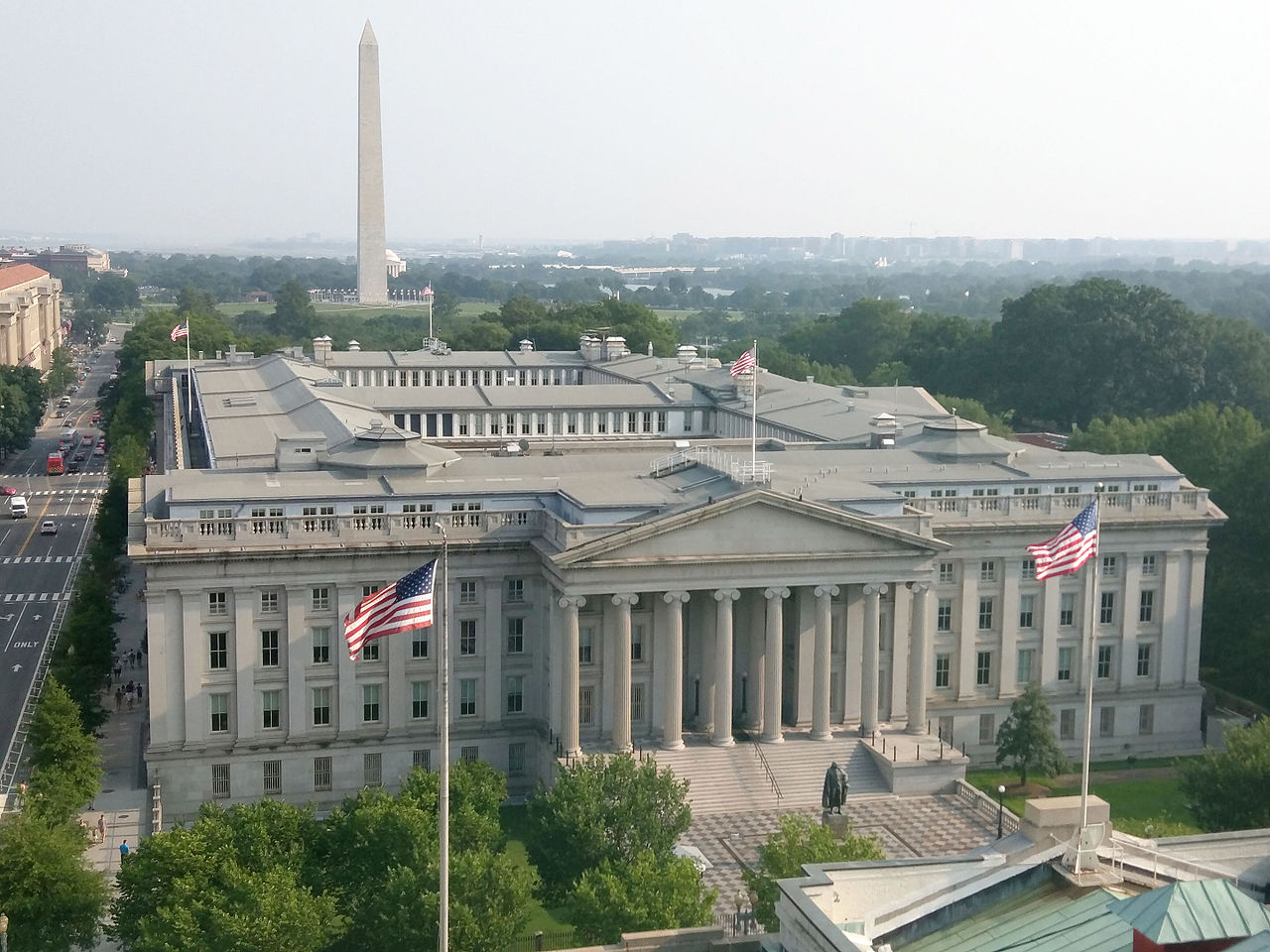
Image context: the cover uses a real photograph of the U.S. Treasury Building because the article is about the institutional machinery around the government-debt market. A diagram would make the piece look cleaner, but the relevant object is the operating system beneath the world's benchmark safe asset.[6]
What the rule is really trying to move
The SEC's extension did not erase the mandate. The rule still requires a covered clearing agency that provides central-counterparty services for U.S. Treasury securities to have policies requiring every direct participant to submit eligible secondary-market Treasury transactions for clearance and settlement when the rule applies.[1] The same release points to the deeper issue: margin for a direct participant's proprietary Treasury positions has to be calculated, collected, and held separately from margin tied to indirect-participant activity, with enforcement of that margin-separation requirement delayed to September 30, 2025.[1]
That sentence is the center of the matter. The reform is not just "more trades go to FICC." It is a reallocation of margin, documentation, operational control, and client access. A buy-side firm that today finances Treasury positions through bilateral repo has to decide whether it uses sponsored access, agent clearing, direct membership, or another workflow. A dealer has to decide whether the client relationship still works when the capital and margin arithmetic becomes explicit rather than embedded in bilateral terms.
DTCC's 2025 annual report shows the scale of the machine that is being asked to absorb more flow: FICC average volumes had surged to $11.9 trillion daily by year-end 2025, while activity across Sponsored and Agent clearing was cited at $3.1 trillion.[5] Those are not decorative numbers. They tell you that the reform is being bolted onto an already huge market utility, not introduced into an empty lane.
Why the basis trade remains the stress test
The basis trade is the cleanest way to see the boundary of the reform. In the trade's familiar form, leveraged investors sell Treasury futures and buy deliverable cash Treasuries, financing the cash position in repo. The expected return is small, so the position depends on cheap, stable financing and enough balance-sheet capacity to roll the repo book. Central clearing can change the counterparty and margin framework around that trade. It does not change the fact that the trade is highly sensitive to repo funding costs and volatility.[4]
The New York Fed's May 2025 discussion of Treasury-market liquidity gives the relevant stress map. In March 2025, leveraged funds' short Treasury futures positions up to 10-year maturities stood at about $1 trillion, a rough proxy for large basis-trade volumes and well above February 2020 levels.[4] The same speech notes that Treasury repo rates stayed orderly during the April 2025 volatility episode, which helped prevent a larger forced unwind. That is exactly the point: the danger is not a normal day with a cleaner clearing label. The danger is a funding-cost jump that turns a crowded convergence trade into synchronized selling.
OFR's March 2026 brief adds the other half of the problem. Recent estimates suggest that about 75% of hedge-fund Treasury repo activity is not centrally cleared.[2] That means the repo leg of the trade still has a large migration ahead of it. If the clearing mandate works well, that migration should make exposures more visible, standardize parts of the margin process, and create clearer access lanes. If it works poorly, the market could discover that operational readiness and economic willingness are two different things.
Six numeric anchors
- Cash Treasury deadline: eligible cash-market transactions move to December 31, 2026.[1]
- Repo deadline: eligible repo-market transactions move to June 30, 2027.[1]
- Margin-separation enforcement: the SEC temporary exemption moved enforcement of the relevant covered-clearing-agency margin policies to September 30, 2025.[1]
- Hedge-fund repo gap: OFR cites estimates that about 75% of hedge-fund Treasury repo activity is not centrally cleared.[2]
- Clearing-utility scale: DTCC's annual report cited $11.9 trillion of daily FICC average volume by year-end 2025 and $3.1 trillion of activity across Sponsored and Agent clearing.[5]
- Basis-trade proxy: the New York Fed cited about $1 trillion of leveraged-fund short Treasury futures positions up to 10-year maturities in March 2025.[4]
Those anchors constrain the thesis. The delay is real, the clearing utility is large, and the remaining repo migration is large. The reform is less a one-time switch than a long handoff from bilateral finance to centrally margined access.
The strongest counterweight
The best pushback is that central clearing is a genuine improvement. The Federal Reserve's November 2025 Financial Stability Report said hedge-fund leverage was as high in the first quarter of 2025 as it had been since comprehensive data began, and that dealers' Treasury intermediation had grown with repo lending to hedge-fund clients.[3] Against that backdrop, a more standardized clearing layer is not cosmetic. It can improve risk management, widen access, reduce some duplicative bilateral exposures, and make the weak points easier to see.
That counterweight is right as far as it goes. The article's narrower argument is that clearing should be treated as better plumbing, not as a deleveraging event by itself. A central counterparty can collect margin more coherently, but someone still has to fund that margin. A dealer may receive balance-sheet relief in some structures, but the client still has to absorb the economics. A crowded trade can be easier to monitor and still be crowded.
Falsifier
This view is too cautious if the next migration phase shows that repo clearing can scale without pushing up client financing costs or reducing market depth. The concrete falsifier is this: by the cash deadline on December 31, 2026, direct and indirect access models are broadly operational, clients can route cash Treasury flow without material friction, and by the repo deadline on June 30, 2027, hedge-fund repo activity has migrated into clearing without a persistent rise in repo-cost volatility or visible basis-trade deleveraging.[1][2][5]
Watchlist
- Before December 31, 2026: watch whether cash Treasury workflows settle into a small number of usable access models, rather than each dealer solving documentation and margin terms separately.[1][5]
- Through June 30, 2027: watch whether repo clients migrate because the economics work, not merely because the rule requires it.[1][2]
- Each Fed Financial Stability Report in 2026: track whether hedge-fund leverage remains near the high end of the Form PF history or begins to fade before repo clearing arrives.[3]
- Any volatility episode before the repo go-live: the key tell is whether repo rates stay stable enough to prevent forced convergence-trade unwinds, the same channel the New York Fed highlighted after April 2025.[4]
Takeaway
Treasury central clearing is useful because it makes a large part of the safest asset's market infrastructure more explicit. That is not the same as making the risk disappear. The mandate moves trades, margin, and access models into a more centralized framework. The real 2026-2027 test is whether that framework absorbs the repo leg of leveraged Treasury trading without turning margin clarity into a new funding constraint.
Sources
- Federal Register, U.S. Securities and Exchange Commission, "Extension of Compliance Dates for Standards for Covered Clearing Agencies for U.S. Treasury Securities..." (March 4, 2025).
- Office of Financial Research, Neth Karunamuni and Robert Mann, "Hedge Fund Participation in Cleared Repo" (March 3, 2026).
- Board of Governors of the Federal Reserve System, Financial Stability Report - November 2025, section 3, "Leverage in the Financial Sector."
- Federal Reserve Bank of New York, Roberto Perli, "Recent Developments in Treasury Market Liquidity and Funding Conditions" (May 9, 2025).
- DTCC, 2025 Annual Report - FICC daily average volume and Sponsored/Agent clearing activity.
- Wikimedia Commons, "File:Us-treasury-building.jpg" - real photograph of the U.S. Treasury Building by MeanieHyaena.