Boeing's first quarter did not prove the recovery is complete. It proved the recovery is finally visible in the numbers. Revenue rose to $22.2 billion, commercial deliveries reached 143, and free cash flow improved to negative $1.454 billion from negative $2.290 billion a year earlier.[1] That is real progress.
The investment question has moved one step forward. Priced is that Boeing is no longer stuck in pure stabilization mode: the 737 line is back at 42 airplanes per month, the company says it is still on track to deliver 500 737s this year, and total backlog has climbed to a record $695 billion.[1][2][3] New is whether that backlog can now become cash with enough consistency to justify a cleaner rerating. That bridge still runs through factory throughput, supplier reliability, and delivery timing, not through backlog headlines by themselves.[2][3][5]
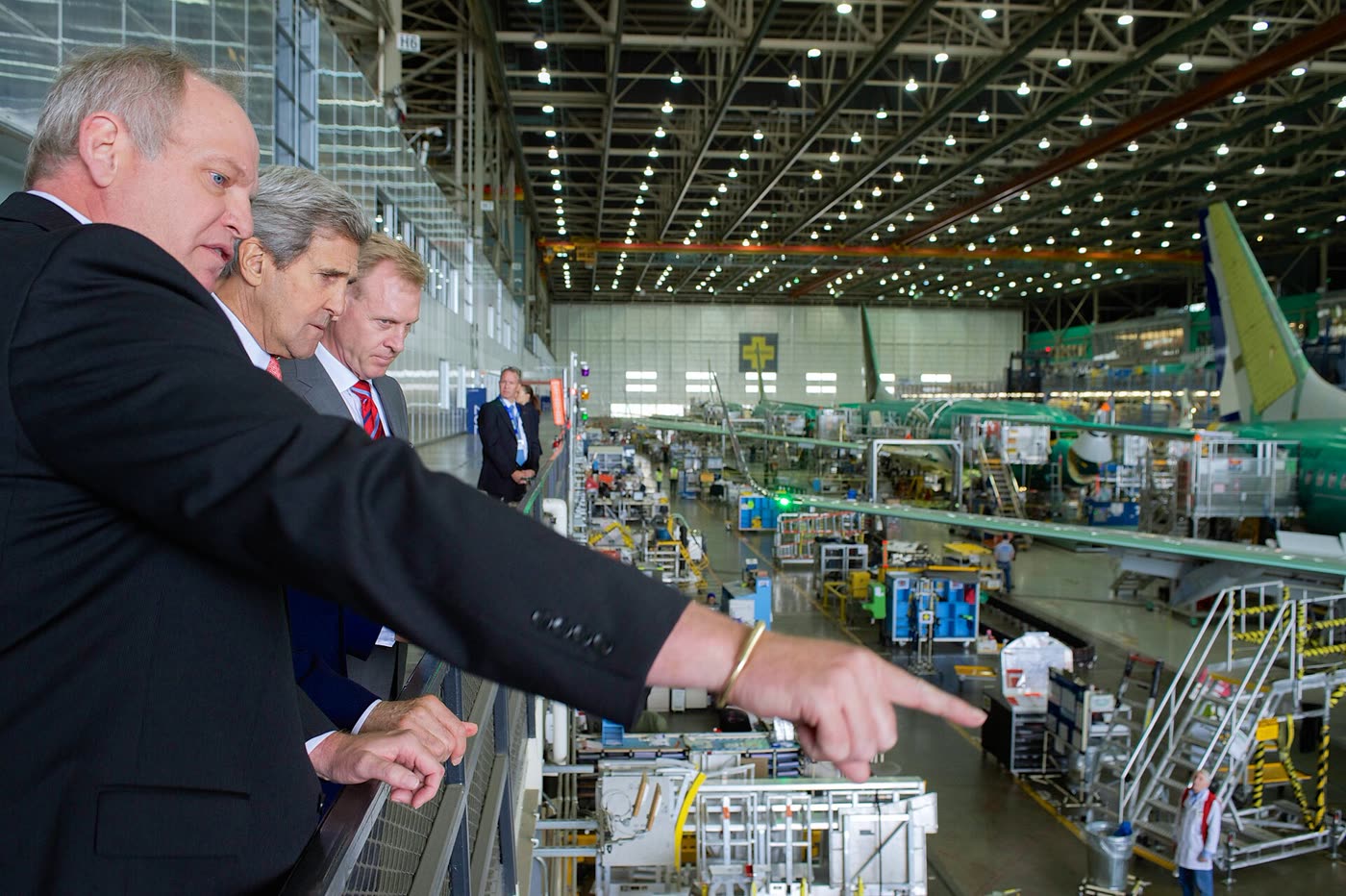
Image context: the cover uses a real 2015 photograph of Boeing's 737 assembly line in Renton, Washington. That is the right visual anchor because this quarter turned on ordinary industrial mechanics: rework, line rate, supplier pacing, and how quickly completed aircraft can move from factory floor to customer delivery.[6]
What the quarter actually proved
The strongest proof point was that commercial recovery is no longer theoretical. Boeing Commercial Airplanes delivered 143 aircraft in the quarter, including 114 737s and 15 787s.[1][4] That lifted BCA revenue to $9.2 billion, up 13% year over year, while BCA operating margin improved to negative 6.1% from negative 6.6%.[2] Those are still weak margins by normal aerospace standards, but they are directionally correct. Volume is finally helping.
The improvement was broader than one division. Defense, Space & Security generated $7.6 billion of revenue, up 21%, with operating margin improving to 3.1%.[1][2] Global Services added $5.4 billion of revenue, up 6%, and exited the quarter with a record $33 billion backlog after booking $8 billion of orders for a 1.6 book-to-bill ratio.[2][3] In other words, Boeing did not need one heroic commercial quarter to save the group. All three businesses contributed.
That matters because Boeing's 2026 cash case still needs help from every segment. Management reiterated a full-year free-cash-flow target of $1 billion to $3 billion, and CFO Jay Malave said the path still depends primarily on higher commercial deliveries, steady BDS improvement, and continued BGS growth.[2][3] The quarter did not break that framework. It made it more plausible.
Why cash conversion is still the boundary
This is where the read gets narrower and more demanding. Boeing's quarter improved, but it still did not produce positive free cash flow. Operating cash flow was negative $179 million, capital expenditures were $1.275 billion, and free cash flow was negative $1.454 billion.[1] Management said first-quarter cash flow benefited from favorable collection timing and a better-than-feared recovery from the 737 wiring issue.[3] That is useful, but it also means some of the improvement was timing help, not only structural repair.
The 737 line explains most of the opportunity and most of the risk. Ortberg said production has stabilized at 42 per month, Boeing expects to move to 47 per month this summer, and the company remains on track for 500 737 deliveries in 2026.[3] Just as important, Boeing said it has already reworked all 25 airplanes affected by the recent wiring nonconformance that pushed some first-quarter deliveries into the second quarter.[3] If that line keeps moving, cash should improve because Boeing still benefits from inventory already in the system.
The 787 line is less forgiving. Boeing delivered 15 787s in the quarter and still expects 90 to 100 deliveries for the full year.[2][3] But management also said the quarter was held back by premium-seat certification delays and supplier constraints, even though the Charleston plant is performing better and rework hours improved by more than 25% versus the first quarter of 2025.[3] Boeing still wants to move 787 production from 8 per month to 10 per month later this year.[2][3] The problem is that the 787 does not enjoy the same inventory buffer as the 737. The company can build airplanes, but delayed seats can still keep those airplanes from turning into cash.
The balance sheet is better than it was, but not light enough to make execution optional. Cash and marketable securities ended the quarter at $20.9 billion, while debt fell by $6.9 billion in the quarter to $47.2 billion after Boeing paid down maturing debt.[3][5] That debt reduction is good discipline. It also means the rerating case now has to come from cleaner operating cash generation, not from another purely financial reset.
Six numeric anchors
- Headline progress: revenue rose to $22.2 billion from $19.5 billion, while free cash flow improved to negative $1.454 billion from negative $2.290 billion.[1]
- Commercial throughput: Boeing delivered 143 commercial airplanes in Q1, including 114 737s and 15 787s.[1][4]
- Commercial margin still below normal: BCA revenue reached $9.2 billion, but operating margin remained negative 6.1%.[2]
- Defense and services helped carry the quarter: BDS revenue was $7.6 billion with a 3.1% margin, and BGS revenue was $5.4 billion with record $33 billion backlog.[1][2][3]
- Production path: the 737 line is stable at 42 per month with a planned move to 47 this summer, while the 787 is stabilizing at 8 per month with a planned move to 10 later this year.[2][3]
- Cash target still ahead, not in hand: Boeing ended Q1 with $20.9 billion of cash and marketable securities, $47.2 billion of debt, and a reiterated $1 billion to $3 billion full-year free-cash-flow target.[2][3][5]
Those anchors point to a simple conclusion. Boeing is no longer asking investors to underwrite an abstract turnaround story. It is asking them to believe that higher rates of airplane production and delivery will now convert into positive cash fast enough to outrun the remaining bottlenecks.
Strongest counterweight
The strongest pushback is that this framing may still be too conservative. Boeing's total backlog is now $695 billion, including more than 6,100 commercial airplanes, while BCA backlog alone stands at $576 billion.[1][2][3] Management also said the 737 program has nearly eliminated its old storage overhang, the 787 program received higher maximum takeoff weight certification on the -9 and -10, and BDS no longer required major estimate-at-completion charges in the quarter.[2][3] If the company can hold 737 quality while moving to 47 per month and keep 787 seat issues from dragging deliveries, then cash conversion may accelerate more quickly than this recap allows.
That counterweight is real. This is not a skeptical-for-its-own-sake quarter. It is a quarter where the operating repair looks convincing enough that the remaining debate has narrowed to one thing: how much of the record backlog is truly cash-ready.
Falsifier
This recap is too cautious if Boeing's next reporting window shows that delivery timing is no longer the main drag on cash. Concretely, if second-quarter free-cash-flow usage stays only in the low hundreds of millions as management suggested, the 737 line reaches 47 per month on schedule, and the 787 seat-certification bottleneck stops holding finished aircraft, then the "backlog first, cash later" framing would already be lagging the real turn.[2][3]
Watchlist
- Summer 2026 737 rate step: Boeing says the move from 42 to 47 aircraft per month is still planned for this summer; that is the cleanest near-term cash-conversion checkpoint.[3]
- Later-2026 787 production increase: the planned move from 8 to 10 per month matters because the 787 program has less inventory cushion and more direct exposure to supplier and seat-certification timing.[2][3]
- Next quarterly earnings release and 10-Q: the key lines are whether BCA margin keeps improving from negative 6.1%, whether free cash flow turns meaningfully less negative, and whether Boeing still holds its $1 billion to $3 billion full-year target.[1][2][5]
- Late-2026 certification milestones: Boeing still expects the 737-7 and 737-10 to be certified later this year, and those milestones would widen the delivery mix that can support future cash generation.[3]
Takeaway
Boeing's first quarter was a real step forward. More airplanes moved, cash burn narrowed, debt came down, and all three segments contributed to the improvement.
The harder proof is still ahead. A record backlog is no longer the bottleneck; turning that backlog into timely deliveries and positive cash flow is. If Boeing can keep the 737 ramp clean and stop the 787 from slipping on seats and suppliers, the rerating case strengthens quickly. If not, the stock remains a recovery story whose industrial math is improving but not yet finished.
Sources
- Boeing, "Boeing Reports First Quarter Results" (April 22, 2026).
- Boeing, "Q1 2026 Investor Presentation" (April 22, 2026 PDF).
- Boeing, "Q1 2026 The Boeing Company Earnings Conference Call" transcript PDF (April 22, 2026).
- Boeing, "Boeing Announces First Quarter Deliveries" (April 14, 2026).
- The Boeing Company, Quarterly Report on Form 10-Q for the quarter ended March 31, 2026.
- Wikimedia Commons, "File:Boeing Co. Officials Show Secretary Kerry 737 Assembly Line Following Trade Speech at Plant in Washington (17685396230).jpg".