The rates market and the credit market are not telling the same story going into Friday's payroll release. Priced is a softer labor handoff and eventual easing. New is that Treasuries have moved further into that view than credit has. On the U.S. Treasury's April 1 curve, the 2-year yield was 3.81% and the 10-year yield was 4.33%, leaving 2s10s at +52 basis points.[1] Yet the latest ICE BofA U.S. High Yield OAS was 3.28% on March 31, a level that still looks more like cooling than genuine credit stress.[2]
That split matters because the last full macro set is mixed rather than cleanly weak. February payrolls fell by 92,000 while the unemployment rate held at 4.4%.[3] February CPI still ran at 2.4% year over year, with core CPI at 2.5%.[4] January PCE inflation was 2.8% year over year, and core PCE was 3.1%.[5] The Fed then left the target range at 3.50% to 3.75%, kept the line that inflation remains "somewhat elevated," and published a March median year-end 2026 fed funds rate of 3.4% alongside 2026 PCE inflation of 2.7%.[6][7]
As of 2026-04-02 UTC, that is a narrow regime. Duration is leaning into a slower labor story. Credit is still behaving as if the slowdown stops short of a real break.
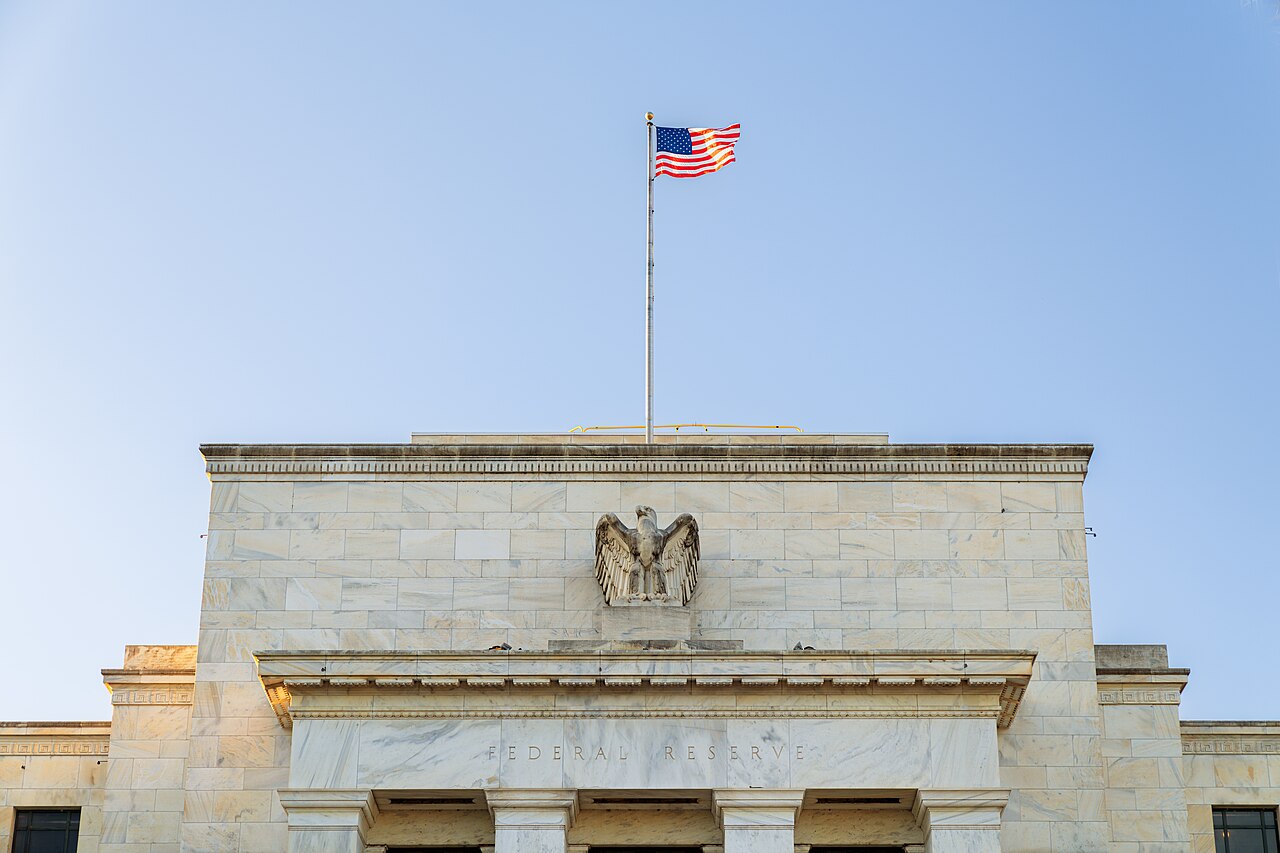
Image context: the cover uses a documentary photograph of the Federal Reserve building rather than a market graphic because this piece is about policy and pricing living in the same frame, not about a single indicator detached from institutions.[12]
Mechanism: why rates are more dovish than spreads
The causal chain is short.
First, Treasuries only need enough softness to pull forward the discussion of additional easing. They do not need a recession on impact. A negative payroll print with a stable unemployment rate is enough to make the front end ask whether the next few labor releases will keep eroding the "higher for longer" case.[1][3]
Second, credit needs something harsher before it stops behaving well. High-yield spreads usually widen in a lasting way when investors can see default pressure, liquidity strain, or a fast deterioration in labor income. A single weak payroll number, by itself, does not create that picture, especially when unemployment is still 4.4% and the Fed is still projecting policy above 3% at year-end.[2][3][7]
Third, inflation has cooled, but not enough for the Fed to ratify the rates market unconditionally. CPI at 2.4% and PCE at 2.8% look much better than the 2022 peak, but core PCE at 3.1% is still too firm for a clean victory lap.[4][5] That keeps the rates rally dependent on continued labor softness and cleaner inflation, rather than on a policy pivot that has already been granted.
The result is a live asymmetry. Rates are already pricing the possibility that the labor market is gliding into a softer phase. Credit is still pricing that the glide remains orderly.
Six numeric anchors
- Fed restraint is still live: the target range remains 3.50% to 3.75%.[6]
- The Fed's own 2026 median still runs restrictive: 3.4% for year-end fed funds and 2.7% for 2026 PCE inflation.[7]
- Labor has softened at the margin: February payrolls -92,000 and unemployment 4.4%.[3]
- Inflation is cooler, not cleanly finished: February CPI 2.4% y/y and core CPI 2.5% y/y.[4]
- PCE is still firmer than a victory narrative wants: January PCE 2.8% y/y and core PCE 3.1% y/y.[5]
- Markets are split: 2-year 3.81%, 10-year 4.33%, 2s10s +52 bps, and high-yield OAS 3.28%.[1][2]
Those numbers describe a market that has moved partway into a softer-growth trade, but not all the way into a recession trade.
Strongest counterweight
The best counterargument is that credit may simply be right. If the labor market is cooling without cracking, then high-yield spreads do not need to widen much, and the Treasury rally does not have to be a mistake. In that branch, the market can support both a lower front-end yield path and still-tight credit because the economy is decelerating into something closer to trend, not into a true earnings-and-default event.[2][3][7]
That counterweight is credible. It is exactly why this is not a bearish credit call. The narrower claim is that rates have already paid for more softness than spreads have.
Falsifier
This wrap becomes too cautious if the next labor-and-inflation sequence lands in the cleanest possible order: payroll growth stays soft, unemployment drifts only modestly, wage and inflation measures step down, and high-yield OAS stays near current levels instead of widening. If that combination appears, then the rates market is not early; it is correctly discounting a benign cooling cycle that credit can live with.[2][4][5]
Watchlist
- 2026-04-03 Employment Situation for March 2026: this is the immediate referee between the Treasury move and the credit move.[8]
- 2026-04-09 Personal Income and Outlays for February 2026: the next PCE print will test whether the Fed can sound patient without sounding trapped.[10]
- 2026-04-10 Consumer Price Index for March 2026: a cooler CPI would help rates keep their lead; a sticky print would expose how much front-end optimism is already in the price.[9]
- 2026-04-28 to 2026-04-29 FOMC meeting: if the next data sequence stays mixed, the Fed meeting becomes the place where the gap between market easing hopes and official caution is either narrowed or left intact.[11]
Takeaway
The market's high-value question is no longer whether growth is slowing. It is whether slowing labor is enough to justify the move already visible in Treasuries while credit still sits in a low-stress range. Right now the answer is unresolved. Rates are leaning into softer labor first. Credit still wants proof that softer labor becomes something larger than a controlled deceleration.
Sources
- U.S. Department of the Treasury, "Daily Treasury Par Yield Curve Rates" (April 1, 2026 row).
- Federal Reserve Bank of St. Louis FRED, "ICE BofA US High Yield Index Option-Adjusted Spread" (BAMLH0A0HYM2).
- U.S. Bureau of Labor Statistics, "Employment Situation News Release - 2026 M02 Results."
- U.S. Bureau of Labor Statistics, "Consumer Price Index News Release - 2026 M02 Results."
- U.S. Bureau of Economic Analysis, "Personal Income and Outlays, January 2026."
- Board of Governors of the Federal Reserve System, "Federal Reserve issues FOMC statement" (March 18, 2026).
- Board of Governors of the Federal Reserve System, "March 18, 2026: FOMC Projections materials, accessible version."
- U.S. Bureau of Labor Statistics, "Schedule of Releases for the Employment Situation."
- U.S. Bureau of Labor Statistics, "Schedule of Releases for the Consumer Price Index."
- U.S. Bureau of Economic Analysis, "Release Schedule" (showing April 9, 2026 Personal Income and Outlays for February 2026).
- Board of Governors of the Federal Reserve System, "Meeting calendars and information" (2026 FOMC meetings).
- Wikimedia Commons, "File:The Federal Reserve - Washington DC.jpg."