Utilities are being repriced as if "AI power demand" were a single asset class. That is too loose. Priced is that data centers will push U.S. electricity demand and capital spending higher. New is that the durable equity spread is not demand alone. It is contract structure: who has service agreements, customer reimbursement, protective tariff design, and transmission projects that can enter rate base before the load story turns politically expensive.[1][3][4][5][6]
That distinction matters because the macro demand case is already well known. The U.S. Energy Information Administration expects U.S. electricity generation to grow 1.2% in 2026 and 3.1% in 2027.[1] EPRI's widely cited 2024 study put data centers at 4.6% to 9.1% of U.S. electricity generation by 2030, depending on the scenario.[2] The market does not need another reminder that load is rising. It needs a cleaner filter for which utility narratives can survive cancellations, regulatory pushback, and customer-bill politics.
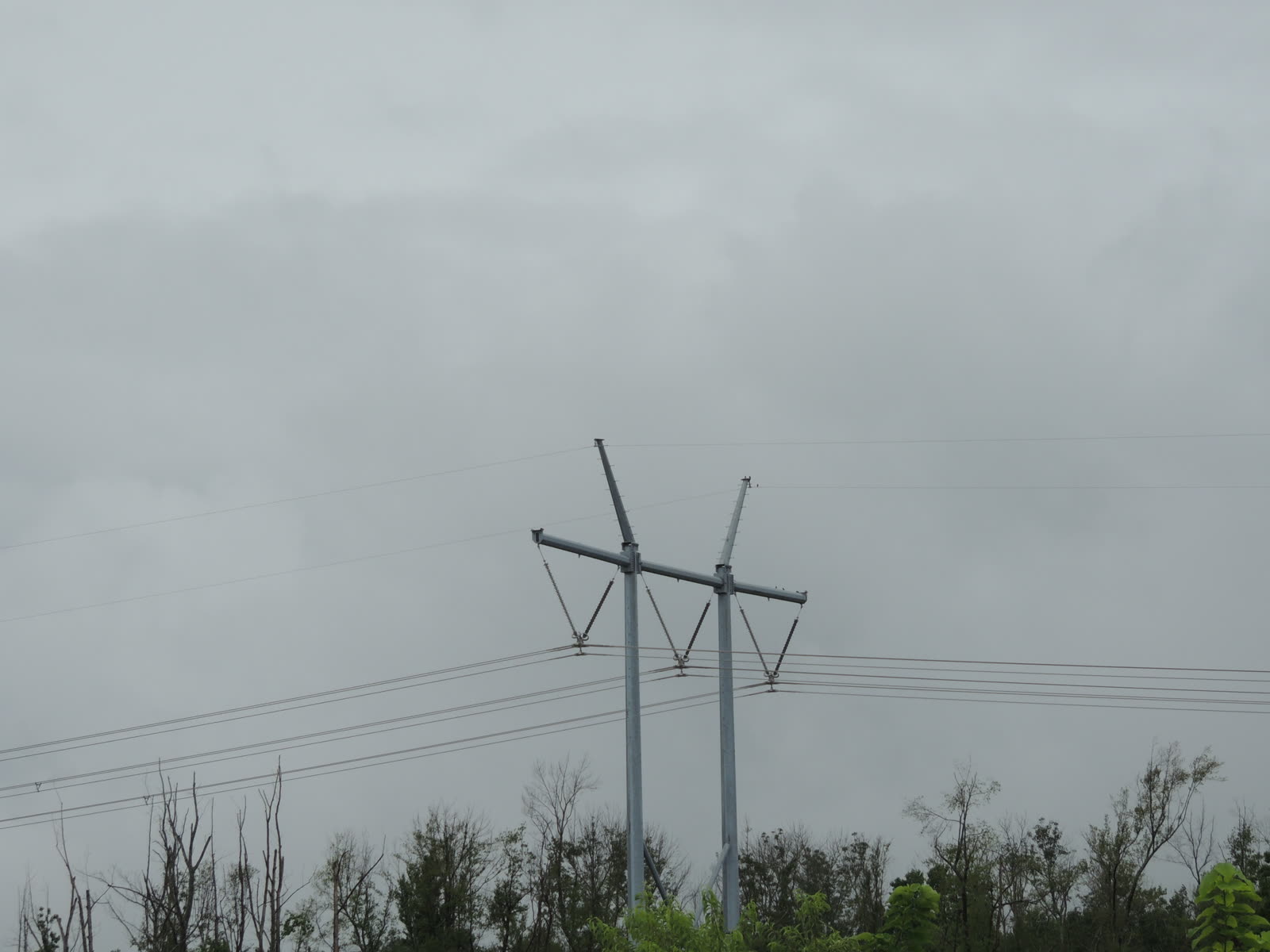
Image context: the cover uses a real Dominion transmission-line photograph because this article is about physical grid investment and recoverable utility economics, not about abstract AI symbolism.[11]
Mechanism: why the utility story is splitting
The causal chain is shorter than the stock move suggests.
First, a gigawatt request is not the same thing as a gigawatt that will earn. Dominion's December 2024 data-center pipeline reached ~40.2 GW, up from ~21.4 GW in July 2024, but only 8.8 GW of that December figure sat in full electric service agreements. Another 5.2 GW was in construction letters of authorization, and 26.2 GW was still in substation engineering letters of authorization.[3] Those categories are not economically identical. The further a project moves toward an actual service agreement, the more the utility can define cost recovery and protect itself if the customer changes its mind.
Second, the best utility management teams are already telling investors that customer protection is part of the growth story, not a footnote to it. Dominion Energy Virginia's March 25, 2025 rate proposal said large high-energy-demand customers would face a 14-year commitment and financial-security requirements, while a typical residential bill using 1,000 kWh per month would rise $8.51 beginning July 1, 2026 and another $2.00 beginning July 1, 2027 under the proposed design.[4] Southern Company used almost the same language in its annual report, saying its pipeline from large-load customers represented over 50,000 MW of potential incremental load by the mid-2030s and that pricing and contract terms were being designed to protect investments and provide benefits back to existing customers.[5]
Third, transmission specificity is where the theme stops being a slogan and starts becoming an earning asset. FirstEnergy's February 2026 data-center overview showed 4.085 GW of long-term contracted demand and 12.9 GW of pipeline demand by 2035, for 16.985 GW total, and attached an estimated ~$250 million per GW of incremental transmission investment opportunity to roughly 13 GW of pipeline demand.[6] That is the difference between saying "AI needs more power" and saying "this utility has a mapped lane from load growth into regulated capital."
This is why a uniform rerating is dangerous. Some utilities have a real sequence: study work, customer reimbursement, service agreements, construction, transmission investment, and then rate-base earning power. Others have a much softer story made of memorandums, queue headlines, and investor imagination.
Six numeric anchors
- Macro demand is rising again: EIA expects U.S. electricity generation to grow 1.2% in 2026 and 3.1% in 2027.[1]
- The AI load range is wide enough to matter: EPRI's scenario band reaches 4.6% to 9.1% of U.S. electricity generation for data centers by 2030.[2]
- Dominion's pipeline got much bigger, but the quality mix matters: the company's staged data-center capacity rose from ~21.4 GW in July 2024 to ~40.2 GW in December 2024, yet only 8.8 GW was in full service agreements.[3]
- Customer protection is becoming explicit: Dominion's proposed design includes a 14-year high-energy-demand commitment, with the typical residential bill impact framed at $8.51 in 2026 and $2.00 in 2027.[4]
- Southern's load opportunity is huge but not free-form: management cited 150+ company expansions or site selections, 20,000+ expected jobs, and 50,000+ MW of potential incremental large-load demand by the mid-2030s, alongside protective contract language.[5]
- FirstEnergy has attached real capital math to the theme: 4.085 GW contracted, 12.9 GW pipeline, 16.985 GW total by 2035, and ~$250 million/GW of incremental transmission opportunity on about 13 GW of pipeline demand.[6]
Those numbers lead to a narrow conclusion. The sector-wide AI-power trade is already priced as demand abundance. The better opportunity is to separate pipeline volume from economically protected volume.
Strongest counterweight
The best pushback is that the whole sector may not need that much discrimination. If electricity demand keeps accelerating, if the lower end of the EPRI range proves too conservative, and if regulators stay cooperative because local tax bases and jobs are attractive, then even utilities with messier pipelines can still earn enough to justify today's broader rerating.[2][5] In that branch, contract quality matters less because demand pressure itself keeps the policy window open.
That counterweight is real. It is also why this is not a bearish call on utilities. The narrower claim is that the next leg of outperformance will belong less to the utilities with the loudest load headlines than to the ones that can show which megawatts are actually contract-backed and financeable.
Falsifier
This framework is too selective if the next twelve months show that earlier-stage pipeline megawatts convert into service with minimal fallout, regulators allow broad cost recovery without tighter customer-protection terms, and utilities with weaker contract visibility still earn the same valuation premium as the more disciplined names. If that happens, the market will have been right to treat raw load exposure as enough.[3][4][5][6]
Watchlist
- 2026-04-07 EIA Short-Term Energy Outlook: this is the next official read on whether national power-demand growth is staying broad enough to support the sector's bullish backdrop.[7][8]
- 2026-04-30 Southern Company first-quarter 2026 earnings call: this is where the company can show whether its 50-GW-plus large-load opportunity is converting into protected economics rather than just pipeline enthusiasm.[5][9]
- 2026-05-05 Dominion Energy annual meeting: the high-value question is whether management keeps emphasizing service-agreement quality, customer protections, and Virginia bill impacts rather than only headline capacity requests.[3][4][10]
- 2026-06-30 PJM 2028/2029 Base Residual Auction: if reliability pricing stays tight, the case for transmission and grid spending remains stronger; if the pressure loosens materially, some of the urgency premium comes out of the theme.[7]
Takeaway
Utilities are not being rerated because investors just discovered that servers use electricity. They are being rerated because investors believe a new class of large-load customers can finance a long capital cycle. The durable spread now sits inside that belief. It belongs to utilities that can prove the demand is attached to reimbursement, protective terms, and regulated investment lanes. In this theme, megawatts are interesting. Contract quality is what gets paid.
Sources
- U.S. Energy Information Administration, Short-Term Energy Outlook (March 2026).
- EPRI via PR Newswire, "Data Centers Could Consume up to 9% of U.S. Electricity Generation by 2030" (May 29, 2024).
- Dominion Energy, "4Q 2024 Earnings Call Slides" (Feb. 12, 2025).
- Dominion Energy Virginia, "Dominion Energy Virginia files proposed rates that protect customers and support growth" (March 25, 2025).
- Southern Company, Annual Report 2024 (CEO letter and business update).
- FirstEnergy, "Data Center Overview Strategic & Financial Highlights" (Feb. 17, 2026).
- PJM Inside Lines, "PJM Files Joint Periodic Review Proposal to FERC" (noting the 2028/2029 Base Residual Auction is scheduled to commence June 30, 2026).
- U.S. Energy Information Administration, Short-Term Energy Outlook release schedule.
- Southern Company, "Southern Company to release first-quarter 2026 earnings on April 30."
- Dominion Energy, "2026 Annual Meeting of Shareholders" event page.
- Wikimedia Commons, "File:Dominion Power 500kV - Southampton County, VA - 40109612672.jpg".