Levi Strauss is no longer being valued like a heritage jeans company waiting for rescue. With LEVI.US closing at $22.76 on 2026-04-09, after the company reported first-quarter net revenues of $1.742 billion, adjusted diluted EPS of $0.42, and direct-to-consumer revenue of $911.5 million, the market is already paying for a cleaner, more focused post-Dockers story.[1][4] The easy read is that the reset is working.
The more useful read is narrower. Priced is a DTC-first denim company with Dockers removed, Levi's still carrying about 94% of revenue, and women and international markets broadening the base.[1][2][3] New is whether that cleaner mix can keep holding the margin line once the tariff bill moves inside the model. Gross margin in the quarter was 61.9%, down from 62.1% a year earlier, adjusted EBIT margin fell to 12.5% from 13.4%, and the company said it had paid about $80 million of now-invalidated IEEPA tariffs through the first quarter while still facing fresh prospective tariffs under other authorities.[1][2] For this stock in April 2026, the real proof is no longer brand simplification by itself. It is tariff absorption without a messy giveback in promotions, inventory cost, or advertising intensity.
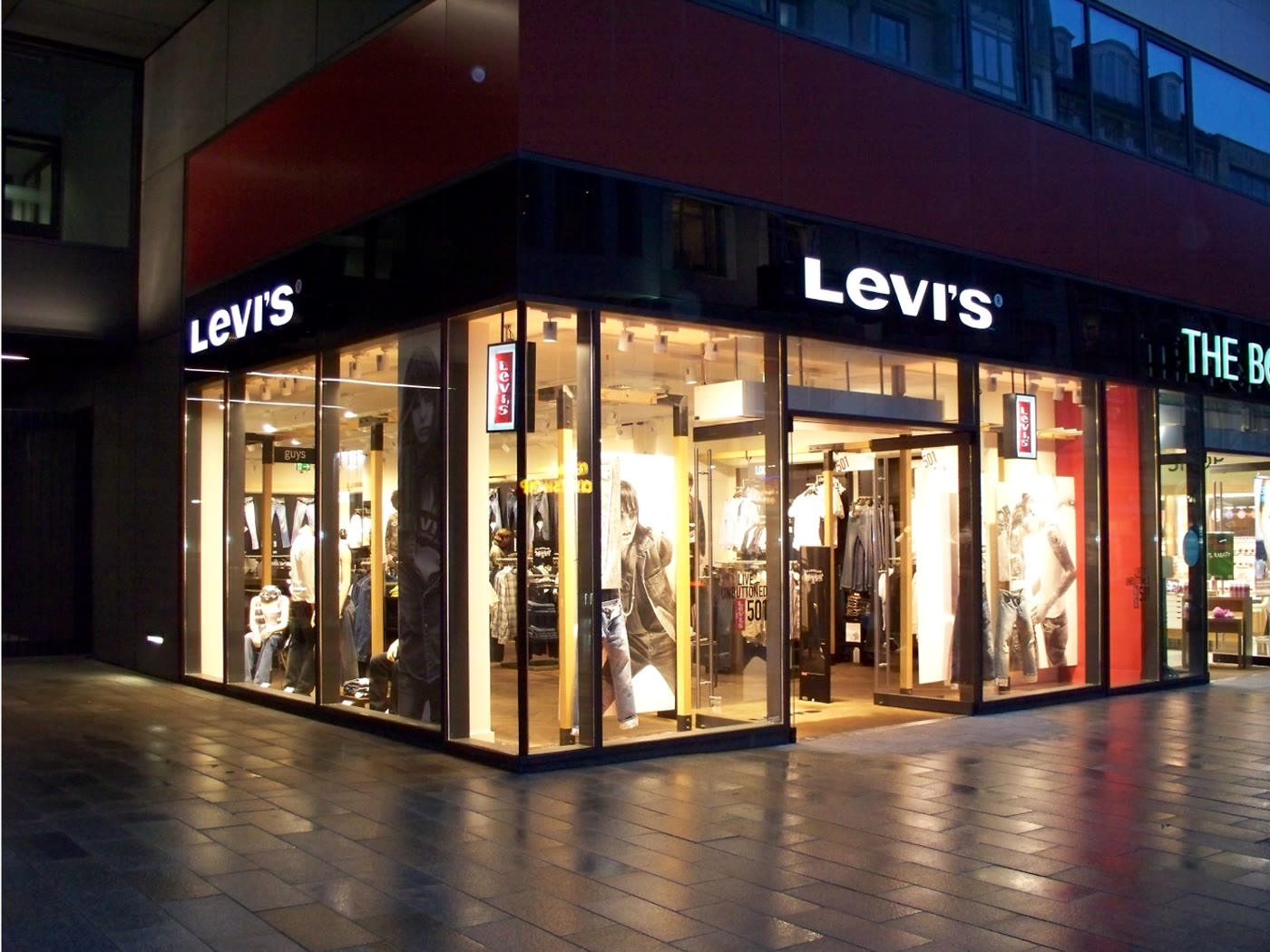
Image context: the cover uses a documentary storefront photograph rather than a fashion-campaign visual because this article is about channel mix and owned retail economics in the ordinary course of business.[5]
Priced vs new
The reason the quarter landed well is straightforward. Levi put up broad growth across channels and geographies, then raised full-year guidance instead of hiding behind the trade backdrop.[1] Reported revenue rose 14%, organic revenue rose 9%, Americas revenue rose 9%, Europe grew 24% reported and 10% organic, Asia grew 13% reported and 12% organic, and DTC comparable sales rose 7%.[1] This is not the profile of a company relying on one temporary pocket of strength.
That is why the argument has shifted. Investors already know Michelle Gass is pushing Levi Strauss toward a more controlled, more global, more women-led, more DTC-heavy model. The first-quarter 10-Q makes that shift visible in the mix itself: women represented 40% of net revenues versus 38% a year earlier, international business represented 61% of net revenues versus 57%, and DTC represented 52% of net revenues.[2] The stock does not need another article about whether the portfolio is cleaner. It needs evidence that the cleaner portfolio can still protect margins when imported product costs rise.
Why this quarter mattered
1. The mix shift is real
The best part of the quarter is that Levi did not buy growth from one weak corner. DTC net revenues increased 16% on a reported basis and 10% on an organic basis, while e-commerce grew 21% reported and 17% organic.[1] Wholesale also grew, which matters because it means the company is not simply shifting volume from one pocket to another.[1][2] The proxy statement helps frame the background: in fiscal 2025, wholesale still represented 51% of revenue and DTC 49%, while the business skewed 60% men's and 39% women's.[3] First-quarter 2026 kept pushing that balance toward a more diversified shape.
That mix shift is why the story still deserves attention. A company with more owned retail, more women, more international revenue, and a smaller role for non-core brands should be capable of steadier growth and stronger merchandising control than the Levi of a few years ago.[2][3]
2. The margin debate has moved from brand cleanup to tariff absorption
The quarter also showed where the clean narrative starts to meet harder arithmetic. Gross margin slipped 20 basis points to 61.9%.[2] Adjusted EBIT rose to $217.8 million, but adjusted EBIT margin still fell 90 basis points to 12.5% on a reported basis.[1][2] Levi said the decline reflected tariff impact and higher advertising and promotion expense, partially offset by higher revenue and a legal-settlement gain at the operating-income line.[1][2]
That matters because tariffs are not being discussed here as a vague macro risk. The 10-Q says the company had already paid about $80 million of U.S. tariffs through the first quarter under the now-invalidated IEEPA regime, and that many of its sourcing countries, including Bangladesh, Cambodia, Pakistan, and Vietnam, remain exposed to new prospective tariffs and further policy changes.[2] Once that much cost has already touched the P&L and inventory base, the next question becomes practical: can Levi preserve its premium gross-margin structure without leaning into heavier promotions or accepting slower demand?
3. Post-Dockers concentration is both strength and pressure
Dockers is gone. The remaining Dockers operations were sold in multiple closings during the first quarter, with the final closing on 2026-02-27 and a gain on sale of $20.5 million on the remaining operations.[2] That makes the company easier to read. But it also means the remaining portfolio has less room to hide.
Levi's brand products represented about 94% of net revenues in the quarter.[2] That concentration is attractive when the core brand is strong, and the first-quarter results suggest it is. It also means execution standards rise. If the Levi's brand, women, international expansion, and Beyond Yoga do not keep converting into clean DTC growth and stable margin, there is no large secondary brand portfolio left to smooth the outcome. Simplification makes the story better and sharper at the same time.
Six numeric anchors
- Quarterly scale: net revenues were $1.742 billion, up 14% reported and 9% organic.[1]
- Channel mix: DTC net revenues were $911.5 million, up 16% reported and 10% organic; DTC represented 52% of total net revenues and e-commerce grew 21% reported.[1][2]
- Margin line: gross margin was 61.9% versus 62.1% a year earlier; adjusted EBIT was $217.8 million and adjusted EBIT margin was 12.5% versus 13.4%.[1][2]
- Earnings and cash: diluted EPS from continuing operations was $0.45, adjusted diluted EPS was $0.42, operating cash flow was $211.5 million, and adjusted free cash flow was $152.1 million.[1]
- Mix after cleanup: women were 40% of revenue, international business was 61%, Levi's brand was about 94%, and Dockers' final closing came on 2026-02-27.[2]
- Guidance reset: Levi raised full-year reported revenue growth to 5.5%-6.5%, organic revenue growth to 4.5%-5.5%, gross margin to flat to slightly up, and adjusted EBIT margin to roughly 12%.[1]
Those anchors are enough to show what changed. The company is clearly growing. The company is clearly cleaner. The unresolved question sits inside the spread between premium gross margin and a higher-cost sourcing environment.
Strongest counterweight
The strongest pushback is that management may already have absorbed enough of the tariff problem to justify the rerating. Levi raised full-year guidance anyway.[1] DTC growth stayed double digit on a reported basis.[1] Operating cash flow jumped to $211.5 million from $52.5 million a year earlier, adjusted free cash flow swung to $152.1 million from negative territory, and the company still returned $214 million to shareholders in the quarter.[1] If revenue growth remains broad and the company can keep offsetting tariff cost through price, mix, and channel control, then the margin debate may be much less threatening than this article implies.
That counterweight is real. It is the reason this is not a skeptical turnaround note. The narrower point is that once the cleanup trade is recognized, the stock starts living or dying on whether high-quality mix actually converts into defended margin.
Falsifier
This recap is leaning too hard on tariff risk if the next quarter shows that Levi can keep DTC above half of revenue, keep gross margin around the low-62% area, deliver adjusted EBIT margin in line with the new roughly 12% full-year guide, and move inventory through the system without a fresh promotional step-down.[1][2] If those things happen while the tariff backdrop remains noisy, then the cleaner post-Dockers model is doing more work than this caution allows.
Watchlist
- April 22, 2026 annual meeting: the clearest near-term read is how management describes tariff mitigation, women-led growth, and DTC productivity after the raised guide.[3]
- Second-quarter FY2026 results and 10-Q: gross margin, adjusted EBIT margin, and DTC share of revenue are the key proof lines.[1][2]
- Tariff-policy and refund updates: the company has already said about $80 million of invalidated IEEPA tariffs had been paid through Q1, so any clarity on refunds or replacement tariff burden matters directly to margins.[2]
- Americas back-to-school flow: U.S. DTC growth, wholesale replenishment, and promotional posture will show whether the stronger first-quarter mix can hold through a more competitive demand window.[1][2]
Takeaway
Levi Strauss delivered the kind of first quarter that justifies a cleaner story: revenue growth was broad, DTC stayed strong, Dockers is gone, and management raised the year.[1][2] The better finance question now is tighter. Can a more focused, more DTC-heavy, more women-and-international mix keep converting into defended gross margin while tariff costs stop being a transitory explanation and start becoming an operating test? That is the proof the market still needs.
Sources
- Levi Strauss & Co., "Levi Strauss & Co. Reports First-Quarter Results" (April 7, 2026).
- Levi Strauss & Co. Quarterly Report on Form 10-Q for the quarter ended March 1, 2026, mirrored by StockTitan with filing text and link back to SEC EDGAR.
- Levi Strauss & Co., Notice of Annual Meeting of Shareholders and Proxy Statement 2026.
- Stooq, "LEVI.US" daily price history (latest quoted line for 2026-04-09).
- Wikimedia Commons, "File:Levi's store in Leipzig.jpg."