AutoZone still looks like a business that earned a premium. Fiscal 2025 sales reached $18.9 billion, fourth-quarter diluted EPS reached $48.71, and the company finished that year with domestic same-store sales up 4.8%.[3] In the second quarter of fiscal 2026, sales rose another 8.1% to $4.27 billion, total same-store sales rose 3.3%, and domestic commercial sales rose 9.8% to $1.15 billion.[1][2]
The valuation question is narrower now. Priced is that AutoZone still controls one of the strongest aftermarket parts networks in U.S. retail: dense stores, fast delivery, commercial share gains, and a buyback habit that keeps shrinking the denominator. New is that the latest growth came with more visible friction. Gross margin fell 137 basis points in the quarter, including a $59 million pre-tax LIFO charge; inventory rose 13.1% year over year to $7.45 billion; inventory turns slipped to 1.3x from 1.4x; and inventory net of payables became less negative than it was a year ago.[1][2] At about $3,464.93 per share, roughly $57.1 billion of market value, and about 24.3x trailing earnings, investors are already paying for the model to stay unusually productive.[4]
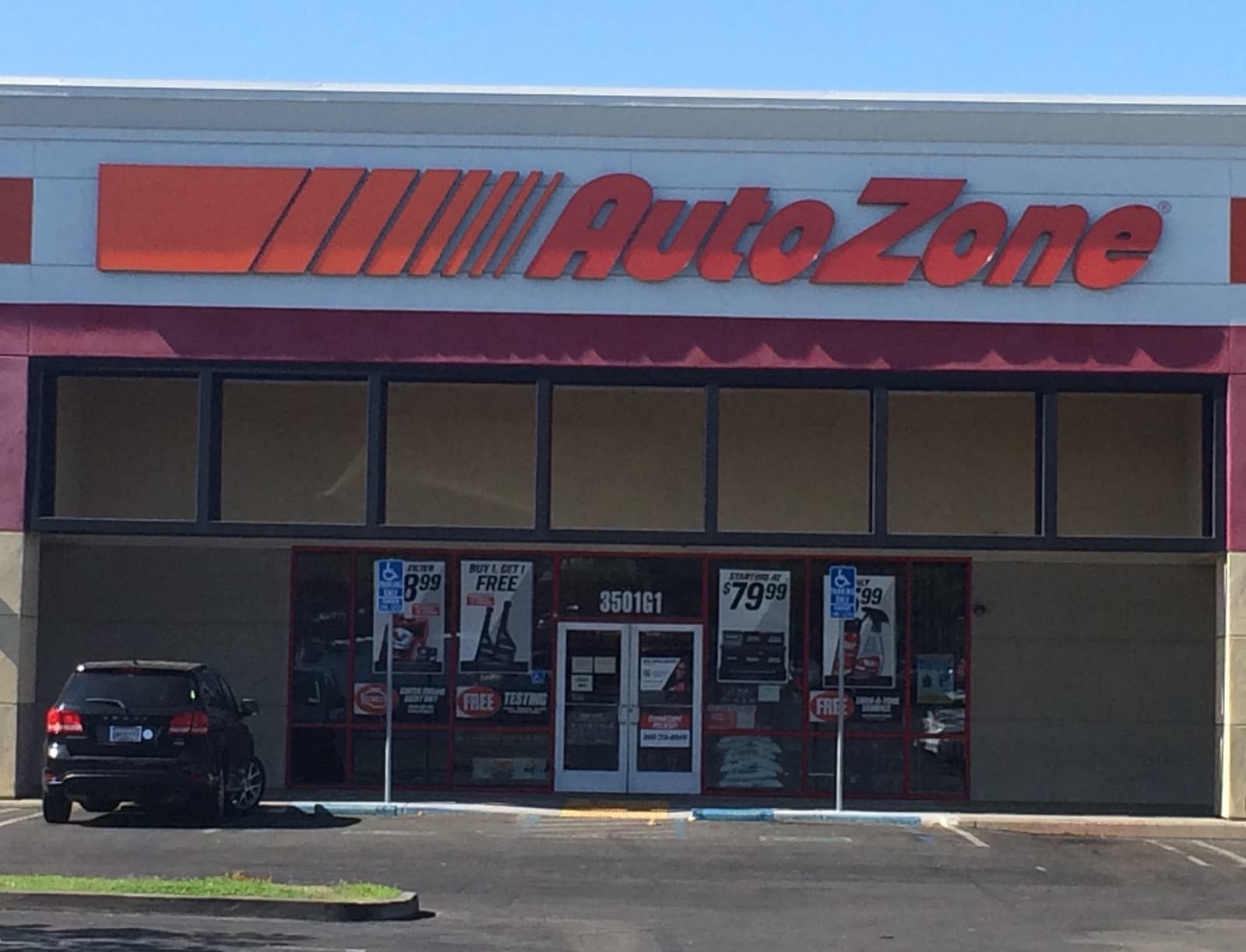
Image context: the cover uses a documentary photograph of an AutoZone store rather than a symbolic retail graphic. That is the right anchor because this investment case is still about a real store-and-hub system moving parts to DIY and repair-shop customers fast enough to justify premium economics.[5]
Why the premium exists
The core bull case is not hard to see. AutoZone's domestic commercial business is no longer a side lane attached to a DIY chain. In the second quarter of fiscal 2026, domestic commercial sales reached $1.1548 billion, the trailing-four-quarter commercial run rate reached $5.479 billion, and the company said it had 6,310 commercial programs operating in 94% of domestic stores.[2] That is a meaningful distribution system, not a small adjacency.
The buyback engine also still matters. AutoZone repurchased $311 million of stock in the quarter and $741.8 million year to date through the second quarter.[2] That has been part of the model for years: operating cash flow funds store growth, hub expansion, and inventory, then excess cash keeps retiring shares. Investors pay a premium for that kind of steady capital-allocation machine because it converts decent operating growth into stronger per-share growth.
Fiscal 2025 explains why the market still gives AutoZone that benefit of the doubt. Fourth-quarter sales rose 4.5% and annual sales reached $18.9 billion, while the company was still opening stores and extending its commercial footprint.[3] The important point is that AutoZone does not need explosive top-line growth to look attractive. It only needs a combination of stable same-store sales, continuing commercial share gains, and disciplined share shrink.
Where the model got heavier
The harder part of the current setup is that the machine is asking for more balance-sheet support than it did a year ago. The second quarter's $59 million LIFO charge is the cleanest signal that merchandise-cost pressure is no longer something investors can wave away as background noise.[1][2] Gross margin fell from 53.9% to 52.5%, operating profit fell 1.2% to $698 million, and operating margin fell from 17.9% to 16.3% even though sales were up more than eight percent.[2]
The balance-sheet details point in the same direction. Inventory per store rose 8.1% to $958,000, while inventory net of payables moved from negative $1.196 billion to negative $813 million.[2] AutoZone still runs negative working capital, which remains a structural advantage. But the advantage was less pronounced this quarter than it was a year ago. When a retailer with a premium multiple needs more inventory and gets less clean working-capital help from suppliers at the same time, investors should stop treating every extra dollar of sales as equally high quality.
That does not make the business fragile. Debt was $8.907 billion, down slightly from the year-ago quarter, and the company is still throwing off enough cash to keep buying back stock.[2] The narrower point is that the margin between "great retailer" and "great stock at this price" has become thinner. If AutoZone is going to keep trading at about 24x trailing earnings, commercial growth and hub density now need to do enough work to offset a heavier inventory posture and recurring cost pressure.[2][4]
Six numeric anchors
- Current valuation frame: about $3,464.93 per share, about $57.1 billion of market value, and about 24.3x trailing earnings.[4]
- Fiscal 2025 base: annual sales of $18.9 billion and fourth-quarter diluted EPS of $48.71.[3]
- Latest quarterly growth: second-quarter fiscal 2026 sales of $4.27 billion, up 8.1%, with total same-store sales up 3.3%.[1][2]
- Commercial engine: domestic commercial sales of $1.1548 billion, up 9.8%, with 6,310 commercial programs active in 94% of domestic stores.[2]
- Margin pressure: gross margin down 137 bps to 52.5%, including a $59 million pre-tax LIFO charge; operating margin down 154 bps to 16.3%.[1][2]
- Balance-sheet weight: inventory $7.449 billion, up 13.1%; inventory turns 1.3x versus 1.4x; inventory net of payables negative $813 million versus negative $1.196 billion a year earlier.[2]
Those anchors describe a stock that still deserves respect and a valuation that still demands evidence.
Strongest counterweight
The best pushback is that the current quarter may overstate the pressure. AutoZone's commercial business is still growing faster than the rest of the company, same-store sales remain positive, debt is not spiraling, and buybacks are still material.[2][3] If merchandise-cost pressure stabilizes and the company keeps taking commercial share, the present margin dip can end up looking like a temporary cost-wave rather than a structural downgrade in quality.
That counterweight is real. It is why this is not a short thesis. The claim is narrower: once a premium multiple is already in place, investors have to care more about inventory productivity than they did during the cleanest phase of the buyback-and-commercial story.
Falsifier
This walkthrough becomes too cautious if the next two reporting windows show the model re-lighting on all the right lines at once. Concretely, if commercial growth stays high single digit or better, gross margin stabilizes despite cost pressure, inventory turns stop slipping, and the company keeps retiring stock at a meaningful pace, then the current "heavier inventory, thinner quality spread" framing would be too conservative.[1][2][3]
Watchlist
- Next quarterly results: the key lines are domestic commercial growth, same-store sales, gross margin excluding commentary around LIFO or merchandise-cost pressure, and whether operating leverage returns.[1][2]
- Inventory productivity: investors should watch inventory per store, inventory turns, and inventory net of payables more closely than raw sales growth, because that is where the quality of the model is being tested now.[2]
- Capital allocation mix: AutoZone's valuation still assumes that buybacks remain an amplifier rather than a compensation mechanism for weaker operating quality.[2][4]
Takeaway
AutoZone still has a premium business. The store base, the commercial network, and the buyback machine all remain real. The narrower issue is what kind of premium the stock can still command when growth arrives with more LIFO drag, more inventory, and less pristine working-capital support. At roughly 24x trailing earnings, the stock no longer needs to prove it is good. It needs to prove that commercial momentum and inventory productivity can keep that premium from feeling fully priced.
Sources
- AutoZone, "AutoZone 2nd Quarter Total Company Same Store Sales Increase 3.3%; Domestic Same Store Sales Increase 3.4%; EPS of $27.63" (March 3, 2026).
- AutoZone, "Second Quarter Fiscal 2026 Conference Call Presentation" (March 3, 2026).
- AutoZone, "AutoZone 4th Quarter Total Company Same Store Sales Increase 5.1%; Domestic Same Store Sales Increase 4.8%; 4th Quarter EPS of $48.71; Annual Sales of $18.9 Billion" (September 23, 2025).
- Google Finance, "AutoZone Inc (NYSE: AZO) Stock Price & News," accessed April 9, 2026.
- Wikimedia Commons, "File:AutoZone Modesto, California.jpg."