Johnson & Johnson's first quarter was good enough to raise the full-year frame, but not good enough to remove the main debate. Reported sales reached $24.1 billion, up 9.9%, adjusted EPS was $2.70, and management lifted the midpoint of full-year estimated reported sales guidance to $100.8 billion while nudging adjusted EPS guidance to $11.55.[1] The market already knew J&J had the scale to carry one patent-loss cycle without breaking. The newer question is narrower: can the company prove that oncology, TREMFYA, CAPLYTA, and MedTech are now deep enough to outrun an approximate 920-basis-point Innovative Medicine hit from STELARA and still keep the growth profile clean?[1]
That is the priced-vs-new split. Priced is diversification: in the 2025 annual report, J&J described itself as a company with $94.2 billion of annual sales, nearly $20 billion of free cash flow, more than $32 billion invested in research, development, and inorganic innovation, and a plan to invest $55 billion in the U.S. over four years.[4] New is whether that breadth is now doing real offset work rather than just making the patent cliff look cosmetically manageable. A raised guide helps, but the guide only moved modestly. The stock still needs evidence that the post-STELARA mix will be stronger, not merely less bad.[1][4]
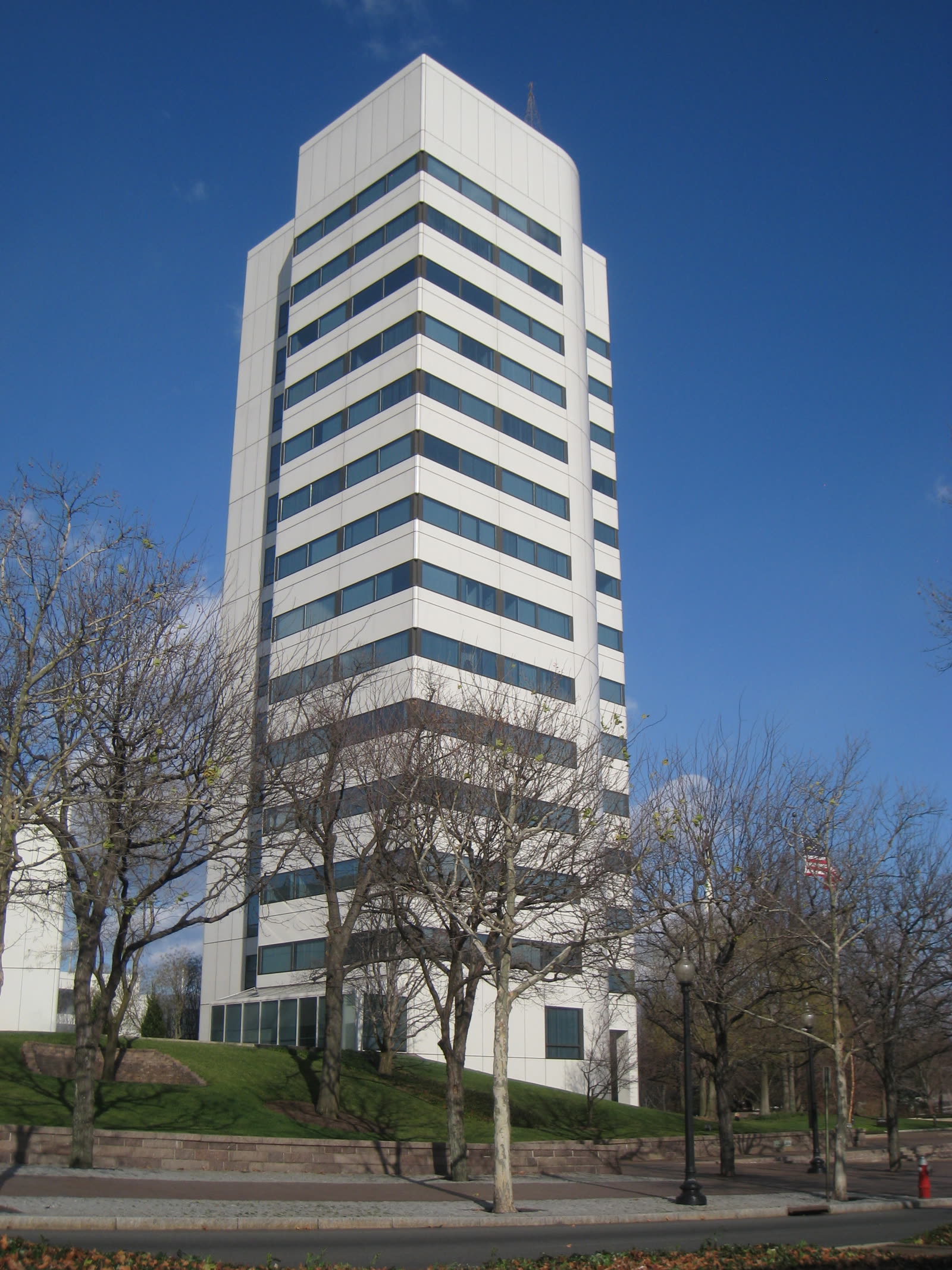
Image context: the cover uses a real street-level photograph of Johnson & Johnson's headquarters rather than an abstract pill bottle, DNA graphic, or candlestick chart. That is the right visual language for this piece because the quarter is really about portfolio management inside one large operating system: launches, manufacturing, M&A, MedTech execution, and capital return all live in the same building before they show up in the numbers.[7]
Why the quarter reads better than the patent-cliff headline
The first reason is that the underlying businesses were not soft. Innovative Medicine delivered $15.4 billion of first-quarter sales and 7.4% operational growth even after the STELARA drag, while MedTech delivered $8.6 billion and 4.6% operational growth.[1] That is not a company leaning on one lucky product. It is a company still getting paid by multiple engines at once.
The second reason is that the better engines are large enough to matter at the corporate level. Oncology alone reached $7.0 billion of sales in the quarter, up 22.8%, with DARZALEX at $4.0 billion, up 22.5%, and CARVYKTI at $597 million, up 62.1%.[1] J&J also pointed to TREMFYA in Immunology, SPRAVATO in Neuroscience, and CAPLYTA as part of the offset set, while MedTech growth came from electrophysiology, Abiomed, Shockwave, and trauma.[1] If you are looking for evidence that the company still has launch depth, this is where it sits.
The third reason is strategic rather than purely quarterly. The annual report makes clear that 2025 was already a transition year: STELARA lost exclusivity, CARVYKTI and Shockwave crossed the $1 billion annual-sales threshold, and management kept broadening the growth lanes across Oncology, Immunology, Neuroscience, Cardiovascular, Surgery, and Vision.[4] In other words, Q1 2026 did not invent the transition. It showed that the transition is still intact.
Why the proof burden is still there
The harder part is that the guidance raise was real but measured. Full-year adjusted operational sales growth moved to a midpoint of 6.1% from 5.9% in January, and adjusted EPS moved to $11.55 from $11.53.[1] Those are helpful revisions, but they are not the kind of move that ends an argument. They read more like confirmation that the machine is holding together than proof that J&J has entered a meaningfully faster earnings regime.
Cash conversion is the second reason the debate stays open. First-quarter free cash flow was only about $1.5 billion, versus $3.379 billion a year earlier.[1] Management can reasonably say first-quarter cash is noisy, and long-duration holders will point to the annual report's nearly $20 billion of 2025 free cash flow as the better baseline.[4] Still, a company arguing for durable post-cliff strength eventually has to show that launch breadth, MedTech growth, and acquisition integration all turn back into easier cash generation, not just top-line resilience.
There is also a portfolio-complexity issue. J&J's quarter was helped by acquisitions and divestitures at the segment level, with Innovative Medicine's adjusted operational growth lower than its reported operational growth partly because of CAPLYTA's contribution.[1] That is not a criticism of the deal logic. It is a reminder that investors still have to separate true organic acceleration from smart portfolio patching. The dividend increase to $1.34 per quarter and the 64th consecutive annual raise underline management confidence, but dividend discipline is not the same thing as proving a cleaner growth mix.[5]
Six numeric anchors
- Quarterly scale: first-quarter 2026 reported sales were $24.062 billion, up 9.9% year over year; operational sales growth was 6.4% and adjusted operational sales growth was 5.3%.[1]
- Quarterly earnings: adjusted net earnings were $6.614 billion and adjusted diluted EPS was $2.70; GAAP diluted EPS was $2.14.[1]
- Innovative Medicine frame: segment sales were $15.426 billion with 7.4% operational growth, despite an approximate 920-basis-point hit from STELARA.[1]
- Launch depth: Oncology sales were $6.973 billion; DARZALEX reached $3.964 billion and CARVYKTI reached $597 million.[1]
- MedTech support: MedTech sales were $8.636 billion with 4.6% operational growth, led by electrophysiology, Abiomed, Shockwave, and trauma.[1]
- Full-year frame: estimated reported sales guidance midpoint rose to $100.8 billion and adjusted EPS guidance midpoint rose to $11.55; the annual report also shows nearly $20 billion of 2025 free cash flow and $55 billion of planned U.S. investment over four years.[1][4]
Strongest counterweight
The best pushback is that this quarter may already be enough. Very few healthcare companies can absorb a flagship exclusivity loss, still post almost 10% reported sales growth, raise guidance, and point to multiple product families that are scaling simultaneously.[1][4] If TREMFYA keeps compounding, CARVYKTI keeps widening capacity and utilization, CAPLYTA continues to broaden the neuroscience lane, and MedTech stays in its current mid-single-digit zone, then the market may be underestimating how quickly J&J's mix can look cleaner again.[1][4]
That counterweight is real. It is why this is not a bearish readout. The narrower claim is that the company has passed the "can it absorb the first punch?" test, but has not yet fully passed the "is the new growth profile obviously better than the old one?" test.
Falsifier
This recap becomes too cautious if the next quarterly window shows the offset set widening rather than merely holding. Concretely, if the July 15, 2026 earnings date brings another step up in guidance, Innovative Medicine ex-STELARA keeps accelerating through oncology and immunology, MedTech stays comfortably in its current growth band, and cash generation rebounds from the soft first quarter, then the "still has to prove launch depth" framing would be too conservative.[1][2]
Watchlist
- April 23, 2026: J&J's annual meeting is the next governance window for management's capital-allocation language, orthopaedics-separation framing, and how aggressively it wants to talk about post-STELARA growth confidence.[3]
- May 26 and June 9, 2026: the ex-dividend and payment dates on the newly raised $1.34 quarterly dividend matter less for income math than for confidence signaling; management would not want the payout message to outrun operating follow-through for long.[5]
- July 15, 2026: J&J's investor calendar already flags the next quarterly date. That is the cleanest near-term test of whether this quarter's raised outlook was the start of a broader slope or just a solid first-quarter hold.[2]
Takeaway
Johnson & Johnson delivered the kind of quarter a defensive compounder is supposed to deliver: sales up, guidance up, dividend up, and enough launch breadth to keep the patent-loss conversation from dominating the whole story.[1][5] The more interesting finance question is what happens next. If oncology, TREMFYA, CAPLYTA, and MedTech keep carrying the load while cash conversion normalizes, the post-STELARA portfolio will look stronger than the market may still assume. If that breadth fades back toward "good enough" rather than "clearly better," then the quarter will read more like stabilization than rerating fuel.
Sources
- Johnson & Johnson, "Johnson & Johnson reports Q1 2026 results, raises 2026 outlook" (April 14, 2026).
- Johnson & Johnson, "Johnson & Johnson to Host Investor Conference Call on First-Quarter Results" (March 2, 2026).
- Johnson & Johnson, 2026 Proxy Statement (April 2026).
- Johnson & Johnson, 2025 Annual Report (March 2026).
- Johnson & Johnson, "Johnson & Johnson Announces 64th Consecutive Year of Dividend Increase; Raises Quarterly Dividend by 3.1%" (April 14, 2026).
- Johnson & Johnson, "Johnson & Johnson Increases U.S. Investment to More than $55 Billion Over the Next Four Years" (March 21, 2025).
- Wikimedia Commons, "Johnson & Johnson HQ - IMG 2615.JPG."
Editor’s Pick Review
This article wins today’s editor pick because it is the strongest 24-hour post on decision quality: it cleanly separates what was already priced into J&J’s valuation from what still has to be proven after the guidance raise, then ties that thesis to concrete segment-level numbers, a clear falsifier, and dated watchpoints.
It also clears the stricter image-policy gate. The cover is an immersive, topic-grounded real-world photo of the New Brunswick headquarters that matches the operating-system argument in the text; there are no analytical charts, diagrams, or symbolic finance visuals. Chinese translation quality also holds up at editor-pick standard: terminology stays consistent, rhythm is natural, and the argument structure remains aligned with the English original without translationese drag.