The lazy 2026 casino-REIT take is that these names are just dressed-up bond proxies: rates down, multiples up; rates up, multiples compress. That frame is not useless. It is just incomplete. Priced is the yield story. New is that the large public gaming landlords are still manufacturing rent growth in ways that do not depend only on Treasury direction: contractual escalators, CPI-linked resets, and fresh development funding that is still being written at initial yields starting with an eight handle.[1][2][5][6]
That distinction matters because the sector is no longer in its simplest post-rate-shock phase. If VICI Properties and Gaming and Leisure Properties were merely waiting for easier long rates, the 2026 debate would be about duration and dividend optics. Instead, the real question is whether they can keep recycling capital into accretive leases without letting tenant concentration or consumer softness eat the spread.
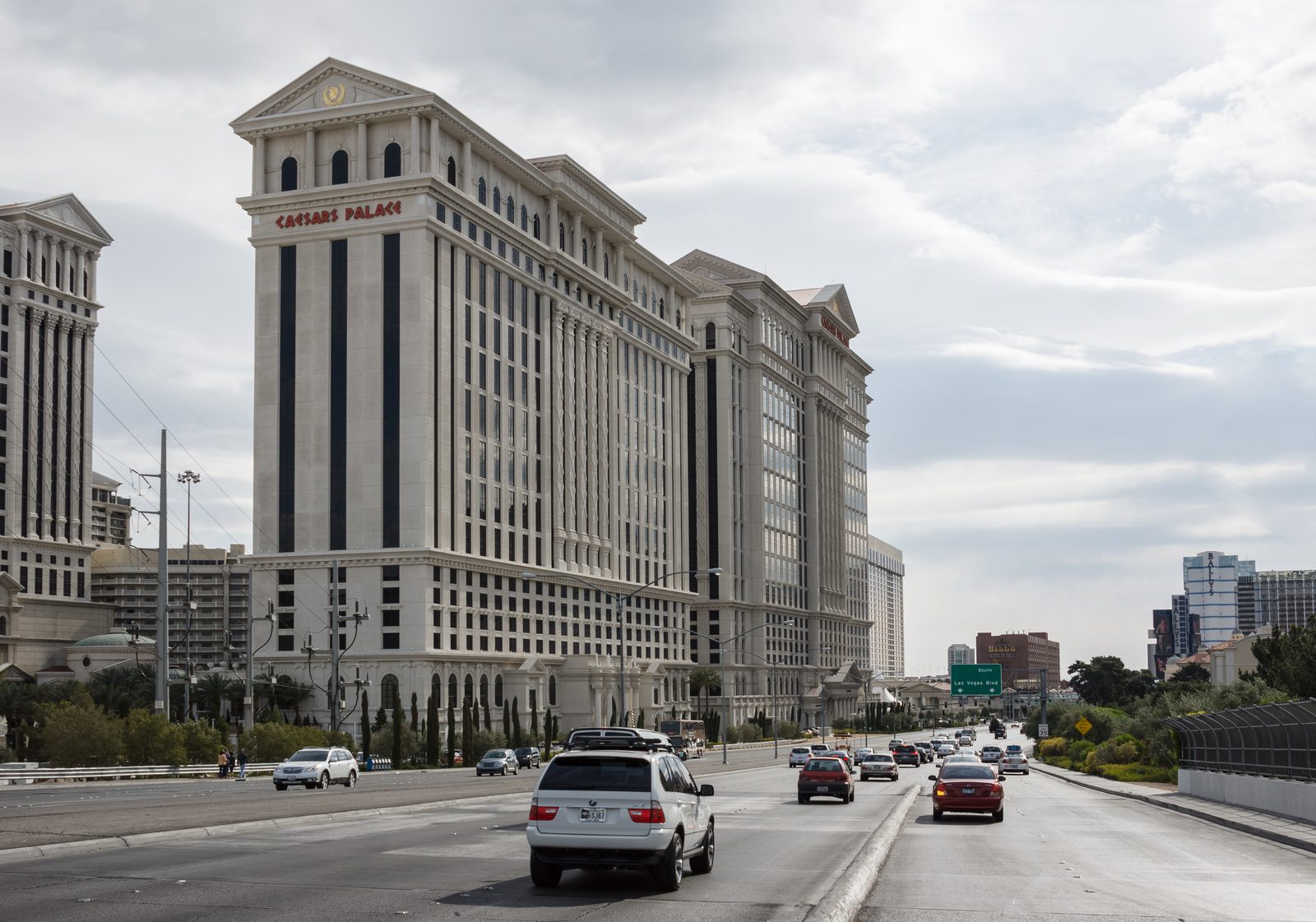
Image context: the cover uses a real Wikimedia Commons photograph of Caesars Palace on Flamingo Road rather than a generic market chart. That is the right visual because the underlying debate is about how much rent specific casino properties can safely carry, and what landlords can still earn when they fund new gaming real estate.[7]
The bond-proxy label misses how much rent still has inflation or contractual lift
Start with VICI, because the company states the structure unusually clearly. In its March 2026 investor presentation, 46% of rent roll is subject to CPI-linked escalation in 2026E, and 90% of rent roll has CPI-linked escalation over the long term, subject to contractual caps.[2] That does not make the cash flow rate-proof. It does mean the revenue line is not frozen like a long bond coupon.
The scale of that lease book matters too. VICI says it owns 93 experiential assets, including 54 gaming properties and 39 other experiential properties, generating $3,184.7 million of annualized cash rent with a weighted-average lease term of 39.6 years inclusive of renewal options.[2][3] That is why the stock often trades in yield language. It is also why the yield-only framing can mislead. Long lease duration matters, but so do the embedded rent mechanics.
GLPI's lease language lands in a similar place from a more regional-gaming angle. The February 2026 Bally's Lincoln acquisition came with $56.0 million of initial cash rent on a $700.0 million purchase price, an 8.0% capitalization rate, and CPI-linked escalation with a 1.0% floor and 2.0% ceiling once the threshold is met.[5] Again, that is not the same thing as saying the landlord is immune to economic slowdown. It is saying the contracts still have internal growth architecture.
The real growth engine in 2026 is not rates alone. It is whether new capital still clears at attractive spreads
This is the underappreciated part of the setup. VICI's full-year 2025 results did not describe a company sitting on a mature portfolio and hoping duration helps. They described a company that announced about $2.1 billion in capital commitments during 2025 at a weighted-average initial yield of 8.9%, while guiding 2026 AFFO per diluted share to $2.42-$2.45.[1] That is active spread capture, not passive rent clipping.
GLPI is showing the same instinct in a different form. In October 2025 it agreed to buy the land for Live! Casino & Hotel Virginia for $27 million and fund $440 million of hard costs, both at an 8.0% cap rate. During construction, Cordish pays rent on capital as drawn, and after the first anniversary of the permanent opening, rent escalates 1.75% per year.[6] The permanent facility is expected to open in late 2027, with the temporary casino scheduled for late January 2026 subject to approvals.[6]
That is the sector's real 2026 hinge. If these landlords can still deploy capital at 8%-plus entry economics while their equity and debt costs remain below that hurdle, then the growth story remains alive even without a dramatic macro tailwind. If they cannot, then the bond-proxy label becomes much more accurate.
Why the counterweight is real: concentration still sits underneath the whole trade
The cleanest objection is tenant concentration. VICI's own rent-roll table shows 39% of annualized cash rent from Caesars and 34% from MGM, or roughly 73% from two operators.[2] Those are strong operators with deeply embedded flagship assets, but the concentration is still there. If the operating health of those tenants weakens, no amount of elegant lease drafting makes the issue disappear.
GLPI is somewhat differently exposed, with a portfolio of 71 gaming and related facilities spread across the country.[4] But the principle is the same. The company keeps emphasizing coverage because coverage is the real safety margin. In the Bally's Lincoln deal, GLPI cited pro forma rent coverage above 2.2x and four-wall coverage above 1.9x.[5] Those are solid numbers. They are also a reminder that this business only works when tenant EBITDAR stays comfortably ahead of contractual rent.
That is why casino REITs in 2026 should be read less like pure duration trades and more like underwritten cash-flow spreads. Rates matter. Rent escalators matter. But underwriting discipline sits above both.
Six numeric anchors
- VICI portfolio scale: 93 experiential assets, including 54 gaming and 39 other experiential properties, with about 127 million square feet and 60,300 hotel rooms.[3]
- VICI rent mechanics: 46% of rent roll is CPI-linked in 2026E, and 90% has CPI-linked escalation over the long term.[2]
- VICI growth math: about $2.1 billion of 2025 capital commitments at a weighted-average initial yield of 8.9%; 2026 AFFO per diluted share guidance of $2.42-$2.45.[1]
- VICI concentration: Caesars accounts for 39% of annualized cash rent and MGM for 34%, or about 73% combined.[2]
- GLPI current portfolio and coverage lens: 71 gaming and related facilities, with management repeatedly framing rent coverage as the bedrock of lease durability.[4]
- GLPI recent transaction economics: Bally's Lincoln adds $56.0 million of initial cash rent on a $700.0 million acquisition at an 8.0% cap rate and pro forma rent coverage above 2.2x; Live! Virginia adds $27 million of land and $440 million of hard-cost funding at an 8.0% cap rate with a 1.75% annual escalator after the first anniversary of permanent opening.[5][6]
Those numbers describe a sector whose appeal still depends on spread discipline. The dividend matters, but the more durable question is whether fresh rent growth continues to arrive from contracts and capital deployment rather than from multiple expansion alone.
Strongest counterweight
The strongest counterweight is that the macro backdrop can still overwhelm good lease structure. Gaming remains discretionary spending. If regional casino demand softens, Las Vegas visitation wobbles, or consumer balance sheets finally crack, coverage ratios can erode faster than escalators can help. Tenant concentration makes that risk even sharper for VICI, where two operators dominate rent roll.[2][5]
That is why this is not a "buy casino REITs because CPI escalators exist" argument. The narrower claim is that the market can misread these landlords if it treats them as static income vehicles. Their value in 2026 still comes from underwriting and reinvestment as much as from coupon-like income.
Falsifier
This framework breaks if upcoming results show that new deal economics are no longer comfortably above funding costs or that tenant coverage is compressing toward the edge. Concretely, if first-quarter updates show weaker rent coverage, slower or deferred development funding, or capital deployment that only clears at yields too close to the sector's own cost of capital, then the "escalators plus development pipeline" thesis becomes too generous.[1][3][4][5][6]
Watchlist
- 2026-04-23: GLPI plans to release first-quarter 2026 results after the market close.[4]
- 2026-04-24: GLPI's first-quarter 2026 earnings call is the next direct read on coverage, pipeline timing, and funding appetite.[4]
- 2026-04-29: VICI plans to release first-quarter 2026 results after the close.[3]
- 2026-04-30: VICI's first-quarter 2026 earnings call is the cleanest check on whether new commitments, rent collection, and tenant health still support the 2026 spread story.[3]
Takeaway
Casino REITs still deserve part of their bond-proxy reputation. They have long leases, visible rent streams, and dividend-heavy shareholder bases. The more useful 2026 read is narrower. Yield is already priced. The new proof is whether landlords can keep turning escalators, tenant credit, and development capital into rent growth that stays clearly above their own funding cost. If they can, the sector remains a cash-flow spread story. If they cannot, it really does collapse back into duration math.
Sources
- VICI Properties, "VICI Properties Inc. Announces Fourth Quarter and Full Year 2025 Results" (February 25, 2026) — 2025 capital commitments, initial yield, and 2026 AFFO guidance.
- VICI Properties, Investor Presentation (March 2, 2026) — rent-roll structure, CPI-linked escalation, tenant mix, and annualized cash rent.
- VICI Properties, "VICI Properties Inc. Announces Release Date for First Quarter 2026 Results" (March 30, 2026) — Q1 2026 earnings release and call dates, plus current portfolio description.
- Gaming and Leisure Properties, Investor Relations homepage — portfolio scale and scheduled first-quarter 2026 results timing.
- Gaming and Leisure Properties, "Gaming and Leisure Properties Acquires Real Estate Assets of Bally's Lincoln for $700.0 Million" (February 11, 2026) — initial rent, cap rate, CPI escalator, and rent coverage.
- Gaming and Leisure Properties, "Gaming and Leisure Properties to Acquire Land and Fund Hard Costs of Live! Casino & Hotel Virginia" (October 27, 2025) — development funding size, cap rate, escalator, and opening timeline.
- Wikimedia Commons, "File:Las Vegas, Caesars Palace 01.jpg."