As of 2026-04-15, the easy rates read is to glance at the 10-year breakeven and treat it as the market's clean 10-year inflation call. On 2026-04-13, the nominal 10-year Treasury yield was 4.30%, the 10-year real yield was 1.92%, and the 10-year breakeven inflation rate was 2.38%.[2][3][4] That arithmetic is real, and it is useful. The mistake is to stop there.
The priced-vs-new split is straightforward. Priced is the visible spread: nominal minus real still leaves inflation compensation around the mid-2s.[2][3][4] New is that the spread is not a clean forecast. The instrument underneath it is a CPI-linked Treasury security, the Fed's formal 2 percent goal is defined in PCE, and the spread itself carries more than one premium inside it.[1][5][6] If you read the breakeven as a one-line forecast, you flatten three different questions into one number.
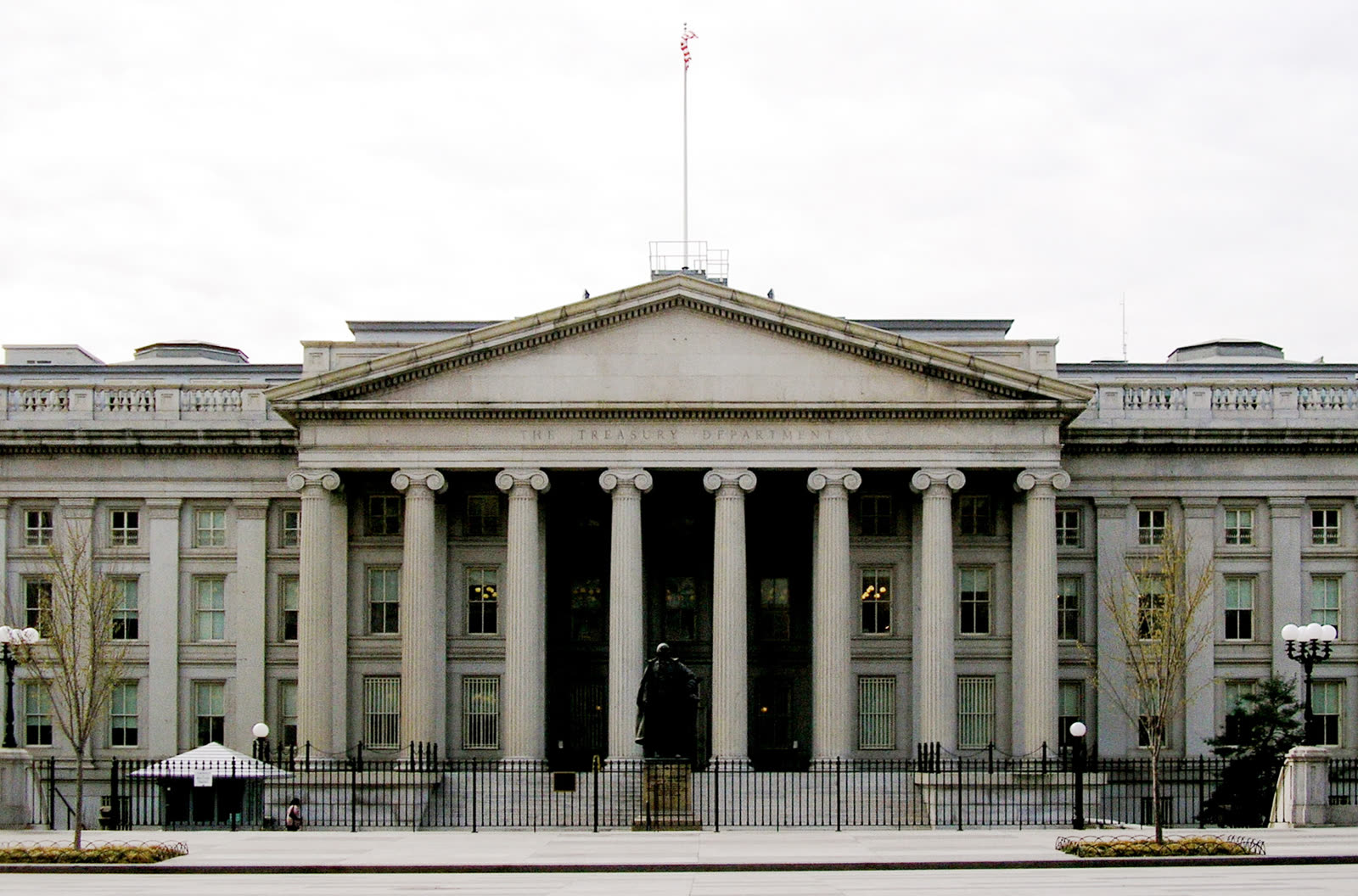
Image context: the cover uses a real street-level photograph of the U.S. Treasury Building rather than a symbolic chart collage. That is the right visual anchor because this article is about how Treasury-market instruments encode inflation compensation, not about abstract macro mood.[10]
What the spread actually is
At a basic level, the breakeven rate is just the gap between a nominal Treasury yield and a similar-maturity TIPS real yield.[2][3][4] In the April 13 example, 4.30% minus 1.92% = 2.38%.[2][3][4] That number tells you how much inflation compensation the nominal market is embedding relative to the TIPS market.
That phrasing matters. The Federal Reserve's own TIPS material uses the language of inflation compensation, not a guaranteed survey-style forecast.[5] A market spread is a price. Prices include expectations, but they also include hedging demand, liquidity differences, and the value of protection under uncertainty.
Why the number is not the Fed's target
The first wedge is the index itself. TreasuryDirect states that TIPS principal is adjusted using a BLS version of the Consumer Price Index, and that a TIPS can finish above original principal if inflation lifts it, while at maturity it will not pay back less than the original amount.[1] The Fed's formal objective is different. In its longer-run goals statement, the FOMC again says its 2 percent inflation goal is measured by the annual change in the price index for personal consumption expenditures.[6]
That means a 2.38% 10-year breakeven is not even a clean 2.38% PCE statement before you get to any premium discussion.[2][6] It is a market price built around CPI-linked protection, while the policy target sits in a different inflation gauge. Sometimes the CPI-PCE gap is small enough that the distinction feels academic. Sometimes it is not. Either way, the translation step is real.
Why premia move the spread around
The second wedge is decomposition. A Federal Reserve FEDS note on TIPS says inflation compensation can be broken into expected inflation, an inflation risk premium, and a TIPS liquidity premium.[5] That is the cleanest official reason the spread should not be read as pure expectation.
The inflation risk premium is the part nominal-bond investors demand because future inflation is uncertain. If inflation volatility rises, that premium can widen even when the central expected path does not move much.[5] In that case, breakevens can rise faster than a simple "the market expects more inflation" story would suggest.
The TIPS liquidity premium works in the other direction. If TIPS trade with less liquidity than nominal Treasuries, their real yields can sit somewhat higher than a frictionless world would imply.[5] That pushes the nominal-minus-real spread lower, making breakevens look softer than underlying inflation expectations alone would justify.
There is a third asymmetry sitting in the bond design itself. TreasuryDirect notes that TIPS principal can move down during the life of the bond, but the investor still receives at least the original principal at maturity.[1] That floor means TIPS are not perfectly linear instruments in deep disinflation or deflation scenarios. Again, the spread remains informative. It just is not mechanically pure.
Six numeric anchors
- 10-year nominal Treasury yield: 4.30% on 2026-04-13.[4]
- 10-year real Treasury yield: 1.92% on 2026-04-13.[3]
- 10-year breakeven inflation rate: 2.38% on 2026-04-13.[2]
- Fed inflation objective: 2 percent, measured by PCE, not CPI.[6]
- TIPS issuance terms: TreasuryDirect says TIPS are sold in 5-year, 10-year, and 30-year maturities.[1]
- Next calendar checkpoints: April 28-29, 2026 FOMC meeting, April 30, 2026 BEA Personal Income and Outlays release for March 2026, and May 6, 2026 Treasury quarterly refunding documents.[7][8][9]
Those anchors keep the interpretation disciplined. The spread is live market information. It is also a bundled instrument-level price, sitting between two inflation measures and multiple premia.
Strongest counterweight
The strongest pushback is that breakevens are still the fastest useful market read of inflation sentiment, even if they are not perfectly clean. That is true. If energy, tariff pass-through, or wage-stickiness risk starts to reprice, the breakeven market will usually react long before a backward-looking inflation average or a survey summary catches up.[2][3][4][5] Investors should not ignore the spread just because it is imperfect.
That counterweight matters. The point is not that breakevens are noisy and therefore useless. The point is narrower: a breakeven is best read as tradeable inflation compensation, not as a one-line substitute for the Fed's long-run inflation forecast.
Falsifier
This explainer leans too hard on the wedge if the next policy-and-data window keeps showing unusually clean alignment. Concretely, if the April 28-29 FOMC meeting, the April 30 PCE release, and the next refunding schedule all land without any visible TIPS-specific liquidity noise, and if nominal yields, real yields, and breakevens keep moving in the same direction for the same reasons, then shorthand use of breakevens as a forecast becomes more defensible than this article argues.[7][8][9]
Watchlist
- April 28-29, 2026: FOMC meeting. The question is whether policymakers sound more concerned about sticky inflation compensation or about broader disinflation progress.[8]
- April 30, 2026: BEA Personal Income and Outlays for March 2026. This is the next direct read on the PCE gauge the Fed formally targets.[6][7]
- May 6, 2026: Treasury quarterly refunding documents. The auction schedule matters because TIPS supply and nominal supply shape how cleanly the market spread can be interpreted.[9]
Takeaway
The 10-year breakeven is a good market signal, but it is not a clean inflation prophecy. It is a CPI-linked Treasury spread that packages expected inflation, risk compensation, and liquidity conditions into one tradeable number.[1][5][6] In April 2026, the right read is not "2.38% means the market forecasts 2.38% inflation for ten years."[2] The better read is that the market is charging about 2.38 percentage points of inflation compensation over the real yield, and the hard work starts when you ask how much of that number belongs to expectations, premia, and instrument design.[2][3][4][5]
Sources
- TreasuryDirect, "Treasury Inflation-Protected Securities (TIPS)."
- Federal Reserve Bank of St. Louis FRED, "10-Year Breakeven Inflation Rate (T10YIE)."
- Federal Reserve Bank of St. Louis FRED, "Market Yield on U.S. Treasury Securities at 10-Year Constant Maturity, Inflation-Indexed (DFII10)."
- Federal Reserve Bank of St. Louis FRED, "Market Yield on U.S. Treasury Securities at 10-Year Constant Maturity (DGS10)."
- Board of Governors of the Federal Reserve System, "Tips from TIPS: Update and Discussions" (FEDS Notes, May 21, 2019).
- Federal Open Market Committee, "Statement on Longer-Run Goals and Monetary Policy Strategy" (reaffirmed January 28, 2026).
- U.S. Bureau of Economic Analysis, "Release Schedule."
- Board of Governors of the Federal Reserve System, "FOMC Meeting Calendars and Information."
- U.S. Department of the Treasury, "Most Recent Quarterly Refunding Documents."
- Wikimedia Commons, "File:US Treasury Building.jpg."