Intuitive Surgical already trades as if the robotic-surgery flywheel works. The company ended 2025 with 11,106 da Vinci systems installed, 3.153 million annual da Vinci procedures, and total revenue just above $10.1 billion.[1] Priced is the installed-base compounding machine. New is the narrower test: da Vinci 5 has to make each hospital relationship more productive without turning the upgrade cycle into a margin drag that a roughly 58.6x trailing P/E cannot easily forgive.[5]
This is a valuation walkthrough, not a call on whether robotic surgery is useful. The market already knows that Intuitive has the category-defining platform, a broad surgeon-training network, and a recurring-revenue model tied to instruments, accessories, service, and leases.[1] The harder question before the April 21 Q1 2026 call is whether investors are paying for durable procedure density or merely for a new-system replacement cycle that has already moved into the share price.[2][3]
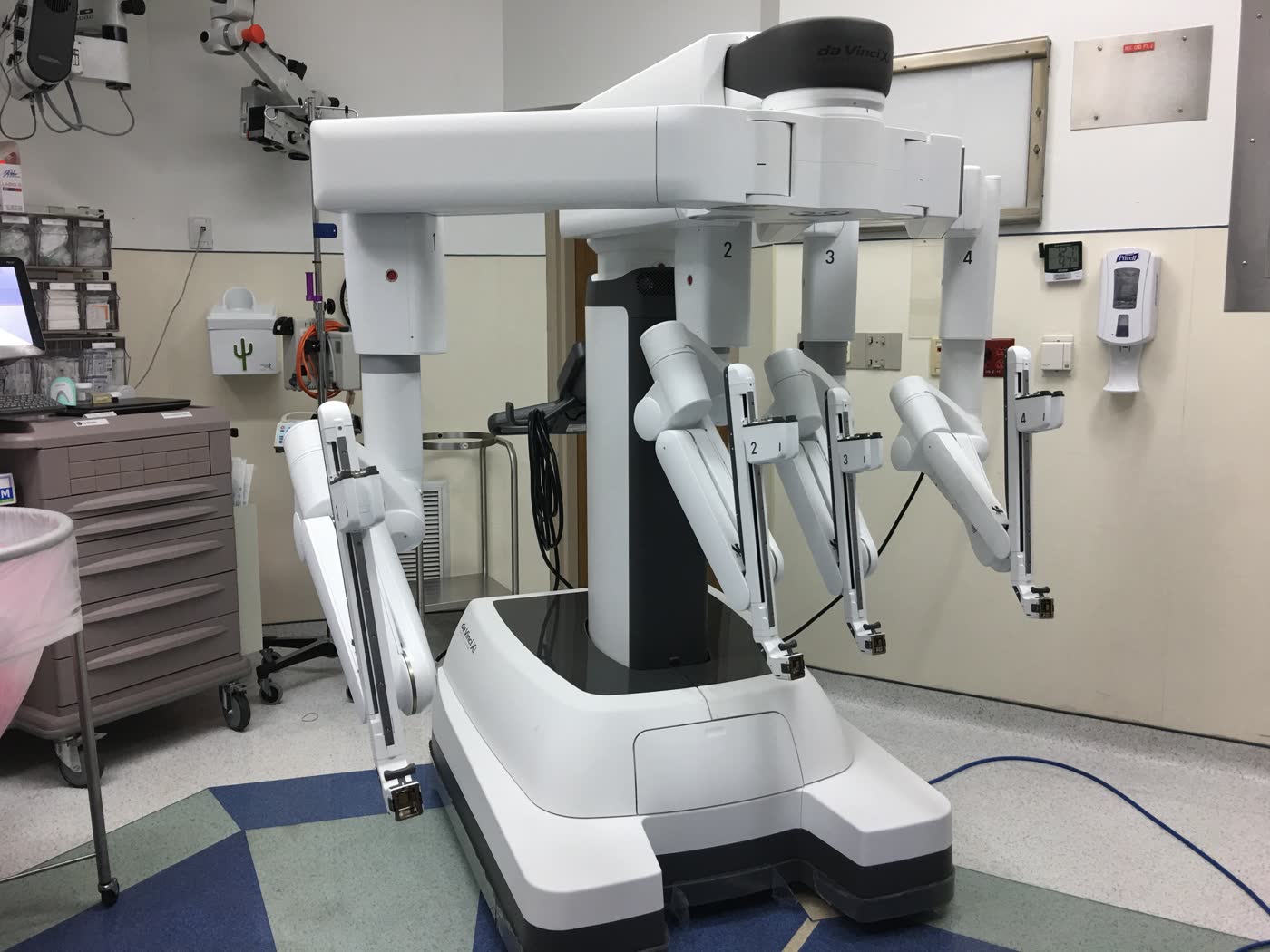
Image context: the cover uses a real photograph of a da Vinci Xi surgical robot. That matters because the investment case is physical and operational: systems in rooms, surgeons trained on platforms, instruments consumed case by case, and service revenue attached to the installed base.[6]
Six anchors for the valuation
The first anchor is scale. Revenue rose 21% in 2025 to $10.1 billion, while da Vinci procedures grew 18% to about 3.153 million.[1] That tells investors the platform is still adding both capacity and utilization, not merely selling replacement boxes into a flat procedure base.
The second anchor is installed base. Intuitive finished 2025 with 11,106 da Vinci systems, up 12% from 9,902 a year earlier.[1] System count matters because the company's economics do not stop when a robot is placed. A system creates recurring demand for instruments, accessories, maintenance, training, and workflow support.
The third anchor is recurring mix. Instruments and accessories revenue was $6.02 billion, service revenue was $1.57 billion, and the company reported 84% total recurring revenue for 2025.[1][2] This is the heart of the premium. A hospital capital cycle is cyclical; a growing case base that consumes tools and service is less fragile.
The fourth anchor is da Vinci 5 adoption. Intuitive placed 1,721 da Vinci systems in 2025, including 870 da Vinci 5 systems, versus 362 da Vinci 5 placements in 2024.[1][2] That is a real upgrade signal, especially because the fifth-generation system received FDA clearance in March 2024 and then moved from controlled launch into broader commercial adoption.[4]
The fifth anchor is profitability. Gross profit as a percentage of revenue fell to 66.0% in 2025 from 67.5% in 2024, even as operating income rose 25% to $2.95 billion.[1] That is not alarming by itself. New platforms, manufacturing scale-up, service load, and mix can all pressure gross margin during a transition. But at a premium multiple, the market will eventually want evidence that the upgrade cycle improves unit economics rather than merely defending share.
The sixth anchor is valuation. CompaniesMarketCap showed Intuitive at roughly 58.6x trailing earnings in April 2026.[5] That multiple can work if procedures keep compounding, recurring revenue stays high, and da Vinci 5 raises utilization or replacement economics. It becomes brittle if investors discover that the upgrade cycle mainly pulls forward purchases without lifting case density.
The mechanism: boxes matter only if cases follow
The clean version of Intuitive's model has three loops. First, procedures grow as more surgeons and specialties adopt robotic-assisted surgery. Second, procedure growth justifies more systems and trade-ins. Third, each system adds recurring revenue through instruments, accessories, leases, and service. The loops reinforce one another because the platform becomes more useful as hospital teams, OR schedules, and training systems adapt around it.[1]
Da Vinci 5 should strengthen that loop if it increases utilization. The launch brought a newer platform into a customer base already trained on prior da Vinci generations.[4] In 2025, trade-in activity also surged: the company reported 437 da Vinci placements involving trade-ins, compared with 150 in 2024.[1] That is exactly what an upgrade cycle looks like. The finance question is whether those upgrades produce more cases per installed system, better service revenue per system, or more durable instrument demand.
This is why procedure density matters more than gross system count. If a hospital buys or leases a da Vinci 5 but simply replaces an Xi at the same case volume, the transaction can support systems revenue but does less for long-term valuation. If the same hospital uses da Vinci 5 to open more procedures, shift cases from constrained hours, improve surgeon adoption, or consolidate more specialties onto the platform, the upgrade can increase the recurring stream that deserves a higher multiple.
The 2025 data lean constructive. Utilization of da Vinci systems rose 3% relative to 2024, and overall da Vinci procedure growth outpaced installed-base growth.[1] That is what investors want to see. The caution is that one year of launch momentum does not settle the payback. Intuitive itself expects worldwide da Vinci procedure growth of about 13% to 15% in 2026, slower than 2025's 18% pace.[2] A deceleration can still be healthy, but the premium multiple needs it to be orderly.
The counterweight
The strongest bear argument is not that Intuitive lacks a moat. It is that the moat is already capitalized. Hospitals face budget pressure, staffing constraints, and capital-spending caution in several markets, and the 2025 annual filing explicitly notes customer caution, lower public funding in Europe and Japan, and China pressure from domestic robotic-surgery competitors and policy focus.[1] Those are not small footnotes for a company selling expensive operating-room platforms.
There is also a product-cycle cost. Gross margin stepped down to 66.0% in 2025, and da Vinci 5 can mix revenue toward newer hardware, service requirements, trade-ins, and launch costs before the recurring tail fully matures.[1] The market can tolerate that if procedure growth and recurring revenue keep proving the installed-base thesis. It will be less forgiving if gross margin pressure arrives at the same time as procedure growth slows.
Falsifier
The thesis breaks if da Vinci 5 turns into a replacement cycle without density. Concretely, if Q1 and later 2026 updates show procedure growth slipping below the 13% to 15% guide, utilization flattening, recurring revenue losing its 84% mix, and gross margin staying under pressure despite high trade-in activity, then Intuitive should be valued less like a compounding platform and more like a premium hardware company in a costly refresh cycle.[1][2]
Watchlist
- April 21, 2026 Q1 call: watch whether management keeps the 13% to 15% worldwide da Vinci procedure-growth guide and whether da Vinci 5 placements are described as utilization-accretive rather than only replacement demand.[2][3]
- 2026 quarterly installed-base updates: procedure growth should keep running ahead of installed-base growth, or the density argument weakens.[1]
- Recurring revenue mix: instruments, accessories, service, and lease revenue need to stay close to the 2025 84% recurring baseline while da Vinci 5 scales.[1][2]
- International pressure: China competition and European/Japanese hospital funding constraints are the clearest places where the premium model can meet local-budget reality.[1]
Takeaway
Intuitive deserves a premium if the market is paying for procedure density. A robot placed in an operating room is only the first transaction. The better business is the years of procedures, instruments, service, upgrades, and surgeon habits that follow. The April 2026 setup is therefore precise: da Vinci 5 does not need to create a new company, but it does need to show that the old flywheel is becoming denser. If it does, the multiple has a defensible operating spine. If it does not, the share price is treating a hardware refresh as if it were already a higher-return recurring platform.
Sources
- U.S. SEC, Intuitive Surgical, Form 10-K for the fiscal year ended December 31, 2025 (filed February 2026).
- Intuitive Surgical / GlobeNewswire, "Intuitive Announces Preliminary Fourth Quarter and Full Year 2025 Results" (January 14, 2026).
- Benzinga, "Intuitive Surgical Earnings Estimates, EPS & Revenue" page showing Q1 2026 earnings scheduled for April 21, 2026.
- Intuitive Surgical / GlobeNewswire, "Intuitive Announces FDA Clearance of Fifth-Generation Robotic System, da Vinci 5" (March 14, 2024).
- CompaniesMarketCap, "Intuitive Surgical (ISRG) - P/E ratio" (April 2026 page view).
- Wikimedia Commons, "File:New Da Vinci Xi.jpg."