Drug distributors are still valued as thin-margin toll roads, but the mix has changed enough that the old shorthand is incomplete. Priced is that U.S. prescription volume and branded-drug inflation keep pushing huge revenue bases upward. New is that specialty drugs, oncology, GLP-1 demand, DSCSA traceability, and cold-chain capacity are turning execution quality into the real spread between distributors.
The causal chain is straightforward. More high-value therapies move through hospitals, physician practices, specialty pharmacies, and manufacturer services. Distributors earn only a small margin on each dollar, so revenue growth by itself does not prove much. What matters is whether the company can control working capital, protect service levels, win manufacturer programs, handle product-level data, and use scale without letting complexity leak into operating cost.
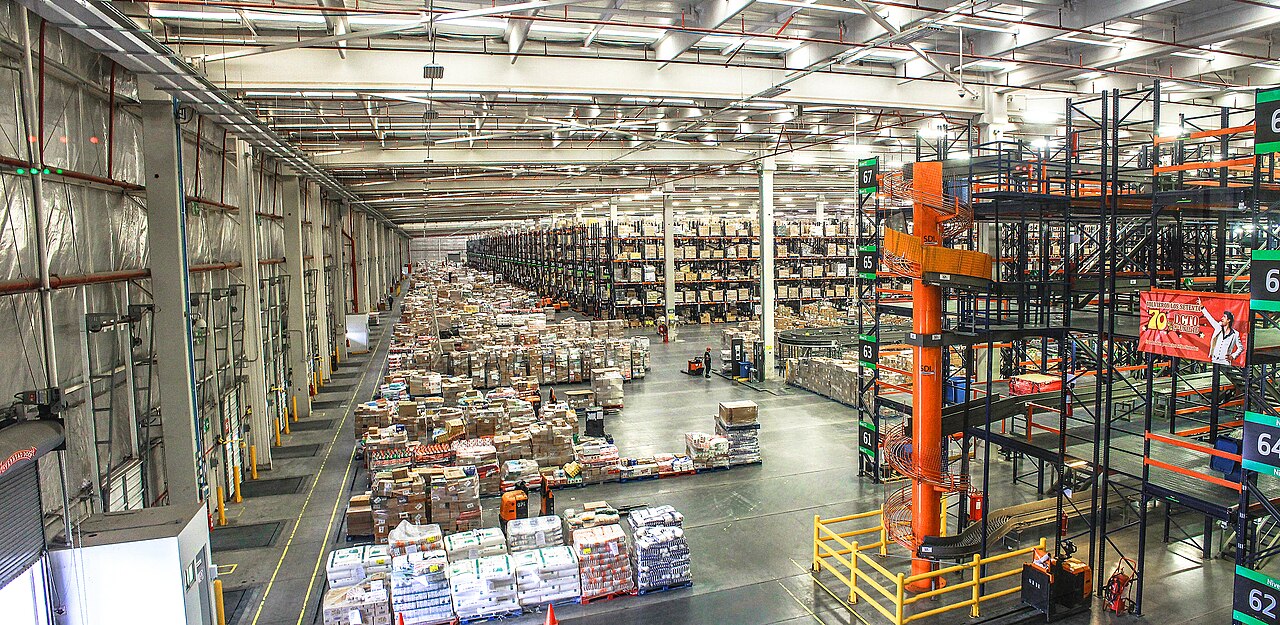
Image context: the cover uses a real warehouse photograph because the article is about distribution as an operating system. The financial question lives in aisles, inventory controls, temperature-sensitive storage, data exchange, and shipped product, not in a generic healthcare symbol.[5]
McKesson shows the quality version of scale
McKesson's fiscal 2025 result gives the cleanest version of the bull case. Full-year revenue reached $359.1 billion, up 16%, while adjusted EPS rose 20% to $33.05.[1] Its U.S. Pharmaceutical segment produced $327.7 billion of revenue, up 18%, and adjusted segment operating profit of $3.7 billion, up 12%.[1] Management also guided fiscal 2026 adjusted EPS to $36.75-$37.55, implying another double-digit year off a very large base.[1]
That is not just pharmacy traffic. McKesson specifically tied growth to prescription volume from retail national customers and distribution of specialty products, including oncology, to providers and health systems.[1] It also said its biopharma services platform helped patients save more than $10 billion on brand and specialty medications and helped prevent 12 million prescription abandonments in the past year.[1] The important point is that the company is trying to own more than the box movement. It wants the access, affordability, oncology, and manufacturer-service layers around the product flow.
The market already pays for some of that. The next test is whether the medical-surgical separation sharpens capital allocation rather than simply adding a transaction headline. If McKesson becomes more concentrated around U.S. pharma, oncology, biopharma services, and prescription technology, then the valuation case should rest on operating-profit growth and cash conversion, not just headline revenue.
Cencora shows the capacity-investment problem
Cencora is the reminder that specialty growth has a real infrastructure bill. Fiscal 2025 revenue increased 9.3% to $321.3 billion, with adjusted gross profit up 15.1% to $11.2 billion.[2] The U.S. Healthcare Solutions segment grew fourth-quarter revenue 5.7%, helped by specialty products sold to health systems and physician practices and by products labeled for diabetes and/or weight loss in the GLP-1 class.[2]
That last phrase is doing a lot of work. GLP-1s are not just another prescription-volume category. They add scale, product value, temperature sensitivity, payer friction, and manufacturer-channel importance. For a distributor, they can lift revenue while raising the bar for inventory discipline and service reliability.
Cencora's answer is investment. The company announced $1 billion of planned investments through 2030 to strengthen its U.S. distribution network, including a second national distribution center, expanded facilities, and more cold-chain storage to support specialty-pharmaceutical growth.[2] That is the core tradeoff. Specialty volume can increase the moat if the distributor controls capacity and service quality. It can compress returns if the company has to spend heavily just to stay even with product complexity.
Cardinal shows how fast the specialty lane is moving
Cardinal Health's first-quarter fiscal 2026 release shows the same migration from ordinary distribution to specialty-enabled logistics. Revenue was $64 billion, up 22% from the prior-year quarter.[3] The company said Sonexus onboarded manufacturer hub programs representing more than 30 new specialty therapies in the quarter, supporting expected growth of more than 30% in fiscal 2026 for BioPharma Solutions.[3]
The physical buildout is visible too. Cardinal announced a new flagship Pharmaceutical and Specialty Solutions forward distribution center in Indianapolis: a 230,000 square foot facility expected to be fully operational by fall 2027, with automation and technology upgrades meant to support growth in that business.[3] That facility detail matters because specialty distribution is less forgiving than commodity wholesaling. A distributor needs storage integrity, lot control, data quality, and delivery precision. If those capabilities are scarce, the distributor earns relevance. If they become table stakes without pricing power, returns can fade.
For investors, Cardinal is a cleaner example of the "execution spread" than a simple revenue-growth screen. Revenue acceleration is helpful, but the higher-quality proof is whether specialty programs, manufacturer hubs, and distribution-center automation translate into segment profit and durable customer stickiness.
Regulation makes the operating bar higher
The Drug Supply Chain Security Act adds another layer. FDA's DSCSA exemption page shows that eligible wholesale distributors had an exemption deadline of August 27, 2025, while dispensers with 26 or more full-time employees had a November 27, 2025 deadline and small dispensers have exemptions extending to November 27, 2026.[4] The point is not that DSCSA is new in 2026. The point is that drug distribution is becoming more data-intensive at the package and trading-partner level.
That favors scale, but only disciplined scale. Large distributors can spread traceability, verification, exception handling, and interoperable data costs across enormous revenue bases. Yet compliance does not automatically produce margin. If transaction exceptions, customer readiness, or system integration problems rise, the cost can sit inside operating expense while customers still expect wholesale economics.
This is the right way to understand the sector's moat. It is not only purchasing power. It is a combined operating system: manufacturer relationships, pharmacy and provider reach, cold-chain capacity, oncology and specialty services, working-capital discipline, and regulatory data plumbing.
The strongest counterweight
The bearish counterweight is obvious: these businesses still run on thin spreads. A distributor can report hundreds of billions of dollars of revenue and still have modest operating margins. Customer concentration, reimbursement pressure, branded-drug pricing politics, generic deflation, opioid litigation, cyber risk, and manufacturer contract resets can absorb the benefit of specialty growth.[1][2][3]
There is also a valuation trap. Specialty growth sounds higher quality than commodity wholesale, but it can require higher capex, more technology spending, and more service labor. If the market capitalizes specialty revenue at a premium while the company earns only ordinary distribution economics after investment, the multiple has moved ahead of the cash.
Falsifier
The thesis breaks if specialty complexity grows faster than distributor economics. Concretely, if McKesson's U.S. Pharmaceutical profit growth drops below its updated 6-8% long-term target, if Cencora's $1 billion network investment fails to support better gross-profit growth and cold-chain capacity, or if Cardinal's specialty hub and Indianapolis buildout produce revenue without segment-profit leverage, then the sector should be treated as a volume pass-through rather than a higher-quality healthcare-infrastructure compounder.[1][2][3]
Watchlist
- McKesson fiscal 2026 updates: watch whether U.S. Pharmaceutical profit growth tracks the new 6-8% long-term target while the company prepares the medical-surgical separation.[1]
- Cencora network investment: the $1 billion program needs to show up as specialty capacity and service quality, not just a larger capex line.[2]
- Cardinal specialty proof: BioPharma Solutions growth above 30% must convert into profitable hub and distribution economics.[3]
- DSCSA customer readiness: traceability deadlines and small-dispenser exemptions should reveal whether data plumbing becomes a scale advantage or an operating-cost drag.[4]
Takeaway
Drug distributors are not glamorous businesses, and that is part of the point. The opportunity is not a sudden margin miracle. It is a spread between companies that merely move more branded dollars and companies that can run specialty, oncology, GLP-1, cold-chain, access, and traceability workflows at scale. In 2026, the better distributor multiple belongs to the operator that turns complexity into service revenue, cash conversion, and customer stickiness without letting the warehouse become the margin leak.
Sources
- McKesson, "McKesson Reports Fiscal 2025 Fourth Quarter and Full Year Results and Provides Fiscal 2026 Guidance; Announces Intent to Separate Medical-Surgical Solutions" (May 8, 2025).
- Cencora, "Cencora Reports Fiscal 2025 Fourth Quarter and Fiscal Year End Results" (November 5, 2025).
- Cardinal Health, "Cardinal Health Reports First Quarter Fiscal Year 2026 Results and Raises Outlook" (October 30, 2025).
- U.S. Food and Drug Administration, "Waivers and Exemptions Beyond the Stabilization Period" (DSCSA).
- Wikimedia Commons, "File:Warehouse distribution-center-1136510.jpg."