Intel's first quarter did not prove the turnaround is finished. It proved the product engine is strong enough to keep the turnaround alive. Revenue reached $13.6 billion, up 7% year over year, non-GAAP gross margin reached 41.0%, and non-GAAP EPS reached $0.29, all above the high end of guidance.[1][2] That was the clean beat.
The narrower question is what changes after the beat. Priced was that better CPU demand, improved supply, and a few pricing actions could rescue the top line. New is that Intel is now asking investors to believe something harder: 18A is helping enough on yields and output that it can support product momentum today without keeping the foundry model trapped in an expensive early-ramp loop tomorrow.[1][2][3]
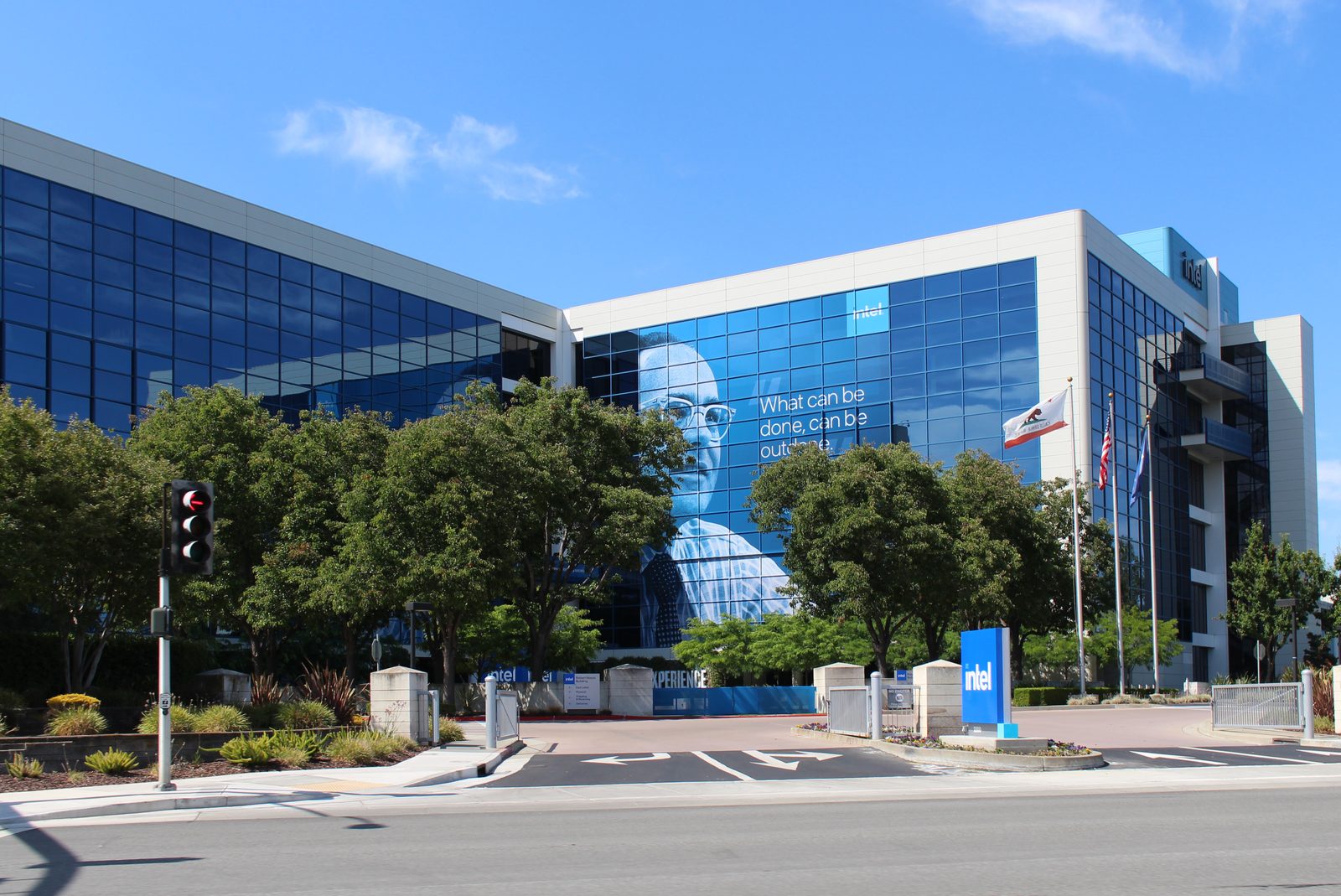
Image context: the cover uses a real photograph of Intel headquarters in Santa Clara because this is an operating-system story in the old industrial sense. The quarter moved on factory output, node yields, packaging capacity, and customer commitments, not on an abstract AI chip graphic.[5]
What the quarter actually proved
The first thing Intel proved was that the CPU franchise still has pricing power when supply improves. CFO David Zinsner said Q1 revenue came in $1.4 billion above the midpoint of guidance, and also said the quarter would have been higher still if demand had not continued to run ahead of available supply.[2] That is a useful distinction. The beat was not just a bookkeeping win. It reflected more product getting out the door into a market that still wanted it.
The segment split supports that reading. Client Computing Group revenue reached $7.7 billion, up 1% year over year, while Data Center and AI revenue reached $5.1 billion, up 22%.[1] In the prepared remarks, Intel added two details that matter more than the headline segment numbers. First, its collective AI-driven businesses now represent 60% of revenue and grew 40% year over year.[2] Second, AI PC revenue grew 8% sequentially and now represents more than 60% of client CPU mix.[2] That says the company is no longer depending on a single PC replacement pocket; it is leaning on both client and server demand as AI shifts from training toward inference and agentic workloads.
Data center was especially important because it gave Intel a better quality beat than a simple consumer-PC rebound would have. Zinsner said DCAI operating profit reached $1.5 billion, or 31% of revenue, helped by better margins, better cycle times, and yield improvement on Intel 3.[2] Intel also highlighted long-term agreements, including Google, and pointed to Xeon 6 being selected as the host CPU for NVIDIA's DGX Rubin NVL8 systems.[1][2] Read together, those details say Intel is still relevant inside the AI stack even when the market narrative is dominated by accelerators.
Why 18A is still the real boundary
This is where the quarter gets harder to read. Intel Foundry reported $5.4 billion of revenue, up 16% year over year, and the call said that number was up 20% sequentially on a richer EUV wafer mix driven by Intel 3 and significant growth in 18A.[1][2] That sounds like progress, and it is. But the same remarks also said external foundry revenue was only $174 million and Intel Foundry still posted a $2.4 billion operating loss in the quarter.[2][3]
That is the real finance problem. Intel's own products are carrying foundry utilization and helping the ramp look real, but the external customer proof is still small relative to the cost base. The company did say foundry operating loss improved by $72 million quarter over quarter as yields across Intel 4, Intel 3, and 18A got better.[2] Even so, that progress remains small beside the absolute loss level and the capital intensity needed to keep the ramp moving.
The Q2 guide makes the tension clearer. Intel guided to $13.8 billion to $14.8 billion of revenue, 39.0% non-GAAP gross margin, and $0.20 of non-GAAP EPS.[1] The revenue range implies continued demand strength. The gross-margin guide tells you the cost curve still bites. Intel explicitly said margin should dip from Q1 because 18A will make a meaningfully larger contribution while still sitting early in its ramp, and because some Q1 inventory benefits will not repeat.[2] In other words, the very node that supports the strategic story is also the thing weighing on the near-term margin profile.
Cash flow tells the same story from another angle. Intel generated $1.1 billion of operating cash flow in Q1, but gross capex was $5.0 billion and adjusted free cash flow was negative $2.0 billion.[2][3] Product demand is paying for the beat. It is not yet paying for the full foundry dream.
Six numeric anchors
- Headline beat: Q1 revenue was $13.6 billion, up 7% year over year, and came in $1.4 billion above the midpoint of Intel's prior guide.[1][2]
- Profitability reset: non-GAAP gross margin reached 41.0%, up from 39.2% a year earlier, while non-GAAP EPS reached $0.29 versus $0.13 a year earlier.[1]
- Segment strength: CCG revenue was $7.7 billion and DCAI revenue was $5.1 billion, with DCAI up 22% year over year.[1]
- AI mix: Intel said AI-driven businesses now represent 60% of revenue and grew 40% year over year, while AI PC revenue is now more than 60% of client CPU mix.[2]
- Foundry gap: Intel Foundry revenue was $5.4 billion, but external foundry revenue was only $174 million and foundry operating loss was $2.4 billion.[1][2][3]
- Next-quarter boundary: Q2 guidance calls for $13.8 billion to $14.8 billion of revenue, 39.0% non-GAAP gross margin, and $0.20 of non-GAAP EPS.[1]
Those anchors point to a specific conclusion. Intel has enough real demand to make the turnaround debate more serious. The rerating case still depends on whether that demand can turn 18A from a strategic promise into a cheaper production reality.
Strongest counterweight
The strongest pushback is that this framing may already be too cautious. Intel said 18A yields are running ahead of internal projections, said 14A maturity is outpacing 18A at a similar point in time, and said foundry operating loss should improve through the year as 18A ramps into volume.[2] CCG operating profit was $2.5 billion, DCAI operating profit was $1.5 billion, and both businesses benefited from better yields and mix.[2][3] If that operational progress keeps compounding, then the current foundry-loss optics may matter less than investors fear because the internal product machine is doing exactly what it needs to do at this stage: absorb capacity, improve learning curves, and fund the next step.
That counterweight is real. It is why this is not a bearish recap. The narrower claim is that the quarter proved product demand and supply improvement, but it did not yet prove that Intel Foundry has crossed from expensive internal bridge to externally validated earnings engine.
Falsifier
This recap is too cautious if the next reporting window shows that 18A scale is already carrying more of the economics than this article allows. Concretely, if non-GAAP gross margin holds around the 39% level or better even with more 18A mix, Intel Foundry's operating loss drops materially below $2.4 billion, and external foundry revenue moves decisively above the current $174 million level, then the "product momentum first, foundry proof later" framing would be lagging the actual turn.[1][2][3]
Watchlist
- May 13, 2026 annual stockholders' meeting: this is the next formal venue for shareholder pressure on capital allocation, foundry milestones, and margin discipline after the Q1 beat.[4]
- Next quarterly earnings release and 10-Q: the key lines are whether DCAI keeps its current growth rate, whether non-GAAP gross margin can stay near the Q2 guide, and whether Intel Foundry loss compression starts to accelerate from the Q1 base.[1][2][3]
Takeaway
Intel's quarter was better than the market expected because CPU demand stayed firm, supply improved, and the company translated that mix into a meaningful gross-margin beat. That part is now visible.
The harder step still sits ahead. Intel has to show that 18A is not only good enough to support exciting product launches, but also good enough to make the foundry cost curve look steadily less punishing. Until that happens, the products fund the story, and the foundry still decides the multiple.
Sources
- Intel, "Intel Reports First-Quarter 2026 Financial Results" (April 23, 2026).
- Intel, "CEO/CFO Earnings Call Comments" for the Q1 2026 earnings conference call (April 23, 2026 PDF).
- Intel, Quarterly Report on Form 10-Q for the quarter ended March 28, 2026.
- Intel, 2026 Proxy Statement and Notice of Annual Meeting, including the May 13, 2026 annual stockholders' meeting date.
- Wikimedia Commons, "File:Intel Headquarters in 2023.jpg."