The easy read on calmer 2025 bank funding is that Federal Home Loan Bank advances have faded back into the background. Priced is that deposits kept growing, short-end rates moved lower, and wholesale funding dependence eased. New is narrower: FHLB advances still matter because they turn eligible collateral into immediate secured funding exactly when a member's liquidity timing slips, but they still do not repair the member's liability franchise. At year-end 2025, the FHLBank System still carried $676.7 billion of advances, and one district bank, Atlanta, reported first-quarter 2026 average advance balances of $105.3 billion, up from $97.1 billion a year earlier.[4][6]
That is the distinction investors and policy readers should keep. A strong bridge is useful. A bridge is still not the same thing as a rebuilt road.
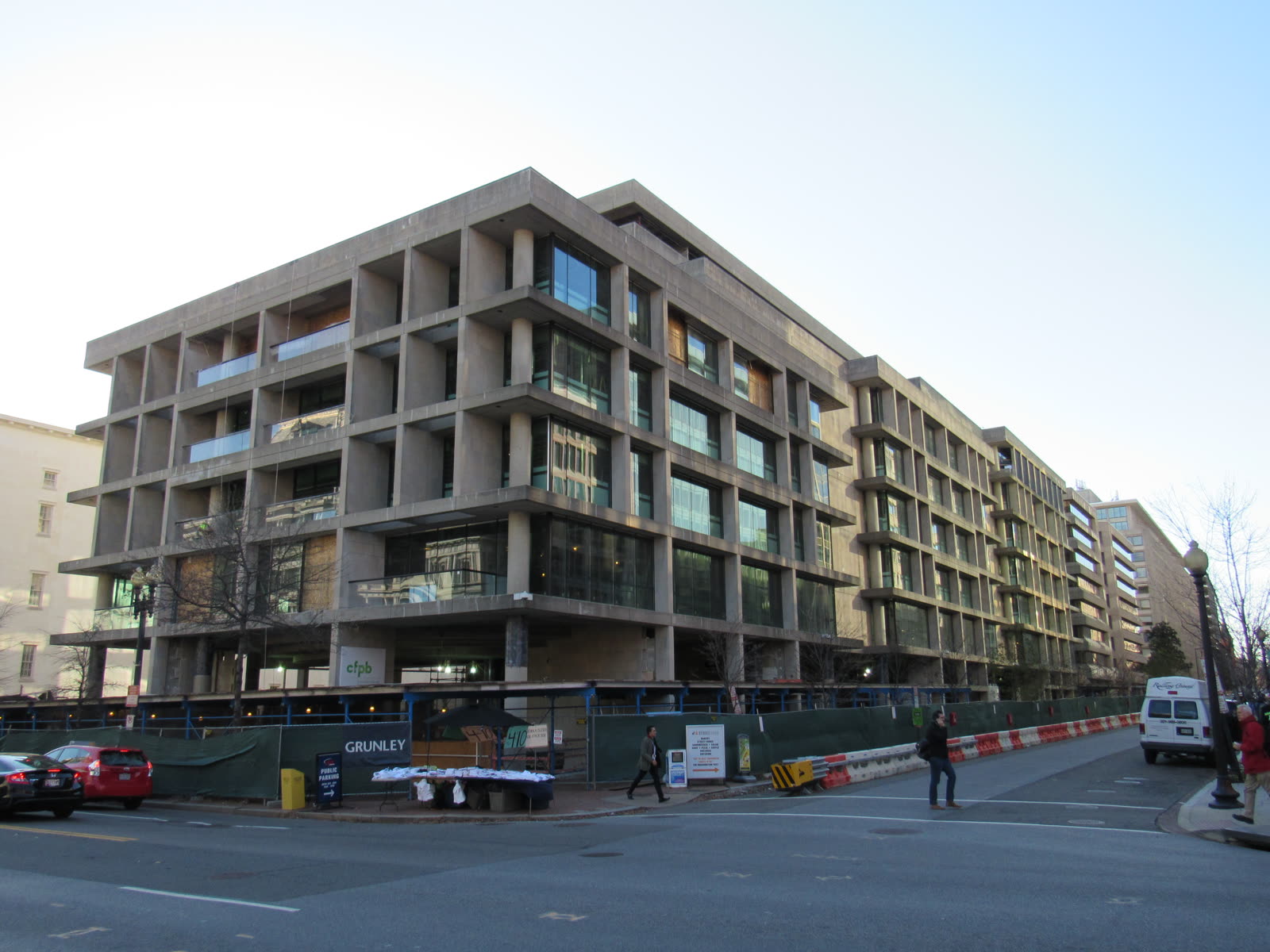
Image context: the cover uses a real 2016 photograph of the Federal Home Loan Bank Board Building in Washington, D.C. That institutional anchor fits this piece because the live question is about a funding channel created by statute and run through collateral rules, cooperative capital, and district-bank balance sheets, not about a generic bank-tower mood shot.[8]
What the bridge actually does
FHFA's collateral report states the core function plainly: the primary business of the Federal Home Loan Banks is to make fully secured, low-cost loans, known as advances, to members, and those members must pledge mortgages and other eligible assets as collateral.[1] The mission is also broader than emergency liquidity. FHFA's targeted-mission report says the Bank Act requires advances targeted to lower-income housing and economic development, which is why the system sits at the intersection of bank liquidity, housing finance, and public-purpose credit support.[2]
GAO's 2026 review helps explain why this tool remains so embedded. As of June 2025, 93 percent of banks, roughly 4,100, were FHLBank members, and GAO says more than three-quarters of banks that filed during the 2015-through-June-2025 window borrowed from their district FHLBank at least once during the period.[3] The same review says bank executives described advances as a way to bridge funding gaps and offset deposit outflows tied to taxes, large customer withdrawals, and other timing shocks.[3] That is the right mental model. The system is not designed to make deposit franchises irrelevant. It is designed to keep timing mismatches from becoming immediate balance-sheet failures.
Why the decline in aggregate borrowing did not make the tool irrelevant
The calmer backdrop is real. FDIC's 2026 Risk Review says deposits continued to grow in 2025, led by uninsured deposits, while wholesale funding declined as institutions reduced FHLB borrowings and brokered deposits.[5] The Office of Finance's year-end 2025 operating highlights tell the same story from the system side: advances fell 8 percent year over year to $676.7 billion.[4]
It would be easy to flatten those two facts into one conclusion: case closed, the bridge is no longer important. That is too simple. The same Office of Finance release says FHLBank assets and liabilities expand and contract as member needs change over time.[4] In other words, lower year-end system balances are evidence that the instrument is being used less heavily than during hotter stress windows. They are not evidence that the instrument has lost relevance.
Atlanta's first-quarter 2026 update is useful precisely because it shows that member demand can still reappear even in a calmer environment. Average advance balances rose to $105.3 billion from $97.1 billion a year earlier; advances outstanding ended March at $95.9 billion, up $930 million from year-end 2025; and the bank originated $110.0 billion of advances during the quarter.[6] That is not a systemic alarm bell. It is a reminder that local lenders still use the bridge when they need it.
Why a bridge is not a franchise repair
The mistake is to treat any accessible liquidity line as if it solved the deeper funding problem. Advances are secured borrowings against pledged assets.[1] They can buy time, smooth seasonal funding gaps, and keep lending capacity alive through stress. They do not create a cheaper or more loyal deposit base. They do not change the fact that uninsured and rate-aware balances behave differently from sleepy retail deposits. And they do not turn a member's liability structure into something less sensitive simply by existing.
That is why the healthier funding narrative in FDIC's own 2026 review is not "banks found a permanent wholesale substitute." The healthier narrative is that deposits kept growing while reliance on wholesale funding, including FHLB borrowings, came down.[5] If deposits are the franchise and advances are the bridge, then improvement means needing less bridge support over time, not proving that the bridge can permanently carry the whole traffic load.
This is also why the public-purpose side of the system should not be ignored. In the 2025 combined operating highlights, statutory Affordable Housing Program assessments were $632 million for the year, and voluntary housing and community investment expense was another $488 million.[4] Atlanta separately said the legal 10 percent AHP commitment made $67 million available for 2026 funding, alongside $45 million of voluntary contributions.[6] The system's mission lane is real. It still does not change the funding logic: mission support and liquidity support are valuable, but neither converts collateralized borrowing into a repaired deposit franchise.
Six numeric anchors
- System scale still matters: FHLBank advances totaled $676.7 billion at December 31, 2025, down 8 percent from a year earlier.[4]
- The liability machine behind the bridge is large: total consolidated obligations were $1.1473 trillion at year-end 2025, with discount notes up 33 percent and bonds down 17 percent year over year.[4]
- The system still retained meaningful capital and earnings: total GAAP capital reached $74.3 billion and full-year net income was $5.645 billion in 2025.[4]
- Mission spending is not cosmetic: 2025 statutory AHP assessments were $632 million, and voluntary housing and community investment expense was $488 million.[4]
- Current district-level usage is still live: Atlanta's average advance balances in first-quarter 2026 were $105.3 billion, while advances outstanding were $95.9 billion at March 31, 2026.[6]
- Usage can be heavy without being a crisis headline: Atlanta originated $110.0 billion of advances in the first quarter and remained in compliance with regulatory capital and liquidity requirements.[6]
Read together, those anchors say something specific. The bridge remains large, functional, and relevant. The bridge is still a bridge.
Strongest counterweight
The strongest pushback is that this framing can sound too skeptical about a tool that many members use normally. GAO found that regular borrowing is common among active members, not just a distress behavior, and FHFA's mission reports make clear that targeted advances are part of the system's intended design rather than an accidental side effect.[2][3] If a member can post sound collateral, use advances prudently, and keep serving housing and community-credit needs, then borrowing from the FHLBank is not automatically a danger signal.
That counterweight is real. This article is not arguing that advances imply weakness every time they appear. The narrower claim is that advances should be read as time bought against collateral, not as evidence that a member's deposit franchise has been structurally repaired.
Falsifier
This explainer is too cautious if the next round of system and district data shows that member funding has become less timing-sensitive than this framing assumes. Concretely, if advances fall sharply while lending activity and liquidity metrics remain healthy across districts, and if deposit growth keeps replacing wholesale funding without visible strain, then the bridge's marginal importance in 2026 would be lower than this article assumes.[5][6][7]
Watchlist
- 2026-04-30: the Office of Finance expects to publish the FHLBanks' Q1 2026 Combined Operating Highlights, the next clean system-level check on advances, obligations, and capital.[7]
- 2026-05-08: FHLBank Atlanta said it expects to file its first-quarter 2026 Form 10-Q on or about this date, which will add detail behind the preliminary advance and capital figures.[6]
- 2026-05-14: the Office of Finance expects to publish the Q1 2026 Combined Financial Report, the fuller system-wide read on the same quarter.[7]
- 2026-07-30: the Office of Finance lists this as the expected date for Q2 2026 Combined Operating Highlights, which will show whether first-quarter demand was temporary or part of a firmer borrowing pattern.[7]
Takeaway
FHLB advances still matter because they do one job well: they convert pledged collateral into timely liquidity for member institutions. In 2026, that remains valuable. What the instrument still does not do is create a deposit franchise where one is weak, or make wholesale funding equivalent to stable relationship funding. The better way to read the system is therefore simple: useful bridge, real mission, limited cure.[1][2][4][5][6]
Sources
- FHFA, "Collateral Pledged to FHLBanks" - on advances as fully secured, low-cost loans backed by mortgages and other eligible collateral.
- FHFA, "2024 Federal Home Loan Bank Targeted Mission Report" - on targeted advances for lower-income housing and economic development.
- U.S. Government Accountability Office, "Federal Home Loan Banks: Role During Financial Stress and Members' Borrowing Trends and Outcomes" (GAO-26-107373).
- FHLBanks Office of Finance, "Fourth Quarter and Annual 2025 Combined Operating Highlights for the Federal Home Loan Banks" (February 20, 2026).
- FDIC, "2026 Risk Review" - on 2025 deposit growth and the decline in wholesale funding, including FHLB borrowings.
- Federal Home Loan Bank of Atlanta, "Federal Home Loan Bank of Atlanta Announces First Quarter 2026 Operating Highlights and Declares Dividend" (April 23, 2026).
- FHLBanks Office of Finance, "FHLBank Financial Data" - anticipated 2026 publication dates for combined operating highlights and combined financial reports.
- National Park Service, "Federal Home Loan Bank Board Building" (NRHP asset detail, reference no. 16000701).