Microsoft does not need to prove that AI demand exists. Priced is that Azure can still grow near 40%, Microsoft Cloud can pass the $50 billion quarterly mark, and the company can hold operating leverage while spending hard on infrastructure.[1][3] New is the scale of the contract book behind that story. In FY26 Q2, commercial remaining performance obligation jumped 110% to $625 billion, up from $392 billion at the end of FY26 Q1.[1][2] That is why the April 29, 2026 print matters. The market already believes in demand. It now needs evidence that capacity delivery and revenue recognition can keep pace with the commitments.
That shift changes the quarter's burden of proof. A year ago, the key debate was whether Microsoft could keep winning AI workloads at scale. Going into FY26 Q3, the sharper debate is whether the business is converting backlog into recognized cloud revenue quickly enough to justify the capital intensity that is building beneath the headline growth rate.[1][2][3]
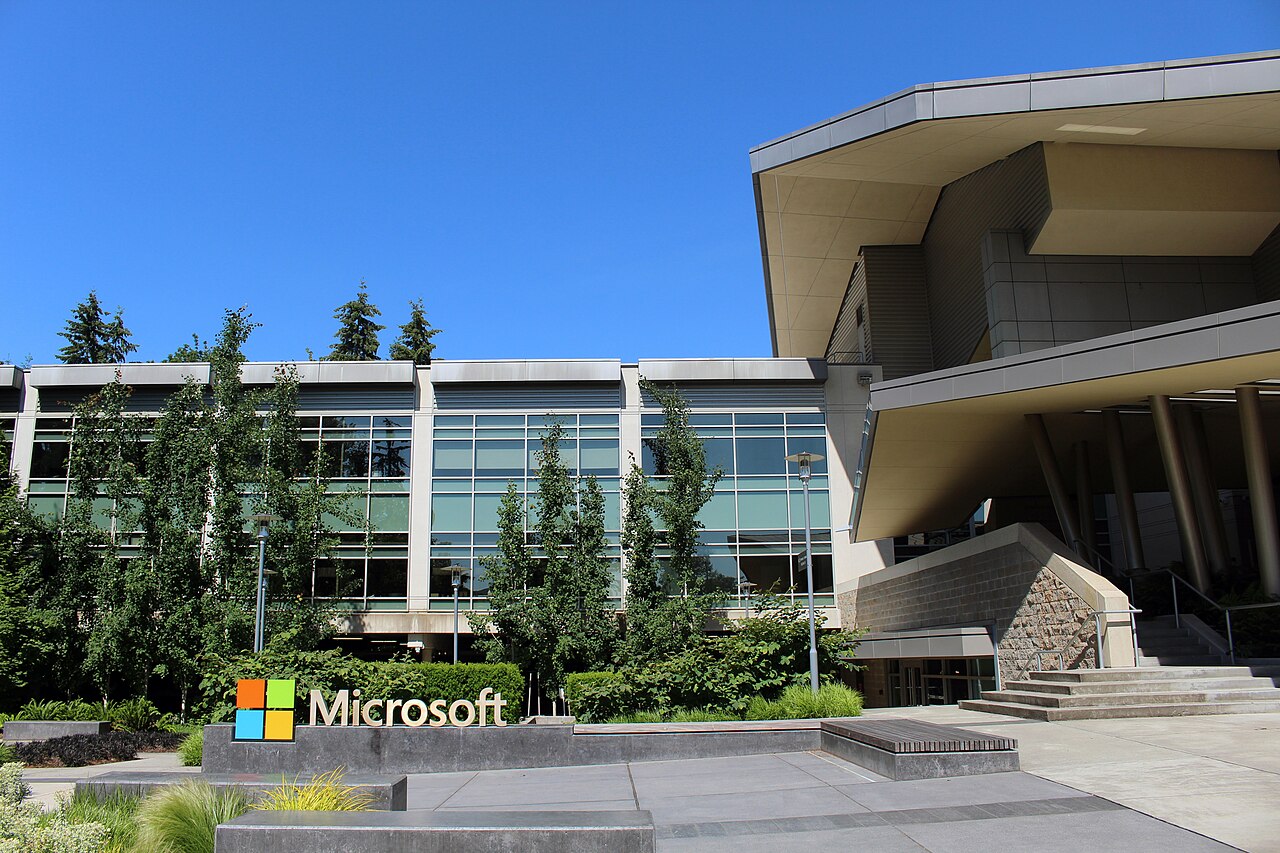
Image context: the cover uses a real 2016 Wikimedia Commons photograph of Building 92 at Microsoft's Redmond headquarters. That is the right visual anchor because this article is about industrial conversion, not app-store excitement: contracts, datacenter sites, finance leases, and the physical operating system behind Azure and Microsoft Cloud.[5]
Priced vs new
The priced part is straightforward. FY26 Q2 was already a powerful quarter. Microsoft reported $81.273 billion of revenue, up 17% year over year, and $38.275 billion of operating income, up 21%.[1] Intelligent Cloud revenue reached $32.907 billion, also up 29%, while Azure and other cloud services revenue grew 39%.[1] Microsoft Cloud revenue reached $51.5 billion for the quarter, and management said Microsoft Cloud gross margin was 67%, down year over year because of continued AI investment even though the result came in slightly better than expected.[1][3]
The new part is the contract-load sitting behind those reported numbers. At the end of FY26 Q1, commercial remaining performance obligation stood at $392 billion, up 51%.[2] One quarter later it was $625 billion, up 110%.[1] That is too large a move to treat as background noise. It says future demand is arriving faster than revenue can be recognized today. For investors, that opens two opposite interpretations. The bullish reading is that Microsoft has locked in an extraordinary multiyear cloud and AI pipeline. The more cautious reading is that the pipeline has expanded so quickly that delivery timing, datacenter capacity, and margin absorption now matter more than another single-quarter Azure growth beat.
Mechanism: why backlog is not the same thing as next-quarter revenue
The first mechanism is simple accounting. Remaining performance obligation is not a cash-market rumor or a slide-deck aspiration. It is contracted business that will be recognized over time.[1][2] But it still does not land all at once. Large AI and cloud agreements can be signed before the required capacity is fully live, before customers ramp usage, or before the contract's revenue schedule turns steep. A huge RPO number is a positive demand signal, yet it can still leave room for uneven quarterly conversion.
The second mechanism is infrastructure timing. Microsoft's six-month FY26 Q2 filing shows cash used in investing rose to $57.3 billion, up $28.0 billion year over year, driven in part by an $18.5 billion increase in additions to property and equipment and a $5.9 billion increase in other investing to facilitate component purchases.[1] On the earnings call, management added that total finance leases were $6.7 billion, primarily for large datacenter sites.[3] That is the physical side of the same story. The company is not merely carrying a bigger sales pipeline; it is also pulling hardware, land, power, and leased capacity forward to serve it.
The third mechanism is margin timing. High growth is easier to celebrate than high growth funded through a still-rising infrastructure bill. Microsoft's FY26 Q2 call said Microsoft Cloud gross margin was 67%, down year over year because of AI investment.[3] That does not invalidate the thesis. It sets the checkpoint. If revenue recognition accelerates with the contract book, the margin pressure can look like rational preloading. If revenue lags while the infrastructure bill keeps climbing, the market will start asking whether Microsoft is temporarily outrunning its own monetization curve.
The fourth mechanism is that the balance sheet still shows unfinished work. In FY26 Q1, purchases of property and equipment remaining in accounts payable were $18.6 billion. By FY26 Q2 that figure had climbed to $23.1 billion.[1][2] That is not a valuation ratio. It is an operating clue. The company is still absorbing a heavy flow of equipment that has been ordered but not yet fully settled in cash, which is another reason backlog conversion deserves more attention than a single reported growth percentage.
Six numeric anchors
- FY26 Q2 total revenue was $81.273 billion, up 17%, and operating income was $38.275 billion, up 21%.[1]
- Intelligent Cloud revenue was $32.907 billion in FY26 Q2, up 29%, while Azure and other cloud services grew 39%.[1]
- Microsoft Cloud revenue reached $51.5 billion in FY26 Q2, up from $49.1 billion in FY26 Q1.[1][2]
- Commercial remaining performance obligation jumped from $392 billion at September 30, 2025 to $625 billion at December 31, 2025.[1][2]
- Cash used in investing reached $57.3 billion for the first six months of FY26, including an $18.5 billion year-over-year increase in additions to property and equipment.[1]
- Property-and-equipment purchases remaining in accounts payable rose from $18.6 billion in FY26 Q1 to $23.1 billion in FY26 Q2, while total finance leases in Q2 were $6.7 billion.[1][2][3]
These anchors support a narrower thesis than "Microsoft is expensive" or "AI demand is real." The better thesis is that the stock's next leg depends on whether the company can turn a contract surge into recognized revenue quickly enough to keep capital intensity from becoming the headline.
Scenarios
Base case: FY26 Q3 still looks strong, but the center of gravity shifts from demand proof to delivery proof. Azure growth stays in the high 30s, Microsoft Cloud keeps compounding, and management frames capex and finance leases as capacity arriving against committed demand.[1][3] In that branch, the stock can hold its premium because the RPO jump looks like a forward revenue engine rather than a timing distortion.
Upside case: Azure growth re-accelerates or stays roughly flat against the FY26 Q2 39% level, cloud margin degradation stays contained, and management makes the $625 billion RPO figure sound less like a one-off contract bulge and more like a broad-based enterprise pattern.[1][3] Then the market will read the datacenter spend as productive scarcity relief, and the backlog jump will deserve a more bullish valuation frame.
Downside case: Reported growth remains respectable, but the quarter reveals a weaker conversion cadence. Azure slows more sharply, capex language stays aggressive, and margin pressure deepens without a matching revenue step-up.[1][3] In that branch, the story does not break, but the market stops paying for "demand certainty" and starts discounting "delivery drag."
Strongest counterweight
The strongest pushback is that Microsoft has already earned the right to be trusted through this conversion phase. It entered FY26 Q2 with $77.673 billion of FY26 Q1 revenue, 40% Azure growth, and $392 billion of commercial RPO, then still managed to raise the reported cloud scale to $51.5 billion of Microsoft Cloud revenue one quarter later while expanding total revenue and operating income at double-digit rates.[1][2] A company that can deliver that sequence may deserve more benefit of the doubt than a standard capex-heavy infrastructure story.
That counterweight is real. It is why this article is not a bearish call. It is a sequencing call. The operating facts are strong enough that Microsoft can keep winning. The question is simply which arrives faster over the next two quarters: recognized cloud revenue or the visible cost of building for it.
Falsifier
This cautious framing is wrong if FY26 Q3 shows three things at once: Azure growth holding near the current band, cloud-margin pressure staying manageable, and management describing the huge RPO balance as translating cleanly into near-term revenue without another visible jump in infrastructure strain.[1][3] If that combination lands on April 29, 2026, the market will have been right to treat the backlog surge as durable monetization rather than a timing problem.
Watchlist
- April 29, 2026 after the market close: Microsoft's FY26 Q3 release needs to show whether Azure growth, Intelligent Cloud revenue, and total operating income still move together.[4]
- April 29, 2026 at 2:30 p.m. Pacific Time: the earnings call matters because management can explain whether the RPO jump reflects broad enterprise adoption, a few massive contracts, or capacity that is still waiting to turn into delivered revenue.[3][4]
- The FY26 Q3 Form 10-Q filed with the quarter: watch additions to property and equipment, finance-related buildout signals, and the accounts-payable line connected to equipment purchases.[1][2]
- Microsoft's FY26 Q4 report in late July 2026: that is the cleaner follow-through test for whether the backlog surge was revenue pulled forward in slow motion or a true multiquarter acceleration.
Takeaway
Microsoft's next quarter is not really a referendum on whether enterprises want AI and cloud capacity. The contract book already answers that. The investable question is whether Microsoft can convert that demand into revenue on a timetable that keeps margin pressure looking temporary rather than structural. After the jump to $625 billion of commercial remaining performance obligation, the market no longer needs another demand story. It needs a conversion story.[1][2][3]
Sources
- Microsoft, Form 10-Q for the quarter ended December 31, 2025, including FY26 Q2 revenue, segment results, Microsoft Cloud revenue, commercial remaining performance obligation, investing cash flow, and equipment-purchase disclosures.
- Microsoft, Form 10-Q for the quarter ended September 30, 2025, including FY26 Q1 revenue, Azure growth, Microsoft Cloud revenue, commercial remaining performance obligation, and equipment-purchase disclosures.
- Microsoft, "Microsoft Fiscal Year 2026 Second Quarter Earnings Conference Call," including commentary on Microsoft Cloud gross margin and finance leases for datacenter sites.
- Microsoft, "Microsoft announces quarterly earnings release date" (April 8, 2026), stating that FY26 Q3 results will be released after market close on April 29, 2026, with the webcast at 2:30 p.m. Pacific Time.
- Wikimedia Commons, "File:Building92microsoft.jpg," a 2016 photograph of Building 92 at Microsoft's Redmond headquarters by Coolcaesar.