Industrial gas stocks already get credit for being sturdier than ordinary chemical cyclicals. The less settled question is what investors are actually buying in 2026: a high-quality onsite-contract compounder, a semiconductor supply-chain toll road, or a hydrogen capex story that still has to prove it can earn through the cycle.
Priced is the resilience. Linde reported $34 billion of 2025 sales, adjusted operating profit above $10 billion, adjusted operating margin of 29.8%, and total project backlog of $10.0 billion.[1] Air Liquide's Q3 2025 release put its investment backlog at a record EUR4.9 billion, while Industrial Merchant revenue grew 4.7% on a comparable basis, helped by a 4.5% price effect.[2] New is that the next leg should be judged less by backlog size alone and more by the quality of capital allocation behind it. Air Products' fiscal 2025 annual report is the warning label: capital expenditures still totaled about $5.1 billion, but the company also exited or wrote down parts of the energy-transition project portfolio after a strategic review.[3]
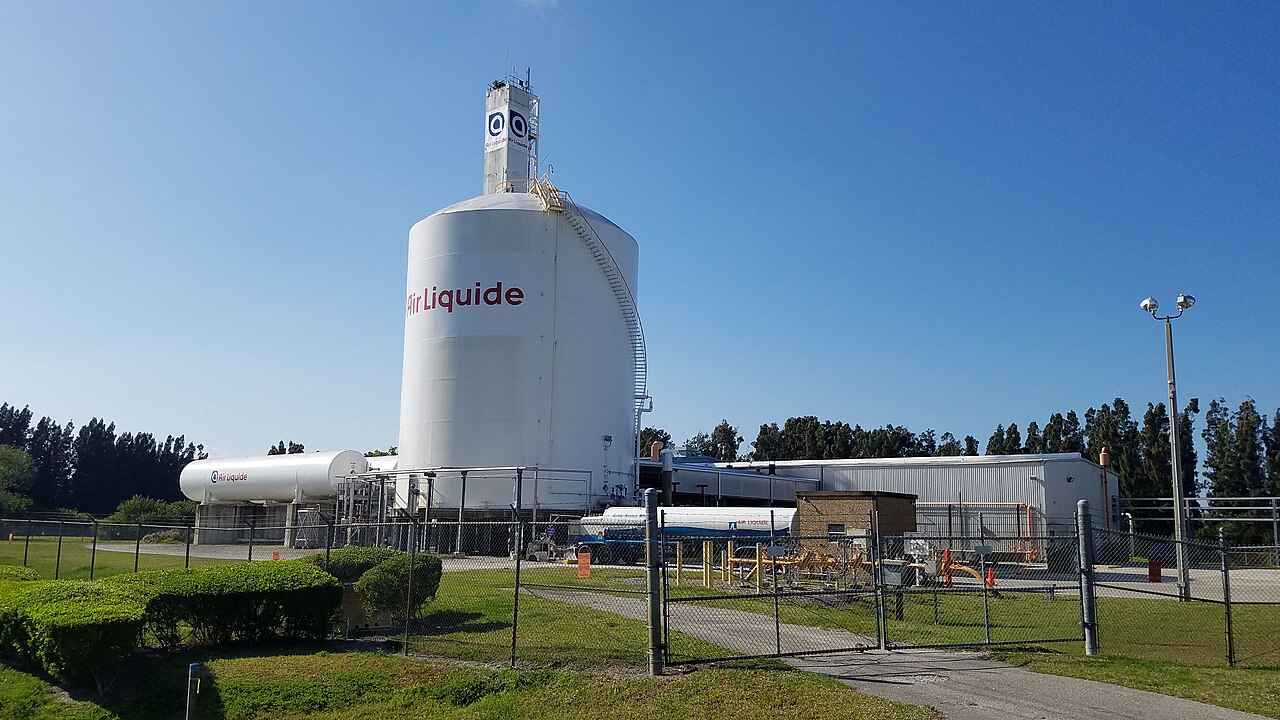
Image context: the cover uses a real Air Liquide air separation unit near Merritt Island, Florida. That matters because the article's central claim is physical. Industrial gas returns come from pipes, tanks, power inputs, purity controls, and customer sites that cannot be swapped out as easily as a purchase order.[6]
Scenario 1: the base case is quiet compounding
The base case is not spectacular. It is that the big industrial gas names keep doing what the best versions of this sector are built to do: win long-dated onsite projects, pass through a meaningful part of energy-cost volatility, keep merchant pricing positive, and turn electronics capacity additions into high-purity gas demand.
Linde's 2025 result shows the shape of that case. Sales were only modestly cyclical at the surface, but the margin structure was powerful: adjusted operating margin reached 29.8% and adjusted operating profit exceeded $10 billion.[1] The backlog matters because it is not the same as speculative commodity capacity. Contractual sale-of-gas projects are usually attached to a customer site and delivered through infrastructure that becomes part of the customer's operating rhythm.
Air Liquide tells a similar story with a different geographic and segment mix. The company said its investment backlog reached EUR4.9 billion at the end of Q3 2025, supported by commercial wins in hydrogen, refining, electronics, and high-purity gases.[2] It also pointed to more than EUR250 million of investment for new industrial gas production units serving a semiconductor customer in Germany's Silicon Saxony cluster.[2] That is the clean version of the thesis: gas suppliers do not need to own the fab economics. They need the fab to run, expand, and treat purity and continuity as non-negotiable.
Scenario 2: electronics turns the moat into a service-level test
The upside case is that electronics demand makes the moat more visible. Semiconductor customers use large volumes of bulk and specialty gases, with nitrogen, hydrogen, argon, helium, oxygen, and carbon dioxide appearing throughout fab operations.[4] Air Liquide's Arizona agreement illustrates the operating model: a long-term supply commitment for ultra-high-purity hydrogen, helium, and carbon dioxide to a large semiconductor manufacturing site.[5]
This is where industrial gases become less like a volume commodity and more like process infrastructure. A chip fab does not merely need molecules. It needs purity, uptime, redundancy, local logistics, and customer-specific integration. Once a supplier is embedded, the switching friction is high because qualification, safety, continuity, and contamination risk all matter. That supports premium margins, but it also raises the bar. The supplier's failure mode is not just lower volume; it is being the weak link in a customer's most expensive production chain.
For investors, that upside case should be measured through three operating signs rather than one headline. First, backlog should convert into start-ups on schedule. Second, electronics projects should show up as durable onsite or high-purity revenue rather than one-time engineering work. Third, merchant pricing should stay positive even if industrial production is uneven. Air Liquide's Q3 4.5% Industrial Merchant price effect is a useful marker; if that collapses while electronics capex keeps requiring spending, the quality of the mix is worse than the story suggests.[2]
Scenario 3: hydrogen becomes the capex trap
The downside scenario is not that hydrogen has no future. The sharper risk is that hydrogen becomes a capital sink before it becomes a return engine. Air Products is the sector's clearest reminder. Its fiscal 2025 report shows roughly $5.1 billion of capital expenditures, and management describes a portfolio reset that exited certain projects, including the World Energy sustainable aviation fuel project, after reviewing capital allocation.[3]
That matters because hydrogen narratives can make all backlog look equally valuable. It is not. An onsite oxygen or nitrogen plant attached to a customer with take-or-pay economics is a different animal from a large clean-energy project that depends on policy support, offtake depth, construction execution, financing cost, and end-market adoption. The former is infrastructure with a visible customer. The latter can become industrial-policy venture capital wearing a utility-like label.
The right finance question, then, is not whether hydrogen demand exists in the abstract. It is whether each project has enough contracted offtake, power-cost visibility, construction discipline, and balance-sheet tolerance to produce acceptable returns after delays and inflation. If management teams cannot answer that project by project, the sector's premium multiple starts subsidizing ambition rather than underwriting compounding.
The strongest counterweight
The bullish counterweight is that the largest gas companies have already learned from the sector's worst excesses. Linde's backlog is paired with high margins and strong cash generation, Air Liquide continues to emphasize pricing, efficiencies, and carefully staged investment, and even Air Products' reset can be read as a move back toward core industrial gases rather than a permanent impairment of the franchise.[1][2][3]
That is a real argument. In fact, it is the reason the base case remains constructive. The industrial gas model has structural advantages: customer plants need continuous supply, qualification is sticky, local density matters, and energy pass-through can blunt some input-cost shocks. A less promotional hydrogen market may even help the best operators by forcing weaker projects out of the funding queue.
Falsifier
The thesis breaks if disciplined backlog conversion fails to show up in margins and cash. Concretely, if Linde's backlog stays near $10 billion but adjusted operating margin falls materially below the high-20s, if Air Liquide's record EUR4.9 billion investment backlog does not translate into profitable start-ups, or if Air Products' post-reset capex remains near $5 billion without clearer core-project returns, then the sector should be treated less like a quality compounder and more like a capital-cycle story.[1][2][3]
Watchlist
- April 30, 2026: Air Products' fiscal Q2 2026 earnings call should show whether the 2025 portfolio reset is lowering project risk or merely postponing the same capex questions.[3]
- Linde 2026 quarterly updates: watch whether the company can keep adjusted operating margin close to the 2025 29.8% level while still funding sale-of-gas backlog.[1]
- Air Liquide 2026 backlog conversion: the record Q3 2025 investment backlog needs to move from awards into operating assets without sacrificing Industrial Merchant price discipline.[2]
- Semiconductor project timing: high-purity gas demand is attractive only if fab start-ups and utilization support the onsite contracts attached to them.[4][5]
Takeaway
Industrial gases deserve a premium to ordinary chemicals, but the reason should be precise. The premium is not for vague exposure to hydrogen or AI. It is for embedded infrastructure, contracted supply, pricing discipline, and the ability to spend capital only where customer demand is already close enough to touch. In 2026, the clean read is this: onsite and electronics backlog can keep compounding, but hydrogen capex has to earn the right to stay in the same multiple.
Sources
- Linde, "Linde Reports Full-Year and Fourth-Quarter 2025 Results" (February 5, 2026).
- Air Liquide, "Q3 2025: Air Liquide continues to combine sales growth with commercial successes to shape the future" (October 28, 2025).
- Air Products, 2025 Annual Report (fiscal year ended September 30, 2025).
- Linde, Electronics: Making our world more productive (semiconductor gases brochure).
- Air Liquide, "Air Liquide announces long term agreement to supply semiconductor manufacturing site in Arizona" (January 25, 2022).
- Wikimedia Commons, "File:AirLiquideASU plant, Florida.jpg."