HVDC cable makers are already priced for the easy part: grids need more long-distance transmission, offshore wind needs export links, and data centers make power availability feel strategic again. The newer question is narrower. Who can turn signed projects into installed cable, margin, and cash without losing the spread to factory ramp costs, vessel bottlenecks, and execution risk?
As of 2026-06-22 UTC, Nexans' June inauguration of the CLV Nexans Electra is the clean signal. The ship is not a marketing prop. It is a capital asset that tells investors where the scarcity has moved: away from "will electrification happen?" and toward "who owns enough manufacturing and installation capacity to deliver the most complex projects on time?" Nexans says Electra has three turntables with 13,500 tons of combined cable capacity, can lay up to four cables at once, and joins Aurora and Skagerrak in its cable-laying fleet.[1]
That makes this a thematic deep dive, not a single-stock call. Prysmian, Nexans, and NKT are all leaning into the same bottleneck. Their businesses are not identical, but the market signal rhymes: high-voltage direct-current cable has become a scarce industrial service wrapped around expensive factories, specialized ships, engineering risk, customer downpayments, and long project timetables.
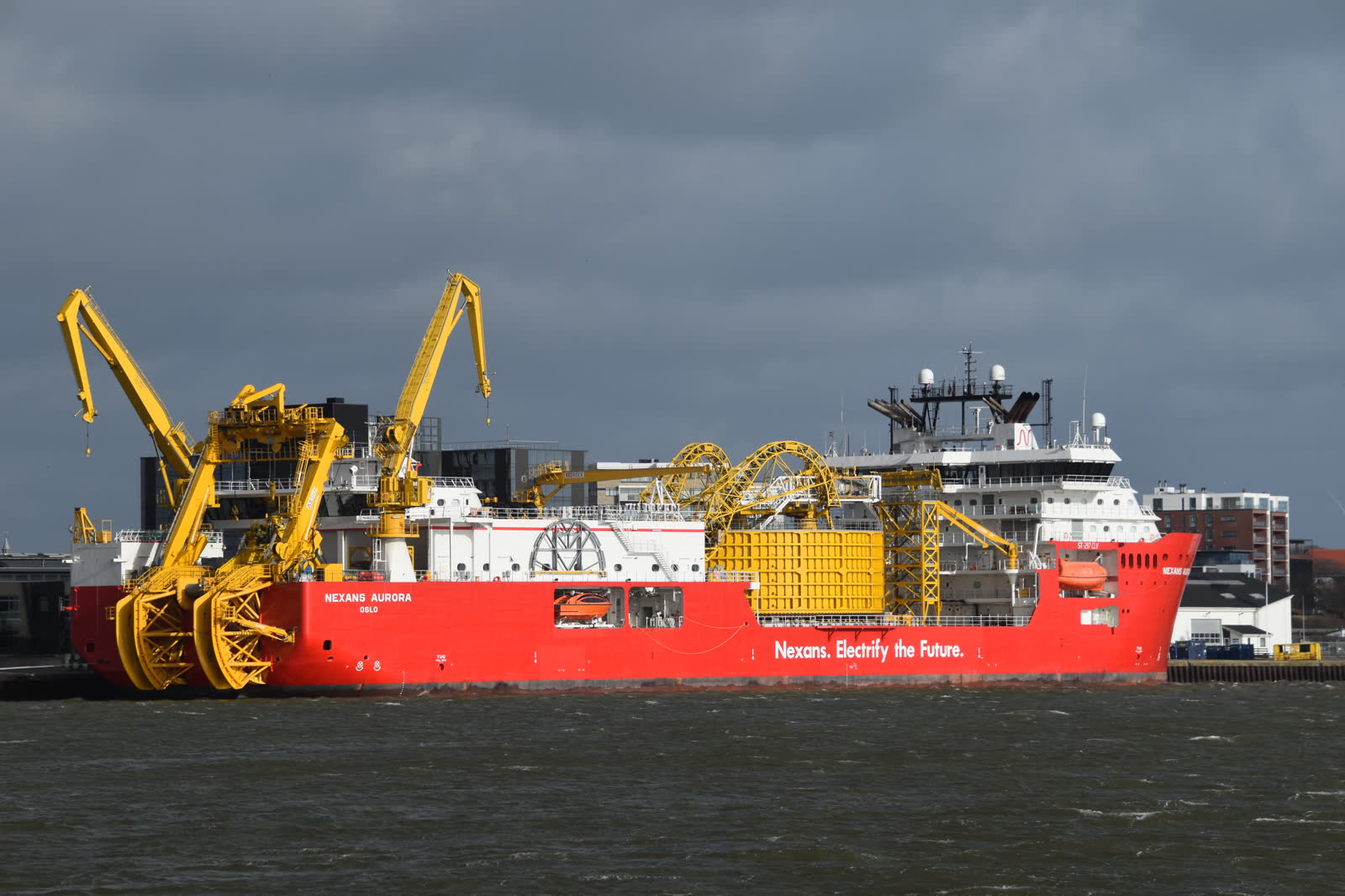
Image context: the cover uses a real 2024 photograph of Nexans Aurora in Esbjerg harbour. Aurora is not the newly inaugurated Electra, but it shows the right asset class: a cable-laying vessel that turns factory output into a commissioned transmission link. The investment case is physical before it is financial.[1][6]
The Mechanism
The demand case begins with the grid, but the margin case begins after the order is signed. IEA's grid report says national climate goals imply adding or refurbishing more than 80 million kilometers of grids by 2040, roughly equal to the existing global grid. It also says at least 3,000 GW of renewable projects were waiting in grid-connection queues, with 1,500 GW in advanced stages, and that grid investment needs to nearly double by 2030 to more than USD 600 billion a year.[2]
Those numbers explain why demand is visible. They do not explain who earns. Long-distance HVDC links, offshore export cables, and interconnectors are not commodity wire sold from a warehouse. They require design, high-voltage manufacturing, testing, transport, vessel availability, seabed work, burial, jointing, permitting coordination, and handover. A supplier can win an order and still disappoint shareholders if the project consumes working capital, slips in weather windows, or ramps through an underutilized factory.
This is why vessel announcements matter. Electra's capacity is useful because it lets Nexans bid for larger and more complex subsea projects with more internal control over installation.[1] But the same asset also raises the standard. A vessel must be utilized, crewed, scheduled, and fed with manufactured cable. If the factory or project pipeline is not ready, the ship becomes depreciation with a nice silhouette.
The Priced Layer
The market already understands three things. First, the grid has become the weak link in electrification. IEA is explicit that delayed grid buildout would slow renewables, increase fossil fuel dependence, and raise outage risk.[2] Second, Europe remains a core high-voltage cable market because offshore wind, interconnectors, and security-of-supply projects are policy priorities. Third, the leading cable makers have backlog.
Prysmian's 2025 result makes the point in public-company language. The company reported its Transmission segment at a 20.9% fourth-quarter margin, up from 14.5% a year earlier, with 8.4% organic growth and backlog at EUR 17 billion.[3] That is the priced part: investors can already see demand, scarcity, and margin improvement.
Nexans shows the same theme through cash discipline. Its 2025 standard sales reached EUR 6.098 billion, adjusted EBITDA was EUR 728 million, and free cash flow rose to EUR 344 million from EUR 177 million in 2024. The company also said PWR-Transmission downpayments helped working capital, which is a critical detail.[4] In this industry, customer advances are not accounting decoration. They are part of how a multiyear project gets financed before revenue recognition catches up.
NKT adds a third version of the same story. The company says demand for high-voltage cable solutions remained high in 2025, expects its average addressable high-voltage market from 2024 to 2030 to exceed EUR 10 billion per year, and is investing around EUR 2.0 billion across 2025-2028 in high- and medium-voltage capacity, a new cable-laying vessel, and its existing asset base.[5]
The New Question
The new question is whether the industry can expand capacity without giving back the scarcity economics that made the backlog attractive. That is the hard part of every capital-cycle trade. Tight supply creates pricing power. The response to tight supply is investment. If everyone expands smoothly and demand keeps rising, returns stay high. If factories arrive late, projects slip, or customers pause awards because costs are too high, the cycle turns messier.
NKT is unusually clear about this boundary. It says DC cables are more complex than AC cables, offshore projects are generally more complex than onshore projects, and the DC/offshore markets are more consolidated as a result.[5] That consolidation is the bull case. Complexity limits new entrants. But complexity is also the risk. A 200-meter extrusion tower, a new cable-laying vessel, and a multiyear order book are not software capacity. They are industrial assets with ramp schedules and execution failure modes.
Nexans' Electra should be read through that lens. The vessel improves capacity and flexibility, especially if project demand remains strong in offshore wind and interconnectors.[1] It also commits the company to keeping the installation machine busy. A cable-laying fleet is a competitive advantage only when it increases delivery certainty and margin capture. If projects are delayed by permitting, customer financing, offshore wind repricing, or grid-operator budget resets, vessel availability can become a fixed-cost problem.
Counterweight
The strongest counterweight is not "electrification is fake." That is too blunt. The sharper risk is sequencing. Grid need can be real while project awards, permitting, factory ramps, or offshore wind economics arrive in the wrong order.
IEA notes that new grid infrastructure often takes five to 15 years to plan, permit, and complete, compared with one to five years for new renewables projects and less than two years for EV charging infrastructure.[2] That timing mismatch matters for cable makers. A renewable developer can want the link now, a grid operator can plan the corridor, and a supplier can reserve capacity, but the cash only becomes high quality when the project moves through engineering, production, installation, and acceptance.
There is also margin mix risk. Prysmian's Transmission margin is strong, but investors should not assume that every new project automatically earns the same spread.[3] Nexans' downpayment benefit shows the positive side of project finance, but it also shows how working capital can swing with contract structure.[4] NKT's capacity program is necessary for growth, yet management says the ramp-up adds costs and resources before the new assets are fully productive.[5]
Falsifier
The clean falsifier is a two-part pattern: backlog remains large, but free cash flow and margins fail to follow. If the leading cable makers keep announcing awards while reporting weaker conversion, rising ramp costs, underused vessels, or repeated project charges, then the thesis has shifted from scarcity rent to capital-cycle overreach.
The bullish reading is confirmed by the opposite pattern. Transmission margins hold near recent highs, downpayments keep working capital manageable, new factories and vessels ramp on schedule, and order awards remain selective enough that suppliers can refuse bad risk. In that version, HVDC cable makers are not just beneficiaries of grid demand. They are toll collectors on the difficult part of electrification.
Watchlist
- Vessel utilization: Electra, Aurora, Skagerrak, NKT Victoria, and NKT Eleonora need project density, not just launch ceremonies.[1][5]
- Transmission margins: Prysmian's 20.9% Q4 Transmission margin is the benchmark to test against normalization.[3]
- Cash conversion: Nexans' EUR 344 million 2025 free cash flow and PWR-Transmission downpayment benefit are the quality signal to monitor.[4]
- Capacity timing: NKT's 2027 factory and vessel ramp should add earnings capacity rather than dilute margin for too long.[5]
- Grid-award cadence: IEA's USD 600 billion annual grid-investment requirement is only investable if it turns into permitted, funded, executable projects.[2]
The practical conclusion is that the HVDC cable trade has matured. Demand is no longer the differentiated insight. Execution is. The companies that own factory capacity, installation assets, project discipline, and customer financing terms can still earn scarce returns. The companies that mistake a full backlog for guaranteed cash will discover that the hardest part of a cable is getting it into the ground or under the sea.
Sources
- Nexans, "CLV Nexans Electra: officially inaugurated" (June 19, 2026) - vessel commissioning, fleet context, 13,500-ton capacity, four-cable laying capability, and offshore wind/interconnector role.
- International Energy Agency, Electricity Grids and Secure Energy Transitions executive summary (2023) - grid-investment requirement, 80 million kilometers of grid additions/refurbishment, renewable connection queues, and permitting timelines.
- Prysmian, "Prysmian continues growth and margin expansion in Q4'25; 2025 is Prysmian's best year yet" (February 26, 2026) - Transmission margin, organic growth, backlog, free-cash-flow outlook, and 2026 guidance.
- Nexans, "Full-year 2025 financial results" (February 19, 2026) - standard sales, adjusted EBITDA, free cash flow, PWR-Transmission growth, downpayment effect, and 2026 guidance.
- NKT, Annual Report 2025 - high-voltage market outlook, DC/offshore complexity, 2025-2028 investment program, Karlskrona expansion, vessel investment, and project-execution requirements.
- Wikimedia Commons, "File:Nexans Aurora (ship, 2021) in Esbjerg harbour.jpg" - Thomas Dahlstrom Nielsen photograph from March 16, 2024, used as the article image source.